Semiotika Buruh dan Barang [The Semiotics of Labour and Goods]
Kompas · Kompas, Sabtu, 3 Mei 2014; rubrik Opini · 2014-05-03
Abstract
An essay by Acep Iwan Saidi in Kompas, 3 May 2014, published two days after Labour Day, which reads the position of workers through the lens of semiotics. The author depicts workers treated like machines, alienated from the concept, planning, and distribution of the goods they make, with the example of craftsmen of deity statues in Bali who do not understand the meaning of their works. He criticizes a state that sides with the owners of capital and measures the protection of workers by a minimum wage rather than minimum welfare. Under the subheading Pasar semiotik (The Semiotic Market), he explains how advertising and image-making transform the use value of goods into sign value, so that the market price far exceeds the cost of production and workers cannot afford the products of their own labour. The author closes with a call to humanize workers through the perspective of minimum welfare. The scan is of low resolution, so part of the text is difficult to read and needs to be checked against the original source.
- Identifier
- KBA-KLP-2014-0031
- Type
- Kliping
- Publisher
- Kompas
- Date Issued
- 2014-05-03
- Bibliographic Citation
- Kompas, Sabtu, 3 Mei 2014; rubrik Opini
- Creator
- Acep Iwan Saidi
- LC Classification
- HD — Ekonomi industri, pertanian, dan tenaga kerja
- LCSH Subject
- Labor -- Indonesia Semiotics -- Social aspects Consumption (Economics) -- Social aspects Minimum wage -- Indonesia
- BISAC Category
- BUS038000 BUSINESS & ECONOMICS / Labor
- Language
- Indonesia
- Description
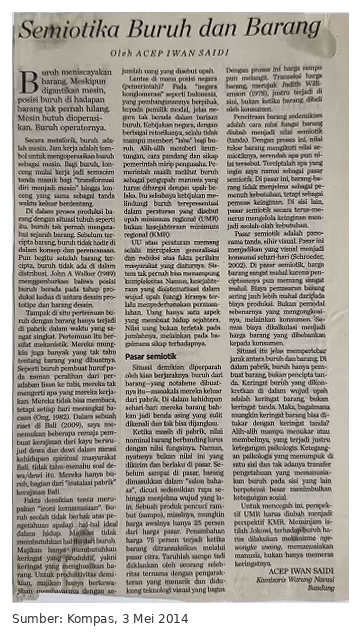
- This clipping contains an opinion article by Acep Iwan Saidi entitled "Semiotika Buruh dan Barang" (The Semiotics of Labour and Goods) from the daily Kompas, Saturday, 3 May 2014. At the end of the piece, the author is listed as Commissioner of Warung Narasi, Bandung. The scan shows a large italic headline, the author's name in capital letters, and four columns of text opening with a large initial letter. The article has one subheading, namely "Pasar semiotik" (The Semiotic Market). The source note "Sumber: Kompas, 3 Mei 2014" (Source: Kompas, 3 May 2014) appears below the image. It should be noted from the outset that the scan of this copy is of low resolution, about 361 by 643 pixels, so that part of the text, especially in the right-hand column and on lines affected by shadows or folds, is difficult to read with certainty. The following description has been compiled on the basis of the legible parts, and the details of quotations should be checked against the print edition or the digital archive of Kompas. Acep Iwan Saidi is widely known as a lecturer at the Faculty of Art and Design, Institut Teknologi Bandung, with expertise in semiotics, visual culture studies, and visual language. He frequently writes in the mass media about signs, images, politics, and popular culture, and is also involved in literacy community activities in Bandung. In this clipping, he does not use his university affiliation, but rather his position as commissioner of Warung Narasi in Bandung, which by its name appears to be a business or activity space with a narrative theme; more detailed information about this institution has not yet been verified. This detail is interesting because it shows that the author chose to appear as a cultural activist, even though Kompas readers at the time generally knew him as a semiotics academic. The article was published two days after International Labour Day, 1 May 2014. That year was the first time 1 May was commemorated as a national public holiday in Indonesia, in accordance with a government decision announced in 2013, and the commemoration was marked by trade-union demonstrations in various cities demanding wage increases, the abolition of the outsourcing system, and social security. The commemoration also took place amid the political climate following the legislative election of April 2014 and ahead of the presidential election of July 2014, when presidential candidates were competing for the support of workers. The opening part of the article states that workers are always tied to goods. Machines may replace part of human labour, but the position of the worker vis-à-vis goods never disappears, because machines still require operators. The author then develops the metaphor that workers are treated as machines: working hours become the switch that turns them on, and the bell for the start of work marks the transformation of the self into a machine until the bell for going home rings. In such a production process, workers do not know the history of the goods they make. They are absent from conception and planning, and once the goods have been created they are also absent from distribution. The author refers to John A. Walker (1989), a scholar of design history, to show that the position of workers lies at the production stage between the design prototype and the finished product. The author then states that the encounter between workers and goods occurs only in the factory, for a short time, and is mechanistic in nature. He compares this situation with the letter-makers in the period of transition from oral culture to written culture who, according to his reference to Walter J. Ong (1982), worked on texts every day without being able to read them. The author also presents his own research experience in Bali in 2009, when he met teenagers making wooden handicrafts in the form of gods and goddesses who did not understand the spiritual meaning of the objects they carved, because they were merely workers in a handicraft "factory installation". He calls this reality a human irony: workers seem to have no right to knowledge, let alone to the ideal things in life, because employers need only productive sweat. In the next column, the author highlights the position of the state. He calls Indonesia a "conglomerate state" whose development sides with the owners of capital, so that the state does not stand in the ranks of the workers. State policy, in his view, is unable to provide added value for workers, and the government's outlook in fact resembles that of employers, because it sees workers as wage-earners who are adequately rewarded with wages alone. The author takes the term regional minimum wage as an example: state protection is formulated in terms of a minimum wage, not minimum welfare. He acknowledges that regulations are always generalizations and reductions of reality, but considers that welfare simplified into money is a narrowing of the problem, because the value of money lies in how people treat it, not in its amount. Under the subheading "Pasar semiotik", the author explains that the alienation of workers becomes even more severe when they leave the factory. In everyday life, the goods they make become foreign objects that are hard to recognize and unaffordable. In the factory, the nominal value of goods is still commensurate with their use value, but before they reach the market, the goods are put into what he calls a "salon of language" and made up in such a way that they turn into something else. The example he gives is shampoo: its production cost may be only a small part of its market price, and most of the additional price arises when the product is marketed through imagery, for example through advertisements with celebrities and captivating visual technology. Referring to Judith Williamson (1978), the author states that the price transaction actually takes place within the advertisement, not when the consumer buys the product. This process of image-making, according to the author, transforms use value into semiotic value or sign value. There thus arises what he calls the semiotic market, where goods no longer appear as fulfilling needs but as signifiers of desire, and the market continually manages desires as if they were needs. Referring to Jonathan Schroeder (2002) on visual consumption, he calls the semiotic market a stage of signs and visual magic, where marketing costs far exceed production costs and the burden of these costs is ultimately borne by the consumer. The consequence for workers is very clear: in the factory they are merely makers of goods, not creators of signs, so their sweat is converted into wages as the sweat of goods, not the sweat of signs. Instead of being able to buy the goods they themselves have made, workers experience accumulated psychological tension, and the absence of a transfer of knowledge that would humanize workers has the potential to trigger social tension. The conclusion of the article offers a normative way out: the minimum-wage perspective needs to be replaced by a minimum-welfare perspective. The author borrows the Javanese expression popularized by Joko Widodo, "nguwongke uwong", that is, treating people as human beings, so that workers are not merely squeezed for their sweat. The reference to Jokowi in May 2014 is worth noting because he was at that time the Governor of DKI Jakarta who had just been nominated for the presidency, so the choice of this expression had a political resonance in the campaign season. The value of this clipping lies in its attempt to bring together semiotics, design studies, and the critique of political economy in concise language for the general reader. The argument about the alienation of workers from the products of their labour clearly echoes the thought of Karl Marx, while the idea of sign value is close to Jean Baudrillard's critique of consumer society, although in the legible parts neither name is explicitly mentioned. For the study of economic and industrial anthropology, this clipping can be used as material for discussion of commodification, labour, value, and consumer culture in Indonesia. The example of the Balinese craftsmen is also relevant to studies of tourism and the commodification of sacred objects, while for readers in Aceh and Southeast Asia, the problems of factory workers, migrant workers, and handicraft industries for the tourist market show a similar pattern. As a critical note, this article is more of a reflective essay than a data-based analysis. The statement about the share of the price of shampoo, for example, is presented as an illustration without a clear source for the figures in the legible part. The proposal to shift from the minimum wage to minimum welfare is also not spelled out operationally, even though in Indonesian labour policy the setting of the minimum wage has already been linked to surveys of the needs for a decent living. Nevertheless, the strength of this essay lies in its ability to make readers see everyday goods as traces of relations of labour and power. Physically, the clipping is a cut-out of a yellowish newspaper page photographed against a white background. There are shadows or faint stains around the title on the right side and fold marks at the bottom of the left column. The low resolution of the image means that some words cannot be read with certainty, so the spelling of names and the years of references in this description need to be verified against the original source. The full text of the article has not been copied into this catalogue because the copyright belongs to the author and the publisher; this note is a curatorial description to help users understand its content, context, and research value. Suitable search subjects include semiotics, labour and employment, Labour Day, the minimum wage, consumer culture, advertising and image, commodification, and economic and industrial anthropology. For citation purposes, the reference may be written as follows: Acep Iwan Saidi, "Semiotika Buruh dan Barang", Kompas, 3 May 2014, Opinion section.
- Rights
- Koleksi pribadi KBA13 Academy
- Collection
- Clippings
How to cite
Acep Iwan Saidi, “Semiotika Buruh dan Barang [The Semiotics of Labour and Goods]”, Kompas, Kompas, Sabtu, 3 Mei 2014; rubrik Opini, 2014-05-03. KBA13 Academy Archive and Library, KBA-KLP-2014-0031.