Muslim Academic Trust, Cambridge · Tahun, cetakan, jumlah halaman, dan ISBN eksemplar belum diperiksa. Rujukan pembanding: Cambridge: Muslim Academic Trust, 2011, cetakan pertama, xx + 90 hlm., 20 cm, ISBN 978-1-902350-07-3 (belum diverifikasi pada halaman hak cipta eksemplar) · Tanpa tahun
Abstract
A resource book for parishes and mosques containing the full text of the open letter A Common Word Between Us and You, a 2007 document signed by 138 Muslim scholars and intellectuals and addressed to church leaders worldwide. According to the catalogue, this book was edited by Lejla Demiri and published by the Muslim Academic Trust in Cambridge in 2011, and contains the editor's introduction, the text of the letter in three parts, the list of signatories, and reflective essays by David Burrell and Abdal Hakim Murad. The letter affirms that love of the One God and love of neighbour are the common foundation of Islam and Christianity, with reference to the Qur'an, hadith, and the Gospel. Its concise format is designed for interfaith discussion at the congregational level. This book is relevant to the study of interreligious relations, Islamic studies, comparative religion education, and discussions of religious harmony in Indonesia, including Aceh. The copy's data still need to be checked against the copyright page.
Identifier
KBA-BKU-TT-0033
Type
Buku
Publisher
Muslim Academic Trust, Cambridge
Date Issued
Tanpa tahun
Bibliographic Citation
Tahun, cetakan, jumlah halaman, dan ISBN eksemplar belum diperiksa. Rujukan pembanding: Cambridge: Muslim Academic Trust, 2011, cetakan pertama, xx + 90 hlm., 20 cm, ISBN 978-1-902350-07-3 (belum diverifikasi pada halaman hak cipta eksemplar)
Islam -- Relations -- ChristianityChristianity and other religions -- IslamCommon word between us and you
BISAC Category
REL017000 RELIGION / Comparative Religion
Language
Inggris
Description
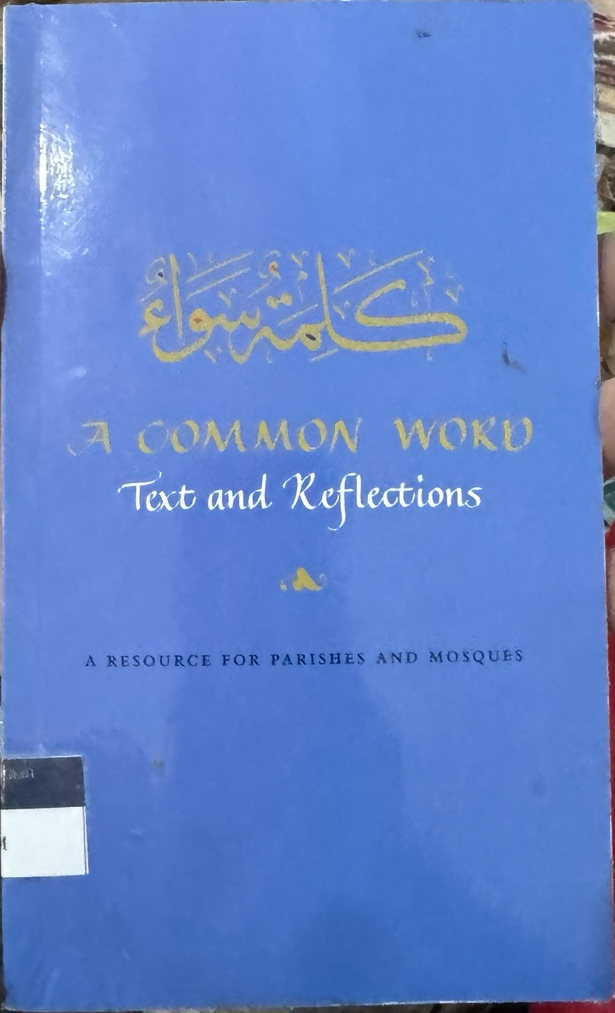
This copy is a thin softcover book in soft blue with an elongated format, slightly slimmer than an ordinary pocket book. The upper centre of the cover is adorned with gold Arabic calligraphy reading kalimat sawa', a Qur'anic expression meaning a common word or meeting point. Below the calligraphy is the title A Common Word in gold classical-style capitals, followed by the subtitle Text and Reflections in white calligraphic-style italics. A small gold ornament separates the title from the line below it, A Resource for Parishes and Mosques, printed in small capitals. The front cover lists neither the editor nor the publisher, so the bibliographic identity of this book must be traced through the title page and catalogues.
This book centres on the document A Common Word Between Us and You, an open letter issued in October 2007 and signed by 138 Muslim scholars, intellectuals, and figures from various countries and schools of thought. The letter was addressed to church leaders around the world, including Pope Benedict XVI, the Orthodox patriarchs, the Archbishop of Canterbury, and the leaders of the Protestant churches. The initiative arose in the atmosphere of tension following the Pope's Regensburg address in 2006, and was developed through a Jordan-based institution, the Royal Aal al-Bayt Institute for Islamic Thought. The core idea of the letter is simple but theologically weighty, namely that Islam and Christianity both stand on two great commandments, love of the One God and love of neighbour. Quoting the Qur'an, hadith, and the Gospel, particularly the passage in the Gospel of Mark on the greatest commandment, the letter invites both communities of faith to make this commonality a foundation for peace, bearing in mind that Christians and Muslims together make up more than half of the world's population.
Available catalogue data indicate that this resource book, entitled A Common Word: Text and Reflections, was edited by Lejla Demiri and published by the Muslim Academic Trust in Cambridge in 2011. A German library catalogue records that first edition as xx and 90 pages, 20 centimetres in height, with ISBN 978-1-902350-07-3, while an online bookshop gives a count of 112 pages, probably because it counts all pages including the front matter. According to catalogue notes, its contents consist of the editor's foreword; the full text of the open letter in three parts, namely love of God, love of neighbour, and an invitation to a common word; the list of signatories; and two reflective essays. The first essay was written by David Burrell, a Catholic theologian and scholar of medieval philosophy, while the second was written by Abdal Hakim Murad, a British Muslim scholar from Cambridge. An initial assumption that this book was published by Lambeth Palace or the Church of England is not supported by the catalogues examined, although church involvement in its distribution is not impossible. The copy's data still need to be checked against the copyright page.
Lejla Demiri is a scholar of Islamic theology who earned her doctorate at the University of Cambridge and later taught Islamic doctrine at the University of Tübingen, Germany. Her research interests include tafsir (Qur'anic exegesis), classical Islamic theology, religious pluralism, and Muslim-Christian relations, so her role as editor is in keeping with her field of expertise. The publisher, the Muslim Academic Trust, is a small publishing house based in Cambridge known for publishing works of traditional Islamic thought in English.
The emphasis on parishes and mosques in the subtitle indicates the practical purpose of this book. It is not intended merely as academic reading, but as discussion material at the congregational level, where encounters between Muslims and Christians take place in everyday life. The concise format, the complete text of the letter, and the relatively short essays make it easy to use in interfaith study groups, community meetings, or educational activities in religious institutions. This approach reflects the tendency of interreligious dialogue in Britain in the late 2000s and early 2010s, when various initiatives sought to bring the results of high-level meetings of religious leaders down to the grassroots level.
In the history of Muslim-Christian dialogue, the letter A Common Word is often regarded as one of the most important initiatives of the early twenty-first century. The initiative produced official responses from many church leaders, a lengthy response from theologians at Yale University, and a series of meetings, including the Catholic-Muslim Forum at the Vatican and conferences at Cambridge and Yale. Its distinctiveness lies in the effort to find a basis for dialogue from within the sacred texts of each religion, not merely from political interests or social tolerance. For Islamic studies, this document is also interesting because it shows a cross-madhhab consensus, encompassing Sunni and Shi'i figures as well as Sufi circles, in formulating a theological stance towards adherents of other religions.
The relevance of this book for Indonesian readers is considerable. A number of Indonesian Muslim figures are recorded as signatories of the letter, and the document is often cited in discussions of interreligious harmony, religious education, and religious diplomacy. Indonesia itself has a long experience of Muslim-Christian relations, both harmonious and marked by conflict, as in Maluku and Poso in the late 1990s and early 2000s. For Aceh, where Islamic sharia is formally applied and Christian communities live as a minority, the idea of a theological meeting point can serve as material for reflection in the study of majority-minority relations, as well as for Islamic higher education that teaches comparative religion.
As a critical note, the A Common Word initiative also received mixed responses. Some Christian observers considered that the emphasis on love of God and neighbour risked obscuring fundamental theological differences, for example concerning the Trinity and the status of Jesus. Some Muslim circles questioned whether the letter adequately represented the diversity of views within the community. Other observers pointed out that dialogue at the elite level does not necessarily influence tensions on the ground, which are often rooted in political, economic, and identity issues. A resource book such as this, with its focus on congregations, can be read as an effort to respond to these criticisms, although its success still depends on how the material is used in practice.
Another value of this book lies in its two accompanying essays, which represent two different traditions that nonetheless address each other. The contribution of a Catholic theologian who long studied the thought of Thomas Aquinas, Ibn Sina, and al-Ghazali shows that a meeting point need not be sought by blurring differences, but by tracing the philosophical and theological sources once shared in the Middle Ages. Meanwhile, the contribution of a British Muslim scholar familiar with the classical Sunni tradition and Sufism affirms human dignity and mutual respect as fruits of faith, not merely as a strategy for coexistence. The presence of these two voices makes this slim book more than a mere reproduction of a document, since readers are invited to see how the letter is interpreted and developed from two sides. For teachers of courses in the study of religions, an arrangement of this kind can be used as an example of teaching material that combines a primary text and secondary reflections in a single volume.
In terms of physical condition, this copy is still relatively intact. The blue cover appears slightly faded and lightly stained in a few places, with light reflections revealing a somewhat glossy surface. On the lower left of the front cover, near the spine, is a white and dark blue library label with a call number that is partly covered or cut off in the photograph, so it cannot be read in full. This description has been compiled as a curatorial introduction based on the cover and catalogue information, not as a comprehensive summary of the book's contents.
Suitable search subjects include A Common Word Between Us and You, Muslim-Christian dialogue, interreligious relations, the theology of love of God and neighbour, religious pluralism, the Royal Aal al-Bayt Institute, and interfaith education. For citation purposes, references should name the editor, the full title, the publisher, the year, and the pages read directly in the copy.
Rights
Koleksi pribadi KBA13 Academy
Contributor
Lejla Demiri (penyunting)David B. Burrell (kontributor)Abdal Hakim Murad (kontributor)
Lejla Demiri (penyunting), David B. Burrell (kontributor), Abdal Hakim Murad (kontributor) (ed.), “A Common Word: Text and Reflections — A Resource for Parishes and Mosques”, Muslim Academic Trust, Cambridge, Tahun, cetakan, jumlah halaman, dan ISBN eksemplar belum diperiksa. Rujukan pembanding: Cambridge: Muslim Academic Trust, 2011, cetakan pertama, xx + 90 hlm., 20 cm, ISBN 978-1-902350-07-3 (belum diverifikasi pada halaman hak cipta eksemplar). KBA13 Academy Archive and Library, KBA-BKU-TT-0033.