Kaukaba (tempat terbit belum diverifikasi) · Tahun, cetakan, jumlah halaman, dan ISBN eksemplar belum diperiksa. Rujukan pembanding: Kaukaba, 2014 menurut daftar koleksi perpustakaan, tempat terbit, jumlah halaman, dan ISBN belum diketahui (belum diverifikasi pada halaman hak cipta eksemplar) · Tanpa tahun
Abstract
A book by an anthropologist of religion from UIN Ar-Raniry Banda Aceh with a foreword by M. Hasbi Amiruddin, published by Kaukaba, which discusses the direction of Aceh's development after the tsunami of 26 December 2004. Judging from its title and subtitle, the book appears to place tradition, namely the values of adat, religion, and local institutions, as capital for building a self-reliant future for Aceh, amid the great flow of international aid, reconstruction, and political change following the 2005 Helsinki peace. This book represents an intellectual response from within Aceh to questions of identity, self-reliance, and the role of religion in the post-disaster period. The idea of tradition as capital needs to be tested with attention to the diversity of Acehnese society and economic realities after reconstruction. Details of the contents, year of publication, page count, and ISBN have not been checked and still need to be matched against the copyright page of the copy.
- Identifier
-
KBA-BKU-TT-0034
- Type
-
Buku
- Publisher
-
Kaukaba (tempat terbit belum diverifikasi)
- Date Issued
-
Tanpa tahun
- Bibliographic Citation
-
Tahun, cetakan, jumlah halaman, dan ISBN eksemplar belum diperiksa. Rujukan pembanding: Kaukaba, 2014 menurut daftar koleksi perpustakaan, tempat terbit, jumlah halaman, dan ISBN belum diketahui (belum diverifikasi pada halaman hak cipta eksemplar)
- Creator
-
Kamaruzzaman Bustamam Ahmad
- LC Classification
-
DS646.15.A2 — Sejarah Aceh
- LCSH Subject
-
Indian Ocean Tsunami, 2004
Aceh (Indonesia) -- Social conditions
Aceh (Indonesia) -- Civilization
Disaster relief -- Indonesia -- Aceh
- BISAC Category
-
SOC002010 SOCIAL SCIENCE / Anthropology / Cultural & Social
- Language
-
Indonesia
- Description
-
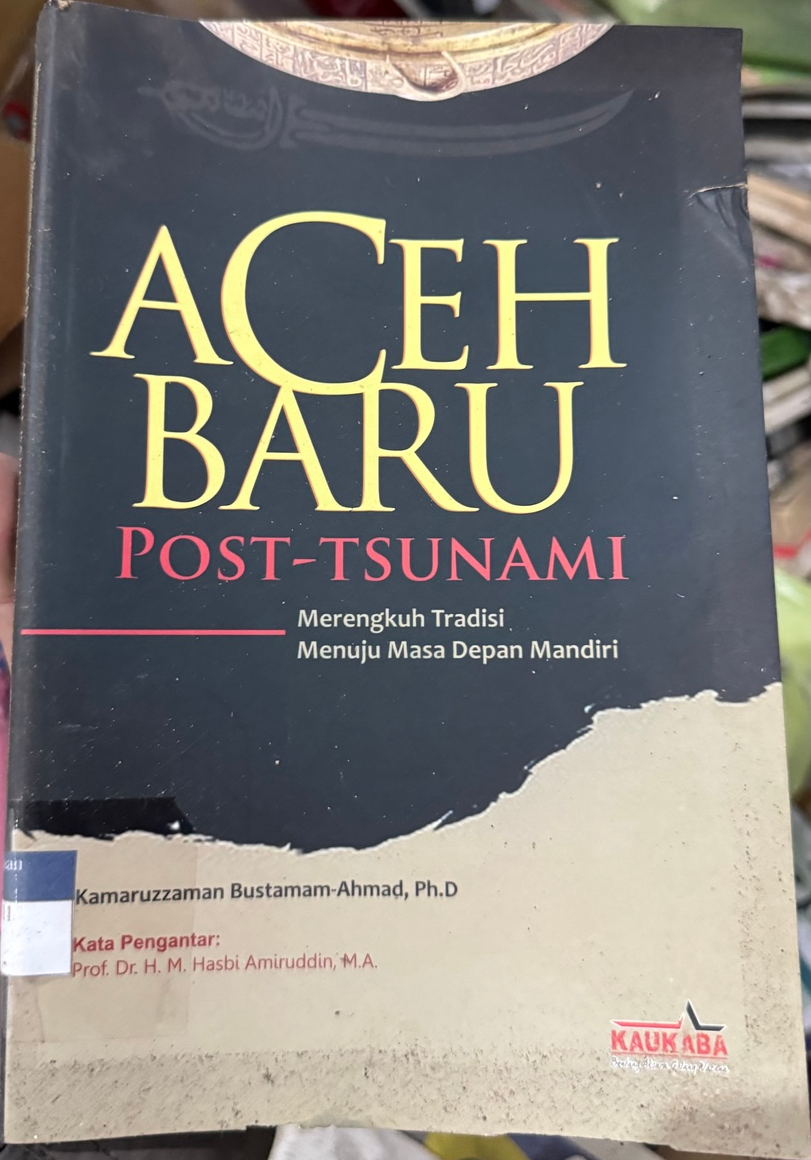
This copy is a softcover book with a jet-black background over the upper two-thirds and a cream field with the texture of old paper at the bottom, separated by an irregular torn line. At the top of the cover is part of a round golden plate engraved with Arabic calligraphy, reminiscent of a royal seal or stamp, while faintly beneath it the dark silhouette of a curved traditional weapon can be seen. The title Aceh Baru is printed very large in golden-yellow capitals, followed by the word Post-Tsunami in red capitals. The subtitle Merengkuh Tradisi Menuju Masa Depan Mandiri is printed in white letters to the right of a red line. On the cream field at the bottom appear the author's name with the title Ph.D and a hyphenated spelling, as well as a note that the foreword was written by Prof. Dr. H. M. Hasbi Amiruddin, M.A. The Kaukaba publisher's logo is in the lower right corner. The combination of the royal seal symbol, the traditional weapon, and the torn paper gives an impression of an encounter between Aceh's historical heritage and the rupture caused by the disaster.
The author of this book is an anthropologist of religion from Universitas Islam Negeri Ar-Raniry, Banda Aceh, who earned a doctorate in sociology from La Trobe University, Australia, and has written extensively on Islam in Southeast Asia, religious movements, and Acehnese culture and society. The author of the foreword, M. Hasbi Amiruddin, is a professor at the same university and is known for his studies of dayah ulama and Islamic education in Aceh. The presence of a foreword by a senior Acehnese academic figure signals that this book is aimed primarily at readers in Aceh itself, including academics, policymakers, and civil society involved in rebuilding after the disaster.
Judging from its title and subtitle, this book appears to put forward ideas about the direction of Aceh's development after the tsunami of 26 December 2004, placing tradition as capital rather than as an obstacle. The phrase merengkuh tradisi (embracing tradition) indicates that the values of adat, religion, and local institutions are seen as resources for building the future, while the phrase masa depan mandiri (a self-reliant future) suggests a critique of dependence on outside aid and on the central government. Details of the contents—whether this book is a single monograph or a collection of writings—and the chapters it contains have not been checked in the copy, so this account is more a matter of placing it in context. The idea of Aceh Baru (a New Aceh) itself is a term used fairly often in Acehnese public discourse since the early 2000s, with various interpretations, ranging from an Aceh at peace after the conflict to an Aceh that is open and democratic.
The historical context of this book is the period of reconstruction and rehabilitation of Aceh, which took place on a very large scale. The 2004 tsunami killed more than a hundred thousand people in Aceh and destroyed coastal settlements, infrastructure, and social institutions. In the years that followed, hundreds of international agencies, non-governmental organisations, and government bodies, including the Badan Rehabilitasi dan Rekonstruksi (Rehabilitation and Reconstruction Agency) Aceh-Nias, worked in Aceh with very large funds. At the same time, the 2005 Helsinki peace agreement ended an armed conflict that had lasted almost three decades, followed by the Law on the Governing of Aceh of 2006 and a local government led by former movement figures. These successive changes raised questions about identity, economic self-reliance, the role of religion, and the future of Acehnese culture. A book with a title like this is one form of local intellectual response to those questions.
In the landscape of studies on post-tsunami Aceh, there are many reports by international agencies, programme evaluations, and academic studies from abroad, for example on the governance of reconstruction, the impact of aid on social structures, and the dynamics of peace. Studies from within, written by local academics in Indonesian, are relatively fewer, even though such perspectives are important for understanding how Acehnese society itself interprets disaster and change. From an anthropological perspective, the idea of embracing tradition can be read in connection with debates on local knowledge, for example the smong story in Simeulue, often said to have helped residents save themselves, the role of the gampong and customary institutions in recovery, and the position of the meunasah and dayah as centres of social life.
For the study of Islam in Southeast Asia, this book is relevant because it touches on the relationship between religion, culture, and development in a region that formally applies Islamic sharia. Aceh's experience shows that a major disaster can accelerate the entry of new ideas, institutions, and values, while also triggering efforts to reaffirm religious and customary identity. This tension between openness and the reaffirmation of identity is what makes post-tsunami Aceh an interesting case for comparison with other regions that have experienced disaster or conflict, both in Indonesia and in the Indian Ocean region.
As a critical note, the idea of tradition as capital for development needs to be tested carefully. Tradition is never singular, and the choice of which elements of tradition to embrace always involves considerations of value and interest. Readers should pay attention to whether this book discusses the diversity within Acehnese society, for example the differences between coastal and interior regions, different ethnic groups, and the experiences of women and vulnerable groups. In addition, the ideal of self-reliance needs to be measured against the economic reality of Aceh after the reconstruction period, when special autonomy funds became the main source of development financing and various studies noted challenges of poverty and governance. Because the year of publication has not been confirmed, readers also need to place the book's argument in the period of its writing, whether still in the atmosphere of reconstruction or already in the phase that followed.
This book can also be read as part of its author's series of writings on Aceh, which on various occasions have paid attention to the relationship between Islam, adat, and social change. For readers following the development of thought about Aceh, a work of this kind is useful for seeing how a local academic formulated a conceptual proposal at a time when development discourse was heavily influenced by donor agencies and technocratic language. Its documentary value lies in the fact that this book records a voice from within during a period of transition, so it can be used as a source for research on the history of ideas, discourses of identity, and the politics of knowledge in Aceh after the disaster. Researchers who use it are advised to compare it with official reconstruction reports, studies by international agencies, and the writings of other Acehnese intellectuals from the same period, so that the position of the book's argument within the wider debate can be assessed fairly.
Comparative publication data are still limited. A library collection list of a non-governmental organisation in Aceh records this book with the publisher Kaukaba and the year 2014, but that information has not been confirmed through the catalogues of the national library or universities. The place of publication, page count, and ISBN have also not been found. All of these data still need to be checked against the copyright page.
In terms of physical condition, this copy appears fairly well kept, but its cover is somewhat warped and shows wear on the upper right edge and the corners. A few scratches and light reflections are visible on the black field. On the left side of the front cover, near the spine, is a blue and white library label with a call number that cannot be read in full in the photograph. This description has been compiled as a curatorial introduction based on the cover and reference information, not as a comprehensive summary of the book's contents.
Suitable search subjects include post-tsunami Aceh, the 2004 Indian Ocean tsunami, the reconstruction and rehabilitation of Aceh, tradition and development, Acehnese culture, the Aceh peace, and regional self-reliance. For citation purposes, references should name the author, the full title, the author of the foreword, the publisher, the year, and the pages read directly in the copy.
- Rights
-
Koleksi pribadi KBA13 Academy
- Contributor
-
M. Hasbi Amiruddin (pengantar)
How to cite
Kamaruzzaman Bustamam Ahmad, M. Hasbi Amiruddin (pengantar), “Aceh Baru Post-Tsunami: Merengkuh Tradisi Menuju Masa Depan Mandiri [A New Aceh Post-Tsunami: Embracing Tradition Towards a Self-Reliant Future]”, Kaukaba (tempat terbit belum diverifikasi), Tahun, cetakan, jumlah halaman, dan ISBN eksemplar belum diperiksa. Rujukan pembanding: Kaukaba, 2014 menurut daftar koleksi perpustakaan, tempat terbit, jumlah halaman, dan ISBN belum diketahui (belum diverifikasi pada halaman hak cipta eksemplar). KBA13 Academy Archive and Library, KBA-BKU-TT-0034.