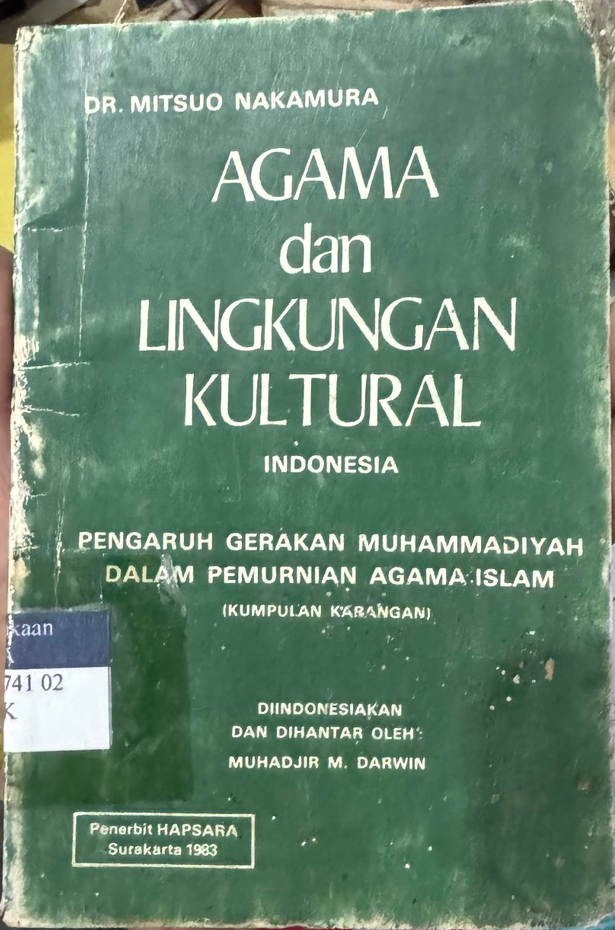
Agama dan Lingkungan Kultural Indonesia: Pengaruh Gerakan Muhammadiyah dalam Pemurnian Agama Islam (Kumpulan Karangan) [Religion and the Cultural Environment of Indonesia: The Influence of the Muhammadiyah Movement in the Purification of Islam (Collected Essays)]
Hapsara, Surakarta · Tahun tercetak di sampul (1983); cetakan, jumlah halaman, dan ISBN eksemplar belum diperiksa. Rujukan pembanding: Surakarta: Hapsara, 1983, jumlah halaman belum diketahui, kemungkinan tanpa ISBN (belum diverifikasi pada halaman hak cipta eksemplar) · 1983
Abstract
A collection of essays by the Japanese anthropologist Mitsuo Nakamura on Muhammadiyah and the purification of Islamic teachings within the cultural environment of Indonesia, particularly Java, translated into Indonesian and introduced by Muhadjir M. Darwin and published by Hapsara in Surakarta in 1983. Drawing on his fieldwork in Kotagede, Yogyakarta, Nakamura views the reform movement not as a total rejection of local culture, but as a process of selection and reformulation that continues to absorb local ethos, social networks, and values. This view tests the santri, abangan, and priyayi framework that was dominant in its day. The book is one of the early entry points of Nakamura's thought into Indonesian and is useful for the anthropology of religion, the history of modernist Islamic movements, and the comparison of the dynamics of Islamic reform in various regions of the Nusantara, including Aceh. The details of the contents of each essay, the number of pages, and the printing data still need to be checked against the copy.
Identifier
KBA-BKU-TT-0035
Type
Buku
Publisher
Hapsara, Surakarta
Date Issued
1983
Bibliographic Citation
Tahun tercetak di sampul (1983); cetakan, jumlah halaman, dan ISBN eksemplar belum diperiksa. Rujukan pembanding: Surakarta: Hapsara, 1983, jumlah halaman belum diketahui, kemungkinan tanpa ISBN (belum diverifikasi pada halaman hak cipta eksemplar)
Muhammadiyah (Organization)Islam -- IndonesiaIslamic renewal -- IndonesiaIslam and culture -- Indonesia -- Java
BISAC Category
SOC048000 SOCIAL SCIENCE / Islamic Studies
Language
Indonesia
Description
This copy is a softcover pocket book with a dark green base colour that now looks faded and stained in many places. All the lettering on the cover is printed in white without any illustration, so its appearance is very modest and typical of small Indonesian academic publications of the early 1980s. At the top appears the author's name with his title, Dr. Mitsuo Nakamura, followed by the large title Agama dan Lingkungan Kultural, and then the word Indonesia in smaller letters. Below it is the subtitle Pengaruh Gerakan Muhammadiyah dalam Pemurnian Agama Islam, with a note in parentheses that the book is a collection of essays. The lower part of the cover states that the text was translated into Indonesian and given a foreword by Muhadjir M. Darwin, while a ruled box at the base of the cover contains the name Penerbit Hapsara and the note Surakarta 1983. The year of publication is thus printed directly on the cover, something not always found on books of the same period.
Mitsuo Nakamura is a Japanese anthropologist whose name is almost inseparable from the study of Muhammadiyah. He carried out long fieldwork in Kotagede, Yogyakarta, in the early 1970s, and his dissertation at Cornell University was later published as The Crescent Arises over the Banyan Tree, an ethnography of the Muhammadiyah movement in a small town that was one of the organisation's early bases. That work is widely known for rejecting the view that the Islamic reform movement is purely scripturalist and dry, and for showing how Muhammadiyah grew out of the Javanese social milieu, including networks of traders, kin, and local traditions of piety. Nakamura later taught for many years in Japan, among other places at Chiba University, and continued to follow developments in Muhammadiyah and Nahdlatul Ulama for several decades. The Indonesian government awarded him the Anugerah Kebudayaan (Cultural Award) in the category of foreign individual in 2017, in recognition of his long contribution to the understanding of Indonesian Islam.
The translator and author of the foreword, Muhadjir M. Darwin, is known as an academic at Universitas Gadjah Mada in the fields of public policy and population studies. His presence as translator shows that Nakamura's essays were from the outset read not only by scholars of religion, but also by social scientists interested in the relationship between religion, social change, and development. A translator's foreword in a book of this kind usually serves to bridge Indonesian readers with the anthropological framework used by the author, and this should be checked directly in the copy.
As a collection of essays, the book appears to bring together several of Nakamura's short writings previously published in English, with the common thread of Muhammadiyah's role in the process of purifying Islamic teachings within the Javanese cultural environment. The titles and origins of the individual essays cannot yet be confirmed from the cover, so they need to be checked against the table of contents. Even so, the main idea Nakamura advanced in this period is quite clear from his other works. He views religious purification not as a total rejection of local culture, but as a process of selection, adjustment, and reformulation. Muhammadiyah did indeed oppose practices regarded as bid'ah (reprehensible innovation), takhayul (superstition), and khurafat (myth), but the organisation also absorbed the work ethic, social solidarity, and modern organisational forms that grew out of the life of urban Javanese society. The phrase cultural environment in the title itself stresses that religion must be understood in a reciprocal relationship with the social environment in which it is lived.
The context of the book's publication is also of interest. The early 1980s were a time when studies of Indonesian Islam were still heavily influenced by Clifford Geertz's framework of santri, abangan, and priyayi. Nakamura was among the scholars who directly tested that framework in the field. He showed that the santri category cannot simply be equated with a group estranged from Javanese culture, because in practice Muhammadiyah activists in Kotagede also inherited elements of Javaneseness, including refinement of character and an ethic of self-restraint. At the same time, the New Order government was reorganising the relationship between the state and religious organisations, and discourses of modernisation and development dominated public debate. In that atmosphere, Nakamura's writings gave Indonesian readers material to see that the Islamic reform movement had deep social roots and was not merely an ideology imported from the Middle East.
For the anthropology of religion, this book is valuable as one of the early entry points of Nakamura's thought into Indonesian. Many Indonesian students and researchers of the 1980s and 1990s generations became acquainted with the ethnographic approach to modernist Islamic organisations through translations such as this. The book can be read together with other classic works on Muhammadiyah, for example Alfian's study of Muhammadiyah as a political movement in the colonial period, Deliar Noer's study of the modern Islamic movement, and later works examining Muhammadiyah as a civil society organisation. For the study of Islam in Southeast Asia, the idea that religious reform proceeds through negotiation with local culture is also relevant for comparing Java with other regions, including Minangkabau and Aceh, where reform movements confronted adat traditions and forms of ulama authority of a different character.
In the context of Aceh, readers can use Nakamura's framework to examine the encounter between the currents of reform brought by modernist organisations and the strong dayah tradition. The relationship between the groups often called traditionalist and modernist in Aceh has its own history, from the activities of the Persatuan Ulama Seluruh Aceh (All-Aceh Ulama Association) to the religious debates of later periods, so a comparison with the experience of Kotagede could yield fresh research questions. Such questions include how ideas of purification were received or rejected at the village level, who carried them, and how they intersected with local adat.
As a critical note, a translation published in the early 1980s needs to be read with attention to possible differences in terminology from the original English text. Technical anthropological terms at that time had not yet been standardised in Indonesian, so readers who wish to quote should compare with the original source where available. In addition, Nakamura's study rests on observation of one particular community during one particular period. Generalisations about Muhammadiyah nationally, let alone about Indonesian Islam as a whole, need to be made with care. The development of Muhammadiyah after the 1980s, including the expansion of its educational and health enterprises (amal usaha) and the emergence of diverse currents of thought within it, is also not covered by this book. Nonetheless, precisely because of its character as a portrait of its time, the book is useful for seeing how Muhammadiyah was understood by an outside observer at an important period.
The publication data printed on the cover state Penerbit Hapsara, Surakarta, 1983. Comparative information from catalogues and the second-hand book market also gives Hapsara and the year 1983, but the number of pages, size, and printing details have not been found in reliable sources. The book was very probably published without an ISBN, given that the use of ISBNs in Indonesia was not yet common at that time. All these data still need to be checked against the copyright page of the copy.
In terms of physical condition, this copy shows clear signs of age. The green cover looks dull, stained, and scratched, with light patches scattered across the middle and lower parts. The edges of the cover are slightly worn and the corners are no longer sharp. On the left side of the front cover, near the spine, is a white and blue library label with a call number reading 741 02 and the letter K, a sign that this book was once part of a library collection. This description has been compiled as a curatorial introduction based on the cover and catalogue information, not a comprehensive summary of the contents of each essay.
Suitable search subjects include Muhammadiyah, Islamic reform in Indonesia, religious purification, the anthropology of religion, Islam and Javanese culture, Kotagede, and the history of the modernist Islamic movement. For citation purposes, references should state the author's name, the full title, the translator's name, the publisher, the year, and the pages read directly in the copy.
Mitsuo Nakamura, Muhadjir M. Darwin (penerjemah dan pengantar), “Agama dan Lingkungan Kultural Indonesia: Pengaruh Gerakan Muhammadiyah dalam Pemurnian Agama Islam (Kumpulan Karangan) [Religion and the Cultural Environment of Indonesia: The Influence of the Muhammadiyah Movement in the Purification of Islam (Collected Essays)]”, Hapsara, Surakarta, Tahun tercetak di sampul (1983); cetakan, jumlah halaman, dan ISBN eksemplar belum diperiksa. Rujukan pembanding: Surakarta: Hapsara, 1983, jumlah halaman belum diketahui, kemungkinan tanpa ISBN (belum diverifikasi pada halaman hak cipta eksemplar), 1983. KBA13 Academy Archive and Library, KBA-BKU-TT-0035.