Padebooks, Banda Aceh · Tahun, cetakan, jumlah halaman, dan ISBN eksemplar belum diperiksa. Rujukan pembanding: Banda Aceh: Padebooks, 2017, 204 hlm., 21 cm, ISBN 978-602-60562-3-8 (belum diverifikasi pada halaman hak cipta eksemplar) · Tanpa tahun
Abstract
A study in the philosophy of Sufism by Ramli Cibro on the dimension of value in the teaching of ma'rifah (gnosis) of Hamzah Fansuri, the sixteenth-century Malay Sufi and poet, published by Padebooks, Banda Aceh. Unlike many earlier studies centred on the ontology of wujudiyah and the controversy over the accusation of pantheism by Nuruddin ar-Raniri, this book poses an axiological question: what ethical and aesthetic values arise from the experience of ma'rifah, and how knowledge of God shapes the moral attitudes and social conduct of a salik (spiritual wayfarer). Placed within the tradition of Hamzah Fansuri studies from al-Attas, Drewes and Brakel, to Abdul Hadi W.M., the book shows a rereading of Aceh's intellectual heritage by a new generation of local scholars. National Library data record a 2017 publication of 204 pages. The book is relevant above all to the study of Sufism, Malay Islamic philosophy, Sufi ethics, and the intellectual history of Aceh and the Malay world.
Identifier
KBA-BKU-TT-0036
Type
Buku
Publisher
Padebooks, Banda Aceh
Date Issued
Tanpa tahun
Bibliographic Citation
Tahun, cetakan, jumlah halaman, dan ISBN eksemplar belum diperiksa. Rujukan pembanding: Banda Aceh: Padebooks, 2017, 204 hlm., 21 cm, ISBN 978-602-60562-3-8 (belum diverifikasi pada halaman hak cipta eksemplar)
Ḥamzah Fanṣūrī, active 16th centurySufism -- Indonesia -- AcehKnowledge, Theory of (Islam)Values
BISAC Category
REL090000 RELIGION / Islam / Sufi
Language
Indonesia
Description
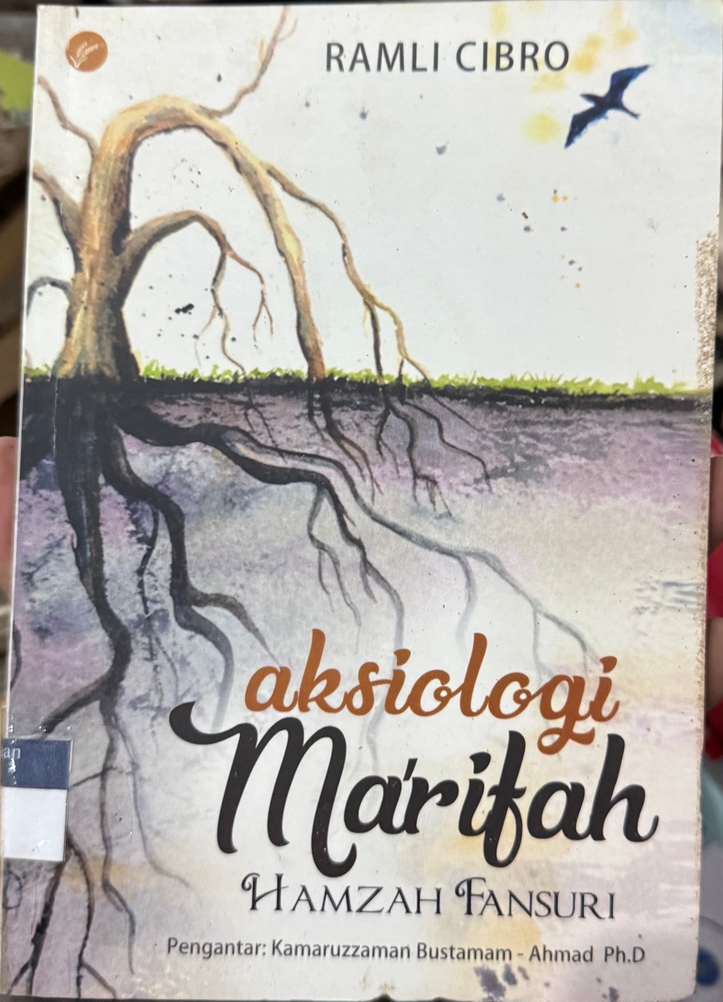
Aksiologi Ma'rifah Hamzah Fansuri (The Axiology of Hamzah Fansuri's Ma'rifah) by Ramli Cibro is a study in the philosophy of Sufism that traces the dimension of value in the teaching of ma'rifah (gnosis) of Hamzah Fansuri, a Malay Sufi and poet of the sixteenth and early seventeenth centuries who is often called one of the pioneers of the written tradition of Sufism in the Malay language. The cover of this copy has an ivory-white background with a watercolour painting of a large tree whose leaves have fallen. Its brown trunk and branches rise in the upper part, while below a line of green grass long roots can be seen spreading deep into purplish-grey soil. A blue bird flies in the upper right corner. The author's name is printed in dark grey capitals at the top, the word aksiologi in slanted orange-brown script, the word Ma'rifah in large black script, the name Hamzah Fansuri in decorative capitals, and the note naming the writer of the foreword at the very bottom. In the upper left corner is the publisher's logo, a small orange-brown circle with an image of a white stalk of rice, in keeping with the name of the publisher, Padebooks.
The choice of cover illustration appears to be in line with the content of the book. A tree that looks dry on the surface but is deeply rooted can be read as a metaphor for the relationship between the outer and inner worlds, or between apparent knowledge and essential knowledge, a theme very close to Hamzah Fansuri's poems, which are rich in images of the sea, waves, boats, and trees. The freely flying bird also recalls the symbol of the soul in the tradition of Sufi literature.
Ramli Cibro is a young researcher and writer from Aceh who is concerned with Sufism, Islamic philosophy, and the thought of the ulama of the Nusantara, particularly Hamzah Fansuri. The name Cibro itself is commonly found in the Singkil and Subulussalam region, the southwestern coastal area of Aceh traditionally associated with Fansur or Barus, although the author's personal origins need to be checked against the biographical note in the book. A number of his writings on the genealogy of Hamzah Fansuri's Sufism, including on the shift from wujudiyah to ma'rifah, circulate in the form of articles and online manuscripts. This book can be seen as a development of that research interest. Information on the author's educational and institutional background is not included here because it cannot yet be verified from adequate sources.
The core of this book, as its title suggests, is an axiological discussion, that is, of the branch of philosophy concerned with value, especially ethical and aesthetic value. Until now, studies of Hamzah Fansuri have centred mostly on the ontological aspect, namely the teaching of wahdat al-wujud or wujudiyah, which interprets the relationship between God and the world, and on the controversy over the accusation of pantheism levelled by Nuruddin ar-Raniri in the seventeenth century. Ramli Cibro shifts the focus of attention to other questions, namely what values arise from the experience of ma'rifah, how knowledge of God shapes the moral attitude of a salik, and how ma'rifah is reflected in social conduct. With this approach, Hamzah Fansuri's teaching is read not only as metaphysical speculation, but also as an ethics of life and an education of the soul. The details of the chapters and arguments need to be examined directly in the table of contents and the content of the copy.
The intellectual context of this book is the long tradition of studies of Hamzah Fansuri. Syed Muhammad Naquib al-Attas, through his works on the mysticism of Hamzah Fansuri and his translations of Hamzah's treatises, placed this Sufi as an important figure in the formation of Malay as a language of Islamic intellectual life. G.W.J. Drewes and L.F. Brakel edited his poems, while Abdul Hadi W.M. studied the aesthetics and hermeneutics of his verse. The debate over Hamzah Fansuri's lifetime also continues, especially since the discovery of a gravestone in Mecca that some researchers associate with him. Ramli Cibro's book enters this current of scholarship by offering a more philosophical-ethical perspective.
The book has a foreword by an anthropologist of religion from UIN Ar-Raniry Banda Aceh, as stated on the cover. The presence of a foreword from the field of anthropology signals that the study of Hamzah Fansuri's Sufism is important not only for Islamic philosophy, but also for efforts to understand the formation of culture and knowledge systems in the society of Aceh and the Malay world.
The publication data in the list of books in the process of publication (cataloguing-in-publication) of the National Library of the Republic of Indonesia record that this book was published by Padebooks in Banda Aceh in 2017, with 204 pages, measuring 21 centimetres, with ISBN 978-602-60562-3-8. The year, printing, page count, and ISBN of the photographed copy still need to be checked against the copyright page.
For the study of Islam in Aceh and the Malay world, this book is relevant in several respects. First, it enriches the Indonesian-language literature on Hamzah Fansuri written by Acehnese scholars themselves, thus showing how Aceh's intellectual heritage is being reread by a new generation. Second, the axiological approach opens the possibility of linking classical Sufism with contemporary ethical problems, for example character education, the relationship between humans and nature, and spirituality amid the formalization of religion. Third, the book is useful for courses on Islam in the Malay World and the Indian Ocean, because Hamzah Fansuri is a key figure in the intellectual network connecting Barus, Aceh, Ayutthaya, Baghdad, and Mecca.
From the perspective of the anthropology of religion, ma'rifah can be understood not only as an individual inner experience, but also as a source of values transmitted through poetry, the dayah (traditional Islamic boarding schools), Sufi orders (tarekat), and oral tradition. Traces of Hamzah Fansuri's influence in Acehnese culture, including in hikayat and dalail, are interesting material to compare with the discussion of values in this book.
As a critical note, a philosophical study of a figure who lived centuries ago faces the limitation of sources, because the surviving works of Hamzah Fansuri are limited in number and the authenticity of some of them is still debated. Readers need to pay attention to the extent to which the author distinguishes between ideas that can genuinely be traced to Hamzah Fansuri's texts and the author's own philosophical interpretations. The use of an axiological framework derived from the Western philosophical tradition also needs to be tested for its suitability to the terms and internal logic of Sufism, so that concepts such as adab, akhlak, and ihsan are not simply equated with modern categories of value.
Nevertheless, the book makes a significant contribution to broadening the ways of reading Hamzah Fansuri, from theological debates about being towards questions about the meaning of life, morality, and beauty. Such an approach is important amid a tendency to regard philosophical Sufism (tasawuf falsafi) merely as a suspect teaching, because it shows that the tradition of ma'rifah also contains rich ethical guidance.
The presence of a local publisher in Banda Aceh also deserves mention. The publication of Islamic studies books by small publishers in Aceh over the last two decades shows the growth of a local intellectual ecosystem after the conflict and the tsunami, as a young generation of scholars from the dayah and Islamic universities began to rewrite the history and thought of the ulama of Aceh from their own perspective. This book is part of that phenomenon, and is therefore also valuable as a document of the dynamics of publishing and scholarly discourse in Aceh in the mid-2010s.
In terms of collection documentation, this copy is relatively well kept, with a few spots and some wear on the right edge of the cover. A blue and white library label is affixed to the spine at the lower left. This note is a curatorial introduction based on the cover and catalogue information, not a summary of the entire content of the book.
Suitable search subjects include Hamzah Fansuri, ma'rifah, philosophical Sufism, wujudiyah, axiology and Sufi ethics, Malay Islamic philosophy, and the intellectual history of Aceh. For citation purposes, references should give the author's name, the full title, the publisher, the year, and the pages read directly in the copy.
Ramli Cibro, Kamaruzzaman Bustamam Ahmad (pengantar), “Aksiologi Ma'rifah Hamzah Fansuri [The Axiology of Hamzah Fansuri's Ma'rifah]”, Padebooks, Banda Aceh, Tahun, cetakan, jumlah halaman, dan ISBN eksemplar belum diperiksa. Rujukan pembanding: Banda Aceh: Padebooks, 2017, 204 hlm., 21 cm, ISBN 978-602-60562-3-8 (belum diverifikasi pada halaman hak cipta eksemplar). KBA13 Academy Archive and Library, KBA-BKU-TT-0036.