Penerbit edisi Indonesia belum teridentifikasi (edisi asli: Leiden University Press, Leiden) · Tahun, cetakan, jumlah halaman, dan ISBN eksemplar belum diperiksa. Rujukan pembanding: edisi asli Islam, Politics and Change: The Indonesian Experience after the Fall of Suharto, Leiden: Leiden University Press, 2016, 334 hlm., ISBN 978-90-8728-238-7; penerbit dan tahun edisi Indonesia belum ditemukan (belum diverifikasi pada halaman hak cipta eksemplar) · Tanpa tahun
Abstract
The Indonesian-language edition of Islam, Politics and Change: The Indonesian Experience after the Fall of Suharto, a book edited by Kees van Dijk and Nico J.G. Kaptein whose original edition was published by Leiden University Press in 2016. This collection of writings by scholars from Indonesian Islamic higher education institutions and Dutch researchers examines the religious and political changes after Suharto stepped down in 1998, especially the strengthening of orthodoxy and radicalism in a climate of democracy and openness. The book can be placed within the debate on the conservative shift of Indonesian Islam, the sharia-isation of regional policies, the position of minority groups, and Aceh's experience with the formal implementation of sharia. The combination of Indonesian and Dutch perspectives is its strength. The publisher, year, number of pages, and ISBN of the translated edition have not yet been found in catalogues and still need to be checked against the copyright page of the copy, while chapter details need to be checked in the table of contents.
Identifier
KBA-BKU-TT-0038
Type
Buku
Publisher
Penerbit edisi Indonesia belum teridentifikasi (edisi asli: Leiden University Press, Leiden)
Date Issued
Tanpa tahun
Bibliographic Citation
Tahun, cetakan, jumlah halaman, dan ISBN eksemplar belum diperiksa. Rujukan pembanding: edisi asli Islam, Politics and Change: The Indonesian Experience after the Fall of Suharto, Leiden: Leiden University Press, 2016, 334 hlm., ISBN 978-90-8728-238-7; penerbit dan tahun edisi Indonesia belum ditemukan (belum diverifikasi pada halaman hak cipta eksemplar)
Islam and politics -- IndonesiaIslam -- Indonesia -- History -- 21st centuryIndonesia -- Politics and government -- 1998-
BISAC Category
REL084000 RELIGION / Religion, Politics & State
Language
Indonesia
Description
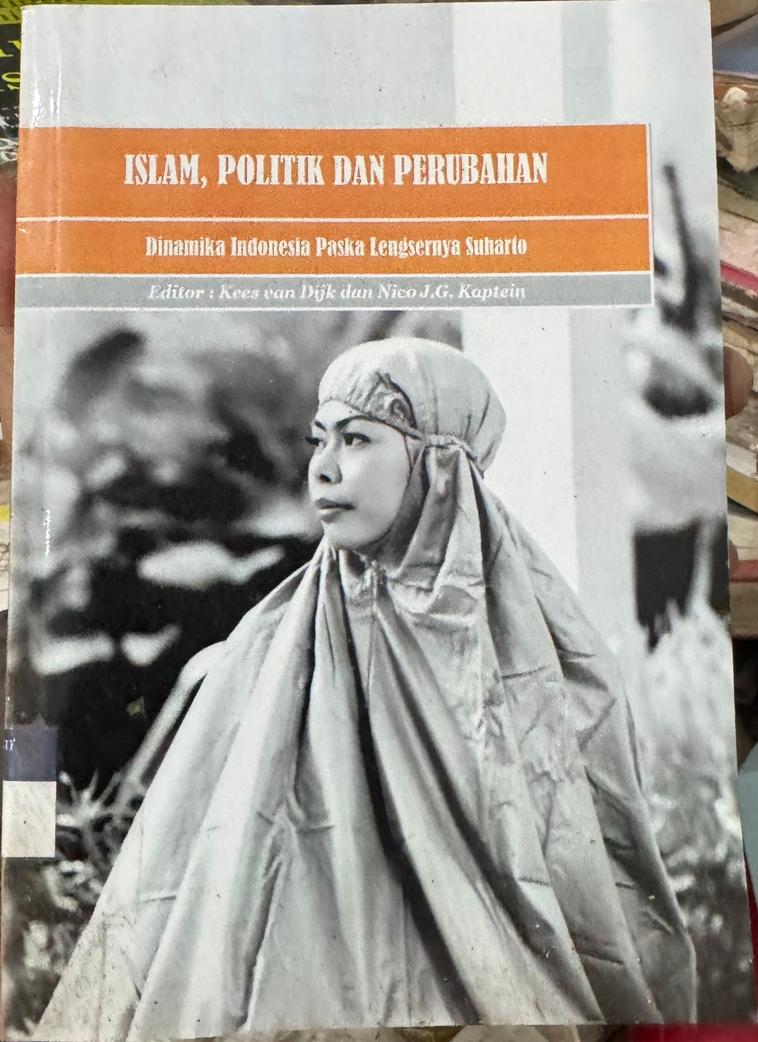
This copy is a paperback with a design combining a black-and-white photograph and fields of orange. Almost the entire cover is filled with a portrait of a young woman wearing a light-coloured mukena (prayer garment), seen from the side looking to the left, against a blurred background of trees and buildings. At the top are two stacked orange bands. The first band carries the title Islam, Politik dan Perubahan in white capital letters, while the second carries the subtitle Dinamika Indonesia Paska Lengsernya Suharto. Below it, on a grey band, is the note Editor: Kees van Dijk dan Nico J.G. Kaptein. The choice of a photograph of a woman in a mukena as the main image gives the impression that everyday piety, public space, and changing religious identity are an important part of the book's theme, although the exact meaning of that design choice cannot, of course, be determined from the cover alone.
This book is the Indonesian-language edition of Islam, Politics and Change: The Indonesian Experience after the Fall of Suharto, edited by Kees van Dijk and Nico J.G. Kaptein and published by Leiden University Press in 2016 in the Debates on Islam and Society series. Leiden University's official page lists the title Islam, Politik dan Perubahan as the Indonesian version of the book, but does not mention the publisher, year, or ISBN of the translated edition. Initial searches have not yet found definitive catalogue data for this Indonesian edition, so the supposition that it was published through cooperation between Leiden University, INIS, KITLV-Jakarta, or a publisher such as Pustaka Obor still needs to be verified through the copyright page. For comparison, the English edition is recorded as having around 334 pages of content, or 352 pages according to the OAPEN repository, with ISBN 978-90-8728-238-7, and is available in open access through the Knowledge Unlatched programme.
Both editors are among the leading Dutch scholars in Indonesian studies. Kees van Dijk is a historian and political scientist who worked for many years at KITLV and taught at Leiden University. His works include a study of the Darul Islam movement in Rebellion under the Banner of Islam, analyses of Indonesian politics during the New Order and after, and a study of the Dutch East Indies during the First World War. Nico J.G. Kaptein is a scholar of Islamic studies at Leiden University known for his studies of the celebration of the maulid (the Prophet's birthday) and of Sayyid Uthman, the mufti of Batavia in the late nineteenth century, as well as of the relationship between religious authority and the colonial government. Both have also long been involved in academic cooperation between the Netherlands and Islamic higher education institutions in Indonesia.
According to the publisher's description of the English edition, the book brings together writings by scholars from Indonesian Islamic higher education institutions and Dutch researchers. Its main focus is the changes that took place after Suharto stepped down in 1998, when Indonesia moved from authoritarian rule to a democratic system. The authors pay particular attention to the strengthening of religious orthodoxy and radicalism, a tendency which, according to the editors, was already visible before 1998 but became increasingly prominent in the climate of openness that followed. Themes commonly discussed in studies of this kind include the role of fatwas and ulama institutions, sharia-inflected regional regulations, the position of religious minority groups, changes within the major Islamic organisations, and the position of Aceh as a region that formally implements sharia. The chapter details and their authors have not yet been checked in the copy, so readers need to consult the table of contents to know its exact scope.
The intellectual context of the book is the long debate about the direction of Indonesian Islam after Reformasi. For several decades, Indonesian Islam was often portrayed as moderate, tolerant, and friendly to democracy. That picture began to be questioned when various studies in the 2000s and 2010s highlighted what came to be called the conservative turn, namely the strengthening of stricter religious views in public space and state policy. This book can be placed within that current of scholarship, together with other works on democratisation, sharia-isation, and identity politics in Indonesia. Its strength lies in the combination of the perspectives of Indonesian and Dutch researchers, so that the issues discussed are viewed not only from outside, but also through the eyes of scholars who live and work within Islamic higher education institutions.
For studies of Aceh, the book is relevant because Aceh's experience after 1998 is one of the clearest examples of the relationship between decentralisation, special autonomy, and the implementation of sharia. The development of qanun, the establishment of the Wilayatul Hisbah (sharia police), and the debate over caning are often referred to in national and international discussions of Islam and the state in Indonesia. For Islamic studies in Southeast Asia, the book provides comparative material with Malaysia and Brunei, where relations between religion and the state have developed along different paths. For students of political science, the sociology of religion, and anthropology, a collection of this kind is also useful as an introduction to the various approaches used to examine religious change.
As a critical note, an edited volume with many authors usually has uneven quality and depth across chapters. Readers also need to note that the terms orthodoxy and radicalism may be understood differently by the various authors, so attention should be paid to the definitions used in each chapter. A review of the English edition in the Journal of Southeast Asian Studies indicates that the book received attention in the international academic community, but detailed assessments of each chapter should be read directly in that review. The translated edition also brings its own problems, especially regarding the accuracy of the translation of technical terms, so for citations requiring precision, comparison with the openly available English edition is strongly recommended. The spelling paska in the subtitle, which is normally written pasca, should also be noted as a feature of this edition.
The existence of this translated edition should also be read as part of the history of academic cooperation between Indonesia and the Netherlands in Islamic studies. Since the 1980s, cooperation programmes such as INIS have brought lecturers from Indonesian Islamic higher education institutions into contact with Dutch traditions of orientalism and social science, producing many scholars, translations, and joint publications. This book shows the continuation of that tradition at a time when the relationship was no longer one-directional, because Indonesian scholars appear as equal authors and not merely as objects or informants of research. Translation into Indonesian extends the book's reach to students, lecturers, activists, and policymakers at home, who are the readers with the most direct stake in the issues discussed. For the libraries of Islamic higher education institutions in Aceh and other regions, editions of this kind help bridge the language gap that has often limited access to international research about Indonesia itself. On the other hand, the existence of a freely downloadable English edition allows readers to compare the two versions directly, an advantage rarely available for academic translations.
In terms of physical condition, this copy appears to be in fairly good condition. The cover is relatively clean, with slight wear on the left edge and corners, and light creases in several places. On the lower left of the front cover, near the spine, a blue-and-white library label is affixed with a call number that cannot be read in full in the photograph. This note has been prepared as a curatorial introduction based on the cover and the catalogue information of the English edition, not as a comprehensive summary of the book's contents.
Suitable search subjects include Islam and politics in Indonesia, the 1998 Reformasi, democratisation, religious radicalism, Islamic orthodoxy, regional Islamic sharia, and Aceh after the New Order. For citation purposes, references should give the names of the editors, the full title, the publisher, the year, and the pages read directly in the copy, and mention the English edition where necessary.
Kees van Dijk, Nico J.G. Kaptein, “Islam, Politik dan Perubahan: Dinamika Indonesia Paska Lengsernya Suharto [Islam, Politics and Change: Indonesian Dynamics after the Fall of Suharto]”, Penerbit edisi Indonesia belum teridentifikasi (edisi asli: Leiden University Press, Leiden), Tahun, cetakan, jumlah halaman, dan ISBN eksemplar belum diperiksa. Rujukan pembanding: edisi asli Islam, Politics and Change: The Indonesian Experience after the Fall of Suharto, Leiden: Leiden University Press, 2016, 334 hlm., ISBN 978-90-8728-238-7; penerbit dan tahun edisi Indonesia belum ditemukan (belum diverifikasi pada halaman hak cipta eksemplar). KBA13 Academy Archive and Library, KBA-BKU-TT-0038.