Logos Wacana Ilmu, Jakarta · Tahun, cetakan, jumlah halaman, dan ISBN eksemplar belum diperiksa. Rujukan pembanding: Jakarta: Logos Wacana Ilmu, 2001, jumlah halaman dan ISBN belum diketahui (belum diverifikasi pada halaman hak cipta eksemplar) · Tanpa tahun
Abstract
An English-language study by Ratno Lukito, professor at the Faculty of Sharia and Law of UIN Sunan Kalijaga, derived from his master's thesis at the Institute of Islamic Studies, McGill University (1997), and published by Logos in Jakarta in 2001. This book criticises the conflict paradigm inherited from colonial scholars and the receptie theory, which set Islamic law against adat. The author examines the position of 'adah and 'urf in usul fikih (Islamic legal theory), the legal policies of the Dutch colonial and Japanese periods, and the post-independence debate on legal pluralism and unification. Through studies of taklik talak (conditional repudiation), harta bersama (joint marital property), and wasiat wajibah (obligatory bequest), he shows that the two legal systems engage in dialogue and accommodation, giving rise to a distinctively Indonesian family law. This book is relevant to the study of legal pluralism, Islamic family law, and the relationship between adat and sharia, including Aceh's experience with customary institutions and the Mahkamah Syar'iyah (Sharia Court).
Identifier
KBA-BKU-TT-0039
Type
Buku
Publisher
Logos Wacana Ilmu, Jakarta
Date Issued
Tanpa tahun
Bibliographic Citation
Tahun, cetakan, jumlah halaman, dan ISBN eksemplar belum diperiksa. Rujukan pembanding: Jakarta: Logos Wacana Ilmu, 2001, jumlah halaman dan ISBN belum diketahui (belum diverifikasi pada halaman hak cipta eksemplar)
Islamic law -- IndonesiaCustomary law -- IndonesiaLegal polycentricity -- IndonesiaDomestic relations (Islamic law) -- Indonesia
BISAC Category
LAW119000 LAW / Islamic
Language
Inggris
Description
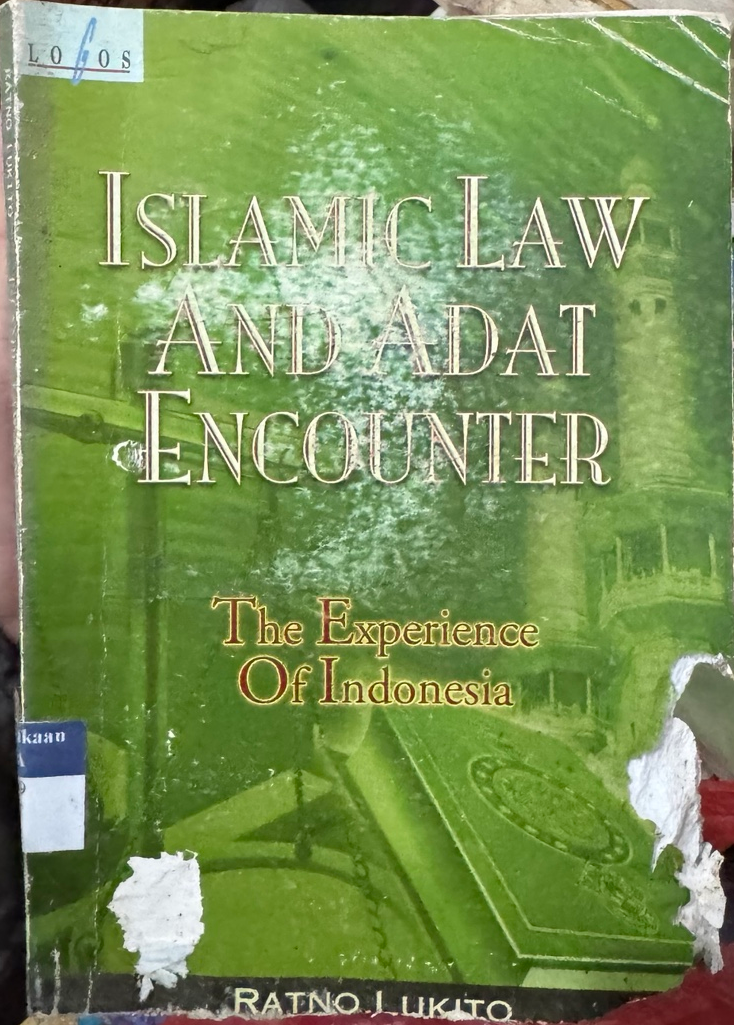
Islamic Law and Adat Encounter: The Experience of Indonesia by Ratno Lukito is an English-language study of the relationship between Islamic law and customary law (adat) in Indonesia, published by Logos in Jakarta. The cover of this copy is dominated by green, with a monochrome green photographic background showing the interior of a colonial-style building or mosque with a minaret on the right side, while at the bottom a large book with a decorated cover appears, open or lying on a table. The main title is printed in shadowed cream serif capitals over three lines, followed by the subtitle The Experience Of Indonesia in dark red serif letters with a yellow border. The author's name is printed in white capitals on the bottom band. The Logos logo, a small white box with lettering in capitals, is in the upper left corner. On the spine the author's name is printed vertically.
Ratno Lukito is a professor at the Faculty of Sharia and Law of Universitas Islam Negeri Sunan Kalijaga, Yogyakarta, and is known as one of the leading scholars of legal pluralism and comparative law in Indonesia. He pursued his master's studies at the Institute of Islamic Studies, McGill University, Montreal, and according to circulating information later continued with doctoral studies in law at the same university. His further study of legal pluralism was published by Routledge under the title Legal Pluralism in Indonesia: Bridging the Unbridgeable. He has also written on legal traditions, comparative legal systems, and the relationship between religion and state in Indonesian law, in both Indonesian and English.
This book derives from Ratno Lukito's master's thesis at McGill University, completed in 1997 under the same title. Its core argument is a critique of the conflict paradigm that has long dominated studies of Islamic law and adat in Indonesia. That paradigm is rooted in Dutch colonial scholars, particularly Cornelis van Vollenhoven and Christiaan Snouck Hurgronje, who through the receptie theory treated customary law as the living law and held that Islamic law applied only insofar as it had been accepted by adat. Ratno Lukito proposes another perspective, namely that the relationship between the two is more appropriately understood as dialogue and accommodation than as an irreconcilable opposition.
To support this argument, the author first examines the position of custom, or 'adah and 'urf, in usul fikih. He shows that since the time of the Prophet and his Companions, the customs of society shaped the practice of Islamic law, and that classical jurists treated custom as a secondary consideration which in many cases determined the direction of interpretation, even though it was not recognised as an independent source of law. The author then traces the policies of the Dutch colonial government towards Islamic law and adat, the legal situation during the Japanese occupation, and the post-independence debate between the ideas of legal pluralism and legal unification, including the differing views of secular nationalist groups and Muslim groups.
The most concrete part of this book is the study of three institutions in Indonesian family and inheritance law, namely taklik talak, joint marital property, and wasiat wajibah. All three show how elements of Islamic law and elements of adat adjust to each other, giving rise to legal forms distinctive to Indonesia. Joint property, for example, is rooted in the concept of harta gono-gini in Javanese adat and various other local terms, but was later accommodated in the Kompilasi Hukum Islam (Compilation of Islamic Law). With these examples the author affirms that Indonesian society has repeatedly been able to harmonise the two legal systems, contrary to the picture of conflict inherited from colonial legal scholarship.
The intellectual context of this book is the long debate on the receptie theory and its critics. Hazairin once called the theory a satanic theory and proposed the receptie exit theory, while Sayuti Thalib proposed the receptio a contrario theory, which holds that adat applies only if it does not conflict with Islamic law. Ratno Lukito takes a position that seeks to transcend this dichotomy, emphasising processes of mutual acceptance and dialogue. His approach was also influenced by Islamic studies at McGill, which paid attention to the social history of Islamic law.
Known comparative publication data indicate that this book was published in Jakarta by Logos, known as Logos Wacana Ilmu, in 2001. The publication of a McGill thesis by an Indonesian publisher at that time was probably connected with the cooperation programme for the development of Islamic studies between Indonesian Islamic higher education institutions and McGill University, but this needs to be confirmed on the book's front pages. The page count and ISBN cannot yet be confirmed from accessible catalogues. The year, printing, page count, and ISBN of the photographed copy still need to be checked against the copyright page.
For the study of Islamic law and the anthropology of law in Indonesia, this book is highly relevant. It provides a framework for understanding legal pluralism not as a condition to be resolved by eliminating one of the systems, but as an ongoing space of negotiation. This framework is useful for students of sharia and law faculties studying family law, inheritance law, and the sociology of law, as well as for researchers examining legal practice in the religious courts.
For readers in Aceh, the discussion in this book can be connected with the customary saying adat geutanyoe ngon hukom lagee zat ngon sifeut, which describes adat and Islamic law as being like essence and attribute, inseparable from each other. Aceh's experience with customary institutions, gampong courts, and the Mahkamah Syar'iyah provides rich comparative material for the accommodation thesis in this book, while also showing that the relationship between adat and sharia in Aceh has its own tensions, for example in matters of inheritance and the position of women.
As a critical note, because this book derives from a master's thesis, its empirical scope is relatively limited and rests more on secondary sources and the texts of regulations than on field research. The emphasis on harmony and accommodation also risks underestimating the real conflicts that occur in practice, for example when women face a choice between inheritance division according to adat or faraid (Islamic inheritance shares). Some readers may also see that the focus on examples from Java and national law does not fully capture the diversity of adat in other regions such as Minangkabau, Aceh, or Sulawesi. The ideas in this book were later developed more broadly by the author in his subsequent works.
The use of English also allows this book to function as a bridge between the study of Islamic law in Indonesia and international academic discussion on law and Muslim societies.
In terms of collection documentation, this copy is in fairly severely damaged condition. The lower right part of the front cover is torn and ripped, exposing the white paper layer beneath, there is also a white tear at the bottom centre, spots and stains on the title area, and wear along the edges. A blue and white library label is affixed to the spine on the left side. This description is a curatorial introduction based on the cover and catalogue information, not a summary of the entire contents of the book.
Suitable search subjects include Islamic law in Indonesia, customary law, legal pluralism, receptie theory, usul fikih and 'urf, joint marital property, taklik talak, and wasiat wajibah. For citation purposes, references should name the author, the full title, the publisher, the year, and the pages read directly in the copy.
Ratno Lukito, “Islamic Law and Adat Encounter: The Experience of Indonesia”, Logos Wacana Ilmu, Jakarta, Tahun, cetakan, jumlah halaman, dan ISBN eksemplar belum diperiksa. Rujukan pembanding: Jakarta: Logos Wacana Ilmu, 2001, jumlah halaman dan ISBN belum diketahui (belum diverifikasi pada halaman hak cipta eksemplar). KBA13 Academy Archive and Library, KBA-BKU-TT-0039.