UII Press, Yogyakarta · Tahun, cetakan, jumlah halaman, dan ISBN eksemplar belum diperiksa. Rujukan pembanding: Yogyakarta: UII Press, 1999, xvi + 160 hlm., 23 cm, ISBN 979-8413-19-9 (belum diverifikasi pada halaman hak cipta eksemplar) · Tanpa tahun
Abstract
An introductory book by Amir Mu'allim and Yusdani, teachers of Islamic law at Universitas Islam Indonesia, with forewords by Moh. Mahfud MD and Asjmuni A. Rahman, published by UII Press, Yogyakarta. Through the term configuration, the two authors map the forms and directions of Islamic legal thought, including the position of ijtihad, the relationship between revealed text and social reality, the role of maslahah and maqasid al-syari'ah, and the shift from madhhab-based fiqh towards more contextual thinking. The book was born amid the debate on the renewal of Islamic law in Yogyakarta in the late 1990s, following the ideas of an Indonesian fiqh, a national madhhab, and the reactualisation of Islamic teachings. Catalogues record a 1999 edition of xvi and 160 pages. For sharia students, including in Aceh, the book is useful as a theoretical foundation for understanding the methods of ijtihad before entering debates on the drafting of qanun, family law, and the relationship between fiqh and state law.
Identifier
KBA-BKU-TT-0040
Type
Buku
Publisher
UII Press, Yogyakarta
Date Issued
Tanpa tahun
Bibliographic Citation
Tahun, cetakan, jumlah halaman, dan ISBN eksemplar belum diperiksa. Rujukan pembanding: Yogyakarta: UII Press, 1999, xvi + 160 hlm., 23 cm, ISBN 979-8413-19-9 (belum diverifikasi pada halaman hak cipta eksemplar)
Islamic law -- MethodologyIslamic law -- Interpretation and constructionIslamic law -- Indonesia
BISAC Category
LAW119000 LAW / Islamic
Language
Indonesia
Description
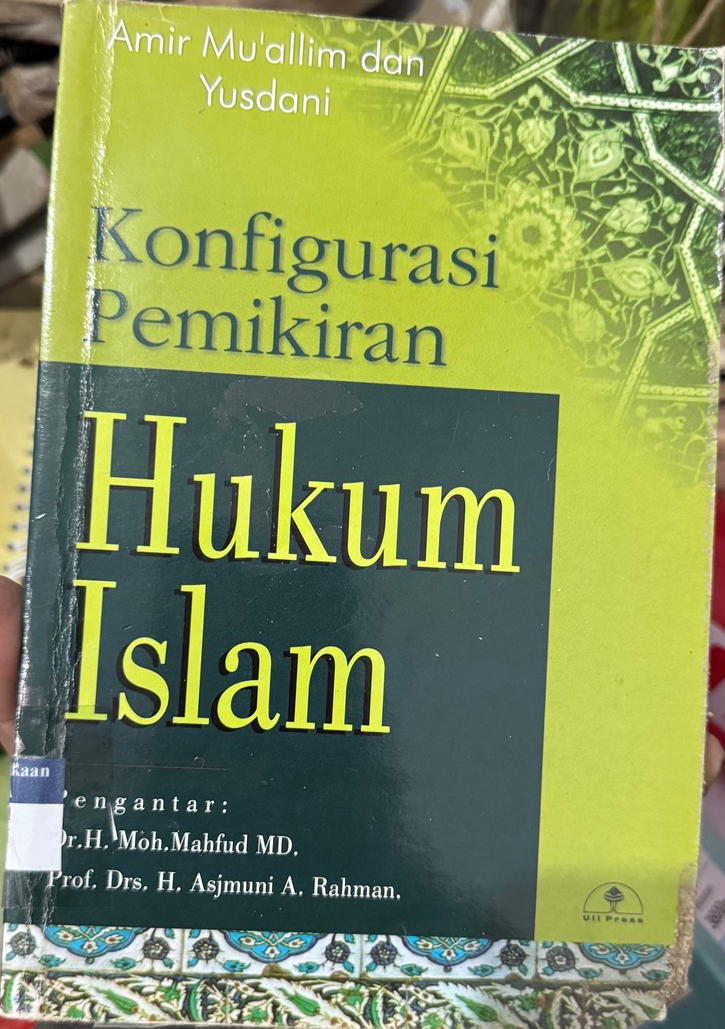
Konfigurasi Pemikiran Hukum Islam by Amir Mu'allim and Yusdani is an introductory book on the study of Islamic legal thought published by UII Press, the publisher of Universitas Islam Indonesia in Yogyakarta, with forewords by Moh. Mahfud MD and Asjmuni A. Rahman. The cover of this copy is dominated by yellowish green with a dark green arabesque ornament of star and tendril motifs in the upper right corner. The names of the two authors are printed in white at the very top, followed by the words Konfigurasi Pemikiran in blackish-grey serif type. The words Hukum Islam are displayed in large yellow serif type on a dark green rectangle, and below it is a note on the forewords naming Dr. H. Moh. Mahfud MD and Prof. Drs. H. Asjmuni A. Rahman. The UII Press logo, a small circle bearing a tree, is printed in the lower right corner of the light green field, while the bottom band is decorated with a Middle Eastern–style ceramic tile motif in blue, green, and yellow.
Both authors are known as teachers in the Faculty of Islamic Studies at Universitas Islam Indonesia, Yogyakarta. Amir Mu'allim and Yusdani both specialise in Islamic law, usul fikih (principles of jurisprudence), and contemporary Islamic thought, and are active in writing about ijtihad and the renewal of Islamic law in Indonesia. Yusdani, as reported in a number of lecturer profiles, has a pesantren educational background before pursuing academic studies at Islamic higher education institutions, and later taught sharia law at UII. The details of their academic careers should be checked against the biographical notes usually printed at the end of the book, since the information here is compiled from general sources and not from the biography page of the copy.
The presence of two foreword writers gives an indication of the book's position within the academic environment of Yogyakarta in the late 1990s. Moh. Mahfud MD, then a lecturer in constitutional law at Universitas Islam Indonesia, later became widely known as Minister of Defence, Chief Justice of the Constitutional Court, and Coordinating Minister for Political, Legal, and Security Affairs. Asjmuni A. Rahman was a professor of usul fikih who taught for many years at IAIN Sunan Kalijaga and was known to be close to the Majelis Tarjih (legal council) of Muhammadiyah. The combination of a constitutional law expert and an usul fikih expert as foreword writers reflects the character of the book, namely an effort to bring classical Islamic legal reasoning together with the legal needs of a modern nation-state such as Indonesia.
The title of the book uses the word configuration, a term that in legal studies in Indonesia is often associated with the idea that legal products are shaped by the arrangement of political, social, and intellectual forces surrounding them. By using that term, the two authors appear to aim at mapping the forms of Islamic legal thought, both in terms of method and in terms of the character and direction of its development. Discussions of this kind usually cover the position of ijtihad as a means of responding to new problems, the relationship between revealed text and social reality, the role of the concepts of maslahah and maqasid al-syari'ah, and the shift from fiqh based on the madhhab towards more contextual thinking. Since this note is compiled from the cover and catalogue data, the chapter details and the structure of the argument need to be checked directly in the table of contents of the copy.
The intellectual context of the book is the long debate about the renewal of Islamic law in Indonesia. From the idea of an Indonesian fiqh put forward by Hasbi Ash-Shiddieqy and the national madhhab proposed by Hazairin to the idea of the reactualisation of Islamic teachings launched by Munawir Sjadzali in the 1980s, Indonesian Muslim scholars repeatedly asked how Islamic law could be formulated in accordance with local social and cultural conditions. In the 1990s, campuses in Yogyakarta, including UII and IAIN Sunan Kalijaga, became important centres for discussions of Islamic legal methodology, hermeneutics, and sociological approaches to fiqh. This book was born in that atmosphere and can be read as part of an academic effort to formulate a map of thought that could be used by students and lecturers in faculties of sharia and Islamic studies.
Catalogue data from the Library of Universitas Muhammadiyah Surakarta record that the book was published in Yogyakarta by UII Press in 1999, with xvi and 160 pages, measuring 23 centimetres, with ISBN 979-8413-19-9 and Dewey classification number 297.401. The year, printing, number of pages, and ISBN of the photographed copy still need to be checked against the copyright page, because books from campus publishers of this kind are often reprinted without conspicuous changes to the cover.
For the study of Islamic law in Indonesia, the book is relevant as concise introductory material. Its modest length makes it suitable for use in courses on usul fikih, the philosophy of Islamic law, and the history of Islamic legal thought, especially for introducing students to the diversity of approaches to understanding sharia. The book is also useful for tracing how scholars of Islamic law at private Islamic universities responded to the wave of renewal of thought in the late New Order and early Reformasi period, when demands for the application of sharia in a number of regions began to grow stronger.
For readers in Aceh, the book can be read together with the development of the formalisation of Islamic sharia that began not long after the book was published, especially through Law No. 44 of 1999 on the implementation of Aceh's special status and later Law No. 18 of 2001 on special autonomy. Questions about the methods of ijtihad, the position of maslahah, and the relationship between fiqh and state law, which are the central concerns of books of this kind, later became practical problems in the drafting of qanun in Aceh. Students in faculties of sharia and law can use the book as a theoretical foundation before entering debates on the formulation of the qanun jinayat, family law, and sharia courts.
From the standpoint of the anthropology and sociology of law, the book shows how Islamic legal thought in Indonesia develops not only in the realm of texts, but is also shaped by educational institutions, religious organisations, and relations with the state. The fact that its forewords were written by a figure who later played an important role in state institutions and by a figure close to the fatwa body of a mass organisation gives a picture of the social networks that sustained the discourse of Islamic law in Yogyakarta.
As a critical note, an introductory book that maps the configuration of thought runs the risk of simplifying the diversity of views into a few broad categories, for example textualist and contextualist groups. Readers need to consider whether the categories used by the authors are sufficiently sensitive to differences within each group, and whether the thought of local ulama and legal practice at the community level also receive a place. In addition, since the book was published more than two decades ago, important later developments, such as the proliferation of studies of maqasid al-syari'ah, regional sharia policies, and the development of Islamic economic law, are naturally not covered in it.
Nevertheless, the value of the book lies in its role as an intellectual document recording how teachers of Islamic law in Yogyakarta formulated methodological problems during Indonesia's political transition. For researchers of the history of Islamic legal thought, the book can be set alongside contemporaneous works on ijtihad, Indonesian fiqh, and the politics of Islamic law in order to see the continuities and shifts of ideas over time.
In terms of collection documentation, this copy shows quite clear wear on the edges of the cover, especially on the left side and the lower right corner, and there are creases and small spots on the dark green field. A blue-and-white library label is affixed to the spine of the book on the left side. This note is a curatorial introduction based on the cover and catalogue information, not a summary of the entire contents of the book.
Suitable search subjects include Islamic legal thought, usul fikih, ijtihad, the renewal of Islamic law in Indonesia, the philosophy of Islamic law, Universitas Islam Indonesia, and the politics of Islamic law. For citation purposes, references should give the names of both authors, the full title, the publisher, the year, and the pages read directly in the copy.
Rights
Koleksi pribadi KBA13 Academy
Contributor
Moh. Mahfud MD (pengantar)Asjmuni A. Rahman (pengantar)
Amir Mu'allim, Yusdani, Moh. Mahfud MD (pengantar), Asjmuni A. Rahman (pengantar), “Konfigurasi Pemikiran Hukum Islam [The Configuration of Islamic Legal Thought]”, UII Press, Yogyakarta, Tahun, cetakan, jumlah halaman, dan ISBN eksemplar belum diperiksa. Rujukan pembanding: Yogyakarta: UII Press, 1999, xvi + 160 hlm., 23 cm, ISBN 979-8413-19-9 (belum diverifikasi pada halaman hak cipta eksemplar). KBA13 Academy Archive and Library, KBA-BKU-TT-0040.