Pustaka Larasan, Denpasar · Tahun, cetakan, jumlah halaman, dan ISBN eksemplar belum diperiksa. Rujukan pembanding: Denpasar: Pustaka Larasan, 2014, jumlah halaman dan ISBN belum diketahui (belum diverifikasi pada halaman hak cipta eksemplar) · Tanpa tahun
Abstract
An anthropological and historical study by Muhajir Al Fairusy, an anthropologist who graduated from Universitas Gadjah Mada and teaches at STAIN Teungku Dirundeng Meulaboh, on the Dayah or Zawiyah of Tanoh Abee in Seulimeum, Aceh Besar, published by Pustaka Larasan, Denpasar, 2014. This institution, which according to tradition was founded by descendants of a scholar from Baghdad, is known for its collection of Arabic and Jawi manuscripts on fiqh (jurisprudence), tasawuf (Sufism), tauhid (theology), and tafsir (exegesis), and for the role of the Teungku Chik of Tanoh Abee in the history of Aceh. Through the idea of hemispheric Islam, the author revisits the cultural traces born of the encounter between cross-hemispheric Islamic networks and local traditions, in manuscripts, architecture, scholarly genealogies, and educational practices. This book is relevant to studies of the dayah, philology and manuscript preservation, Indian Ocean ulama networks, Sufi orders (tarekat) in Aceh, and the anthropology of religion in Aceh and Southeast Asia.
- Identifier
-
KBA-BKU-TT-0041
- Type
-
Buku
- Publisher
-
Pustaka Larasan, Denpasar
- Date Issued
-
Tanpa tahun
- Bibliographic Citation
-
Tahun, cetakan, jumlah halaman, dan ISBN eksemplar belum diperiksa. Rujukan pembanding: Denpasar: Pustaka Larasan, 2014, jumlah halaman dan ISBN belum diketahui (belum diverifikasi pada halaman hak cipta eksemplar)
- Creator
-
Muhajir Al Fairusy
- LC Classification
-
DS646.15.A2 — Sejarah Aceh
- LCSH Subject
-
Islamic religious education -- Indonesia -- Aceh Besar
Zawiyas -- Indonesia -- Aceh
Islam -- Indonesia -- Aceh -- History
Manuscripts, Arabic -- Indonesia -- Aceh
- BISAC Category
-
SOC048000 SOCIAL SCIENCE / Islamic Studies
- Language
-
Indonesia
- Description
-
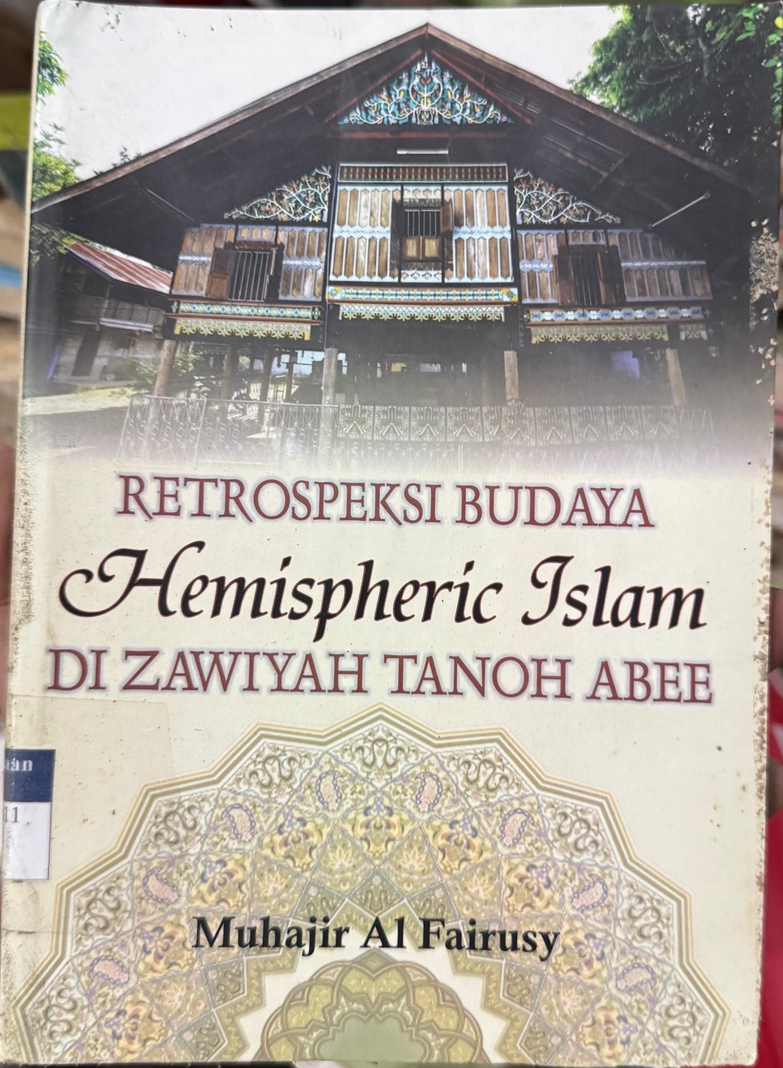
Retrospeksi Budaya Hemispheric Islam di Zawiyah Tanoh Abee by Muhajir Al Fairusy is an anthropological and historical study of the Dayah or Zawiyah of Tanoh Abee in Seulimeum, Aceh Besar, one of the oldest centres of Islamic education in Aceh, widely known for its collection of old manuscripts. The cover of this copy shows a colour photograph of a typical Acehnese wooden stilt house with a high gabled roof, dark plank walls, barred windows, and wood carvings with tendril and floral motifs painted white, blue, and green on the front and sides of the building. In front of the house is an ornamental iron fence, and on the left part of another building with a zinc roof and dense trees can be seen. The photograph fades into a cream background in the middle, where the title is printed in three lines: Retrospeksi Budaya in maroon capitals, Hemispheric Islam in large black cursive script, and Di Zawiyah Tanoh Abee again in maroon capitals. The lower part of the cover is decorated with a large medallion with geometric and floral motifs in a Persian or Ottoman style in gold, purple, and green, with the author's name printed above it in bold black serif type.
Muhajir Al Fairusy is an anthropologist from Aceh who studied anthropology at Universitas Gadjah Mada and later taught at the Sekolah Tinggi Agama Islam Negeri (State Islamic College) Teungku Dirundeng Meulaboh, West Aceh. He has written a number of articles on the dayah, traditional Islamic education, and Acehnese culture, and co-authored a book on Acehnese coffee-shop culture with Saiful Akmal. The name Al Fairusy that he uses recalls the al-Fairusi or al-Fairus al-Baghdadi family which, according to local tradition, founded and led the Dayah of Tanoh Abee across generations, but the author's personal connection with that family needs to be confirmed in the book's biography or preface.
The Dayah of Tanoh Abee occupies a special place in the history of Islam in Aceh. According to oral tradition and a number of historical studies, this institution was founded by descendants of a scholar originating from Baghdad and developed from the time of the Sultanate of Aceh Darussalam. In the nineteenth century, the dayah was led by the Teungku Chik of Tanoh Abee, one of whom was Syekh Abdul Wahab, known as a scholar and a figure in the resistance against the Dutch. Its manuscript library holds hundreds of Arabic and Jawi manuscripts on fiqh, tasawuf, tauhid, tafsir, hadith, and the linguistic sciences, so it is often referred to as one of the oldest Islamic libraries in Southeast Asia. In later periods, efforts to preserve the manuscripts were made by the dayah's custodians together with various institutions, including cataloguing and digitisation projects.
The term hemispheric Islam in the title suggests a perspective that places Tanoh Abee within an Islamic network stretching across hemispheres of the world, from the Middle East, Persia, and the Indian subcontinent to the Nusantara. By using the word retrospeksi (retrospective), the author appears to want to look back at the cultural traces formed by the encounter of global Islam with Acehnese local traditions, whether in the form of manuscripts, architecture, educational practices, scholarly genealogies, or religious rituals. An anthropological approach allows this zawiyah to be read not only as a historical site, but also as a living space where collective memory, religious authority, and the identity of a family of ulama are maintained. Chapter details, research methods, and field findings need to be checked directly in the contents of the copy.
The use of the word zawiyah, rather than simply dayah, is also worth noting. In the traditions of the Muslim world, zawiyah refers to a centre of a Sufi order or a place where Sufis gather to study and worship, and in North Africa the term is also used for religious educational institutions. By choosing this term, the author emphasises the Sufi dimension and the connection of Tanoh Abee with tarekat networks, particularly the Syattariyah, which has had great influence in Aceh and the Malay world since the time of Syekh Abdurrauf as-Singkili.
Comparative publication data recorded in the references of an article in Jurnal Ilmiah Islam Futura state that this book was published by Pustaka Larasan, a publisher in Denpasar, Bali, in 2014. The page count and ISBN cannot yet be confirmed from accessible catalogues. The year, printing, page count, and ISBN of the photographed copy still need to be checked against the copyright page.
For the study of Islam in Aceh and Southeast Asia, this book is relevant in several respects. It documents one of the most important institutions for the intellectual history of Aceh, at a time when many traditional dayah faced major changes due to conflict, the 2004 tsunami, the modernisation of education, and the formalisation of sharia. This book can also be read together with philological studies of the Tanoh Abee manuscripts, studies of the networks of Middle Eastern and Nusantara ulama, and research on the history of Sufi orders in Aceh. For courses on Islam in the Malay World and the Indian Ocean, Tanoh Abee is a concrete example of how Indian Ocean networks materialised in a local institution.
From the perspective of the anthropology of religion, the study of this zawiyah opens questions about the inheritance of religious authority within families of ulama, the relationship between manuscripts as sacred objects and manuscripts as sources of knowledge, and the ways the surrounding community gives meaning to that heritage. The wooden house architecture shown on the cover is also a reminder that material culture is an important part of the identity of the dayah, so the preservation of buildings is as important as the preservation of manuscripts.
As a critical note, a study written by a researcher who has close ties with the institution or family being studied has the advantages of access and insider understanding, but also risks presenting a narrative that tends towards glorification. Readers should pay attention to the extent to which the author distinguishes between oral tradition about Baghdadi origins and verifiable historical evidence, and how the term hemispheric Islam is defined and tested conceptually. In addition, because the publication data of this book are incomplete in accessible catalogues, information on the printing and edition needs to be traced further.
Nevertheless, this book is a valuable contribution to the literature on Aceh's Islamic heritage written by an Acehnese researcher with an anthropological perspective. Its presence enriches the documentation of an institution that has so far been known mostly through philological and historical studies, and provides material for efforts to preserve cultural and intellectual heritage in Aceh Besar.
The choice of a publisher in Bali for a study of a zawiyah in Aceh is also noteworthy, because it shows how academic publishing networks in Indonesia in the 2010s were no longer centred in Jakarta and Yogyakarta. Pustaka Larasan is known for publishing many studies of culture, local history, and anthropology, so the presence of this book among its titles places Tanoh Abee in a wider conversation about the cultural heritage of the Nusantara, not only within the scope of Islamic studies. For researchers, this information is useful for tracing the availability of the book in libraries outside Aceh and for understanding the readership the author envisaged.
In terms of collection documentation, this copy shows wear on the edges of the cover, especially on the right and bottom sides, as well as brownish stains on the lower left near the spine. A blue and white library label is affixed to the spine on the left side. This description is a curatorial introduction based on the cover and catalogue information, not a summary of the entire contents of the book.
Suitable search subjects include the Dayah of Tanoh Abee, zawiyah, traditional Islamic education in Aceh, Acehnese Islamic manuscripts, Indian Ocean ulama networks, the Syattariyah order, the anthropology of religion, and the history of Aceh Besar. For citation purposes, references should name the author, the full title, the publisher, the year, and the pages read directly in the copy.
- Rights
-
Koleksi pribadi KBA13 Academy