Kaukaba (tempat terbit belum diverifikasi) · Tahun, cetakan, jumlah halaman, dan ISBN eksemplar belum diperiksa. Rujukan pembanding: Banda Aceh: Kaukaba, t.t., jumlah halaman dan ISBN belum diketahui (belum diverifikasi pada halaman hak cipta eksemplar) · Tanpa tahun
Abstract
A book by two academics of UIN Ar-Raniry Banda Aceh, published by Kaukaba, which brings together three important keywords in the discourse on Aceh, namely ulama, separatism, and radicalism. Judging from its title and cover design, the book appears to examine the position of the ulama in the context of the conflict between the Gerakan Aceh Merdeka (Free Aceh Movement) and the Indonesian government, as well as in concerns about religious radicalism, drawing on the perspective of the anthropology of religion and studies of the dayah ulama. This theme is rooted in the long history of the role of the Acehnese ulama from the sultanate period, the colonial war, and Darul Islam, to the period after the Helsinki peace of 2005. Readers need to note how the book distinguishes or connects separatism and radicalism. The details of the content, chapter structure, place and year of publication, page count, and ISBN have not yet been examined and still need to be checked against the copyright page of the copy.
- Identifier
-
KBA-BKU-TT-0042
- Type
-
Buku
- Publisher
-
Kaukaba (tempat terbit belum diverifikasi)
- Date Issued
-
Tanpa tahun
- Bibliographic Citation
-
Tahun, cetakan, jumlah halaman, dan ISBN eksemplar belum diperiksa. Rujukan pembanding: Banda Aceh: Kaukaba, t.t., jumlah halaman dan ISBN belum diketahui (belum diverifikasi pada halaman hak cipta eksemplar)
- Creator
-
Kamaruzzaman Bustamam Ahmad
M. Hasbi Amiruddin
- LC Classification
-
DS646.15.A2 — Sejarah Aceh
- LCSH Subject
-
Ulama -- Indonesia -- Aceh
Islam and politics -- Indonesia -- Aceh
Radicalism -- Indonesia -- Aceh
Aceh (Indonesia) -- Politics and government
- BISAC Category
-
REL084000 RELIGION / Religion, Politics & State
- Language
-
Indonesia
- Description
-
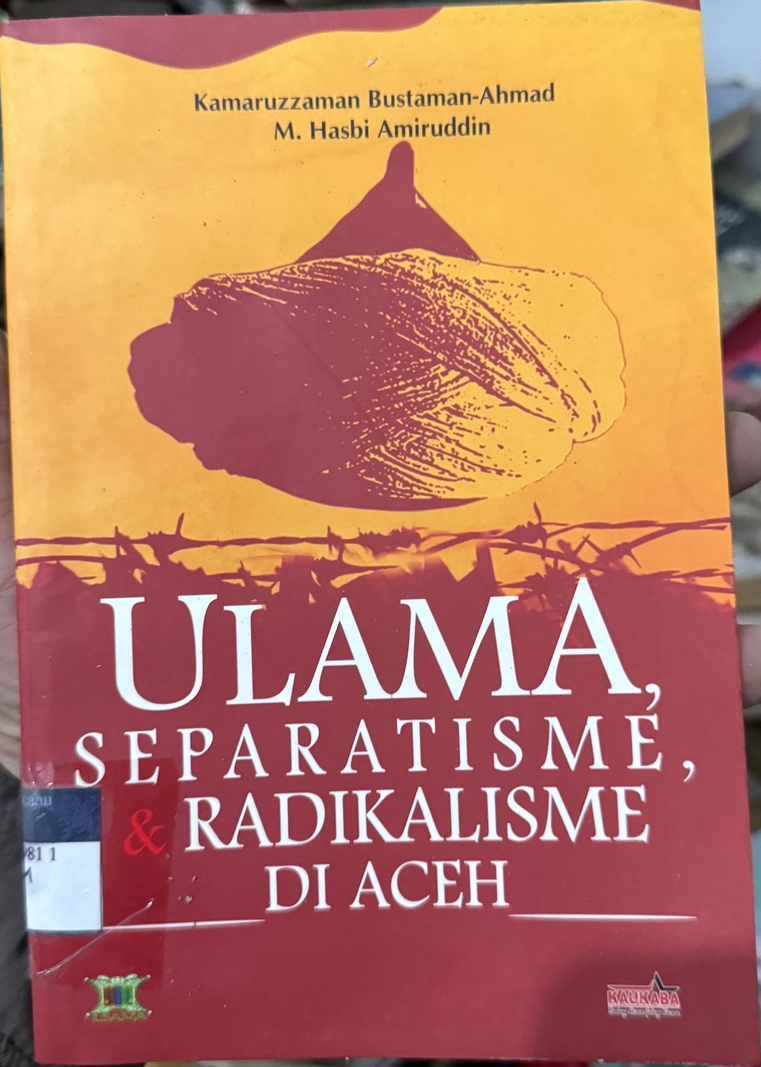
This copy is a paperback with a bold two-colour design, golden yellow in the upper part and maroon red in the lower part. The names of the two authors are printed in black letters at the top of the cover, with the spelling of the first author's name using a hyphen and the form Bustaman, which differs from the spelling commonly used in catalogues. The yellow field is dominated by a red silhouette in a rough print style resembling a kopiah or traditional head covering, a symbol readily associated with the figure of an ulama. Below it, a line of barbed wire stretches across and forms the boundary between the yellow field and the red field, as if marking an atmosphere of conflict and confinement. The title Ulama, Separatisme, & Radikalisme di Aceh is printed in large white capitals, with a red ampersand. In the lower left corner there is a green and yellow logo of an institution that cannot yet be identified from the photograph, while the logo of the publisher Kaukaba appears in the lower right corner.
Both authors come from the academic community of the Universitas Islam Negeri Ar-Raniry in Banda Aceh. The first author is an anthropologist of religion who completed doctoral studies in sociology at La Trobe University, Australia, and has written extensively on Islam in Southeast Asia, religious movements, and Acehnese culture. The second author, M. Hasbi Amiruddin, is a professor at the same university and is known for his studies of the dayah ulama, traditional Islamic education, and the role of the ulama in Acehnese society, including during the conflict. The combination of their backgrounds, between an anthropological approach and long experience researching dayah institutions, is an important asset for a book on a theme such as this.
The title of the book brings together three keywords that in public discourse are often treated as overlapping, namely ulama, separatism, and radicalism. Judging from the title and cover design, the book appears to examine how the position of the ulama in Aceh is read in the context of the armed conflict between the Gerakan Aceh Merdeka and the Indonesian government, as well as in concerns about the religious radicalism that grew stronger in Indonesia after the 2000s. The details of the content, the chapter structure, and whether the book is a single monograph or a collection of writings have not yet been examined in the copy, so the following description is more a placing in context than a summary of the content. The main questions commonly posed in studies on similar themes concern the extent to which the ulama were involved in, rejected, or were ambivalent towards the separatist movement, how the state and armed groups alike sought to co-opt or pressure the ulama, and whether there is a relationship between Acehnese religious tradition and the phenomenon of radicalism that has emerged at the national level.
The historical context of the book is very long. The ulama in Aceh have held a strong social position since the period of the sultanate, played an important role in the war against the Dutch, and came to the fore again in the Darul Islam upheaval of the 1950s under the leadership of Teungku Muhammad Daud Beureueh. When the Gerakan Aceh Merdeka emerged in 1976, the rhetoric of this movement emphasized ethnic nationalism and the history of Aceh's sovereignty more than a religious programme, so that the relationship between the ulama and the separatist movement became a complex matter. Some dayah ulama kept their distance, others were squeezed between the two armed parties, and some came into contact with the movement's networks. After the Helsinki peace agreement of 2005, attention shifted to the implementation of sharia, the role of the Majelis Permusyawaratan Ulama (Ulama Consultative Council), and the emergence of groups labelled radical, including the case of armed training in Aceh Besar in 2010, which attracted national attention.
On the map of studies of Aceh, the theme of the relationship between the ulama and politics has been discussed by a number of scholars, for example in classic studies of the ulama and the uleebalang (traditional aristocracy), studies of Darul Islam in Aceh, and studies of the separatist movement and Acehnese nationalism. This book makes a contribution from within, that is, from academics who live in Aceh and have direct access to dayah communities. Such a perspective is important because many international studies of the Aceh conflict focus more on political and military actors than on religious actors. For the study of Islam in Southeast Asia, the book can be compared with studies of the role of ulama in the conflicts in Pattani, Southern Thailand, and in Mindanao, the Southern Philippines, where religion, ethnicity, and demands for independence are also intertwined.
For the anthropology of religion, the keyword radicalism in the title opens space for discussion of how the term is used. The discourse of radicalism in Indonesia often arises from state security interests, so that its application to local religious communities can give rise to misunderstanding. A study grounded in field observation has the opportunity to show the differences between strict piety, a political attitude critical of the state, and organized violence. Distinctions of this kind are relevant for policymakers, especially in deradicalization and religious moderation programmes that have lately targeted religious educational institutions, including the dayah in Aceh.
As a critical note, combining three major themes in a single title carries risks. Separatism in Aceh and religious radicalism have different origins, actors, and aims, so readers need to pay attention to whether the book treats them as interrelated phenomena or as two separate problems that both concern the ulama. Readers also need to scrutinize the sources of data used, for example interviews, documents, or observation, as well as the period of the research, because the situation in Aceh changed rapidly before and after the peace. The absence of a year of publication in the references found adds to the importance of examining the copyright page in order to place the book accurately in the chronology of the debate. As the work of local academics, the book should also be read together with studies from outside Aceh in order to obtain a balanced picture.
The position of this book in the collection also has a documentary significance of its own. As a work written by academics directly involved in the intellectual life of Aceh, the book can be read not only as analysis, but also as a source on how local Islamic higher-education circles formulated the problems of the ulama, conflict, and radicalism in their time. Researchers who later trace the history of discourse on Aceh can use it to see the terms, frameworks, and concerns circulating among local intellectuals, and then compare them with the discourse constructed by security agencies, the national media, and foreign researchers. In this way, the book serves a dual function, as a study and at the same time as material for study.
Comparative publication data are still limited. An article in Jurnal Ilmiah Islam Futura cites this book with the information Banda Aceh, Kaukaba, without a year. The publisher Kaukaba, known in full as Kaukaba Dipantara, published many works by Acehnese academics in the early 2010s, but the place of publication, year, page count, and ISBN of this copy have not yet been found in a reliable catalogue. All of these data still need to be checked against the copyright page.
In terms of physical condition, this copy appears to be still in good condition, with a relatively clean cover and colours that are still bright. There is slight wear on the left edge and the corners of the cover. On the lower left of the front cover, near the spine, a blue and white library label is attached with a call number partly legible as ending in 81 1 and the letter M, but it cannot be read in full in the photograph. This note has been compiled as a curatorial introduction based on the cover and reference information, not a comprehensive summary of the content of the book.
Suitable search subjects include the ulama of Aceh, dayah ulama, the Gerakan Aceh Merdeka, separatism, religious radicalism, the Aceh conflict, Islam and politics in Aceh, and the Helsinki peace. For citation purposes, references should give the names of both authors, the full title, the publisher, the year, and the pages read directly in the copy.
- Rights
-
Koleksi pribadi KBA13 Academy
How to cite
Kamaruzzaman Bustamam Ahmad, M. Hasbi Amiruddin, “Ulama, Separatisme, & Radikalisme di Aceh [Ulama, Separatism, & Radicalism in Aceh]”, Kaukaba (tempat terbit belum diverifikasi), Tahun, cetakan, jumlah halaman, dan ISBN eksemplar belum diperiksa. Rujukan pembanding: Banda Aceh: Kaukaba, t.t., jumlah halaman dan ISBN belum diketahui (belum diverifikasi pada halaman hak cipta eksemplar). KBA13 Academy Archive and Library, KBA-BKU-TT-0042.