Pelanduk Publications, Subang Jaya · Tahun, cetakan, jumlah halaman, dan ISBN eksemplar belum diperiksa. Rujukan pembanding: Subang Jaya: Pelanduk Publications, 2002, cetakan pertama, 236 hlm., indeks, 21 cm, ISBN 967-978-818-0 (978-967-978-818-1) (belum diverifikasi pada halaman hak cipta eksemplar) · Tanpa tahun
Abstract
A collection of selected speeches by Mahathir Mohamad, Prime Minister of Malaysia, edited by Hashim Makaruddin and published by Pelanduk Publications in 2002. These speeches contain Mahathir's critique of economic and cultural globalisation as practised by the developed countries and international financial institutions, against the background of the experience of the 1997–1998 Asian financial crisis, his condemnation of currency speculators, his rejection of the IMF's prescriptions, and Malaysia's capital-control policy. Mahathir does not reject globalisation entirely, but demands a just order, South-South cooperation, smart partnership, and room for small countries to protect their sovereignty. As a primary source, this book is useful for the study of the political economy of Southeast Asia, economic nationalism, the discourse of Asian values, relations between the Islamic world and the West, and comparisons of the responses of Malaysia and Indonesia to the crisis, with the caveat that its contents reflect the official viewpoint of the government then in power.
Identifier
KBA-BKU-2002-0002
Type
Buku
Publisher
Pelanduk Publications, Subang Jaya
Date Issued
Tanpa tahun
Bibliographic Citation
Tahun, cetakan, jumlah halaman, dan ISBN eksemplar belum diperiksa. Rujukan pembanding: Subang Jaya: Pelanduk Publications, 2002, cetakan pertama, 236 hlm., indeks, 21 cm, ISBN 967-978-818-0 (978-967-978-818-1) (belum diverifikasi pada halaman hak cipta eksemplar)
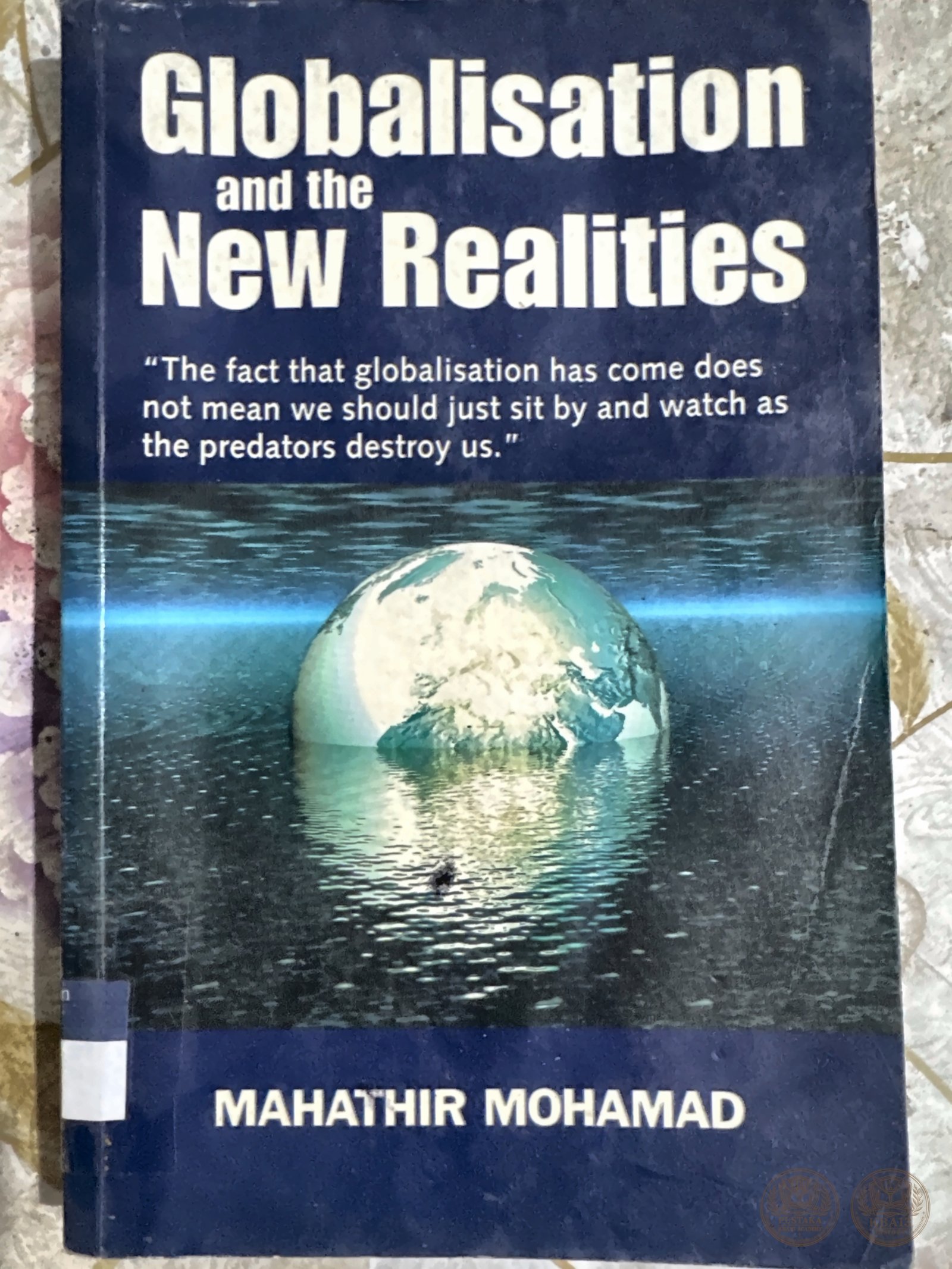
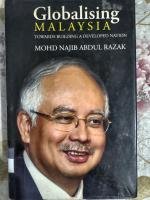
Globalisation and the New Realities is a collection of selected speeches by Mahathir Mohamad, Prime Minister of Malaysia, edited by Hashim Makaruddin and published by Pelanduk Publications in Subang Jaya, Selangor, in 2002. Library catalogues record its full subtitle as selected speeches of Dr. Mahathir Mohamad, Prime Minister of Malaysia. The book belongs to a series of collections of Mahathir's speeches compiled and published towards the end of his first tenure, when the issue of globalisation, the Asian financial crisis, and the position of developing countries in the world economic order were at the centre of his attention. The cover of this copy is dark blue. The title is printed in bold white letters at the top, followed by a quotation from the book which in essence states that the arrival of globalisation does not mean that we must stand by silently watching the predators destroy us. The centre of the cover shows an image of a pale greenish globe half-submerged in a dark sea surface, with a reflection of light on the water and a small dot resembling a boat in the middle. The name Mahathir Mohamad is printed in white capital letters on a blue band at the bottom.
Mahathir Mohamad was born in Alor Setar, Kedah, in 1925. He was trained as a physician at the King Edward VII College of Medicine in Singapore, and then practised as a doctor before entering politics through UMNO. His book The Malay Dilemma, published in 1970, provoked controversy and was for a time banned in Malaysia, but later became an important reference for his views on the economic position of the Malays. He served as Prime Minister of Malaysia from 1981 to 2003, and held the office again in 2018–2020. During his first tenure, Malaysia experienced rapid industrialisation, major infrastructure development such as the Petronas Twin Towers and the Multimedia Super Corridor, and the implementation of the Look East policy, which made Japan and South Korea models of work ethic and development. Mahathir was also known as an outspoken voice of the countries of the South in international forums, from the Non-Aligned Movement and the Organisation of Islamic Cooperation to Asia-Pacific economic forums.
The editor of this book, Hashim Makaruddin, is recorded in catalogues as the editor of a number of other collections of Mahathir's speeches published by Pelanduk, for example collections on globalisation, smart partnership, and governance. Some booksellers state that these publications were prepared in cooperation with the prime minister's office, although this information needs to be checked against the title page and foreword of the copy. The speeches in collections of this kind were generally delivered at international conferences, business forums, diplomatic meetings, and academic events, and then edited without much change to their content, so that this book is more properly read as a primary source on Mahathir's political thought and rhetoric than as a systematically structured academic work.
The main theme of the book, as is apparent from the title, the cover quotation, and booksellers' notes, is a critique of economic and cultural globalisation as practised by the developed countries and international financial institutions. Mahathir sees globalisation not as a neutral process but as an order whose rules of the game are set by the powerful, so that it can turn into a new form of colonialism if developing countries are not vigilant. Some booksellers even summarise his view as the belief that globalisation is westernisation by another name. The experience of the 1997–1998 Asian financial crisis forms an important background to this stance. At that time, Mahathir condemned currency speculators and hedge-fund traders, rejected the structural adjustment prescriptions of the International Monetary Fund, and then imposed capital controls and pegged the ringgit to the US dollar in September 1998. These policies were at first sharply criticised by many Western economists, but were later assessed more evenly by some because Malaysia was able to recover without an IMF loan. The phrase "new realities" in the title can be read as Mahathir's effort to make his audiences aware that the post-Cold War and post-crisis world demands new strategies for developing countries, including South-South cooperation, reform of the international financial architecture, and the strengthening of national capacity.
The quotation on the cover shows Mahathir's characteristic stance: he does not reject globalisation entirely, but demands that globalisation be regulated fairly and that small countries have room to protect themselves. This view is in line with the idea of smart partnership that he promoted, namely cooperation between government, the private sector, and developing countries on the principle of mutual benefit. In the context of the year of publication, the speeches on globalisation also intersect with the issue of international terrorism after the events of 11 September 2001, relations between the Islamic world and the West, and the position of Muslims in the world order. The list of speeches included and the dates on which they were delivered should be checked directly in the table of contents of the copy.
Catalogue data that can be used for comparison indicate that the book was published in Subang Jaya by Pelanduk Publications in 2002, first printing, 236 pages with an index, 21 centimetres in size, with ISBN 967-978-818-0 or 978-967-978-818-1. The catalogue of the Technical University of Munich Library records LCCN 2002348061, while the INTAN catalogue in Malaysia records the subjects globalisation, international relations, and speeches and lectures. The printing, year, and ISBN data of the photographed copy still need to be checked against the copyright page.
For Southeast Asian studies, this book is relevant as a document of the discourse of development and economic nationalism in Malaysia at the turn of the century. Mahathir's views on Asian values, economic sovereignty, and his critique of Western domination influenced public debate in the region, including in Indonesia, which at the same time was undergoing political reform and an economic recovery programme under IMF supervision. The comparison between the Malaysian path and the Indonesian path in facing the 1997–1998 crisis has become an important theme in studies of the region's political economy, and this book provides a direct voice from one of its principal figures. For Islamic studies, Mahathir's speeches also show how the leader of a Muslim-majority country formulated modernisation, scientific progress, and economic self-reliance as part of the revival of the ummah. For readers in Aceh, this discourse is of interest because the historical, economic, and diasporic ties between Aceh and the Malaysian Peninsula are very close, and the Malaysian development model is often used as a point of comparison in discussions of development in Aceh.
As a critical note, a collection of speeches by a sitting head of government naturally reflects the official viewpoint and political interests of the government. Mahathir's anti-Western rhetoric is often judged to have been effective for domestic consumption and for building Malaysia's image in the Global South, but his domestic critics highlight problems of governance, restrictions on civil liberties, the use of the Internal Security Act, and the political crisis that accompanied the dismissal of Anwar Ibrahim in 1998. Readers are advised to read this book together with academic studies of Malaysia's political economy, for example Khoo Boo Teik's work on Mahathir's thought, so that the rhetoric of the speeches can be tested against independent data and analysis.
In terms of collection documentation, this copy shows fairly clear wear on the edges of the cover, rounded corners, and fine scratches on the surface. On the left side of the spine there is a blue and white library label. This description is a curatorial introduction based on the cover and catalogue information, not a summary of the entire contents of the book.
Suitable search subjects include Mahathir Mohamad, globalisation, the 1997–1998 Asian financial crisis, the political economy of Malaysia, international relations, developing countries and the world economic order, and political speeches. For citation purposes, references should state the name of the author, the editor, the full title, the publisher, the year, and the pages read directly in the copy.
Mahathir Mohamad, Hashim Makaruddin (penyunting), “Globalisation and the New Realities”, Pelanduk Publications, Subang Jaya, Tahun, cetakan, jumlah halaman, dan ISBN eksemplar belum diperiksa. Rujukan pembanding: Subang Jaya: Pelanduk Publications, 2002, cetakan pertama, 236 hlm., indeks, 21 cm, ISBN 967-978-818-0 (978-967-978-818-1) (belum diverifikasi pada halaman hak cipta eksemplar). KBA13 Academy Archive and Library, KBA-BKU-2002-0002.