Abstract
This monograph examines the dynamics involved in implementing Islamic law in Southeast Asia, and how this issue has become a source of conflict in Kelantan, Malaysia and Aceh, Indonesia. Using textual and fieldwork methodology, the study compares and contrasts the collective experience of trying to apply Islamic law in these two locations.
In both Kelantan and Aceh, Islamic law was first developed in the thirteenth century with the coming of Islam to the region, but was later replaced by colonial legal systems, and then by the jurisprudence of national governments following independence. Reinstituting Islamic law has become a dominant political issue in both countries.
Through an analysis of the conditions that have made the emergence of Islamic law in Kelantan and Aceh possible, the author helps extend previous studies on this issue by providing a sociological understanding of religious law as a source of both conflict and identity.
- Identifier
-
KBA-BKU-2010-0001
- Type
-
Buku
- Publisher
-
Silkworm Books
- Date Issued
-
2010-08-27
- Bibliographic Citation
-
Paperback; 88 halaman; ISBN 978-9749511091
- Creator
-
Kamaruzzaman Bustamam Ahmad
- LC Classification
-
KBP — Hukum Islam
- LCSH Subject
-
Islamic law
Islamic law -- Malaysia -- Kelantan
Islamic law -- Indonesia -- Aceh
- BISAC Category
-
LAW119000 LAW / Islamic
- Language
-
Inggris
- Description
-
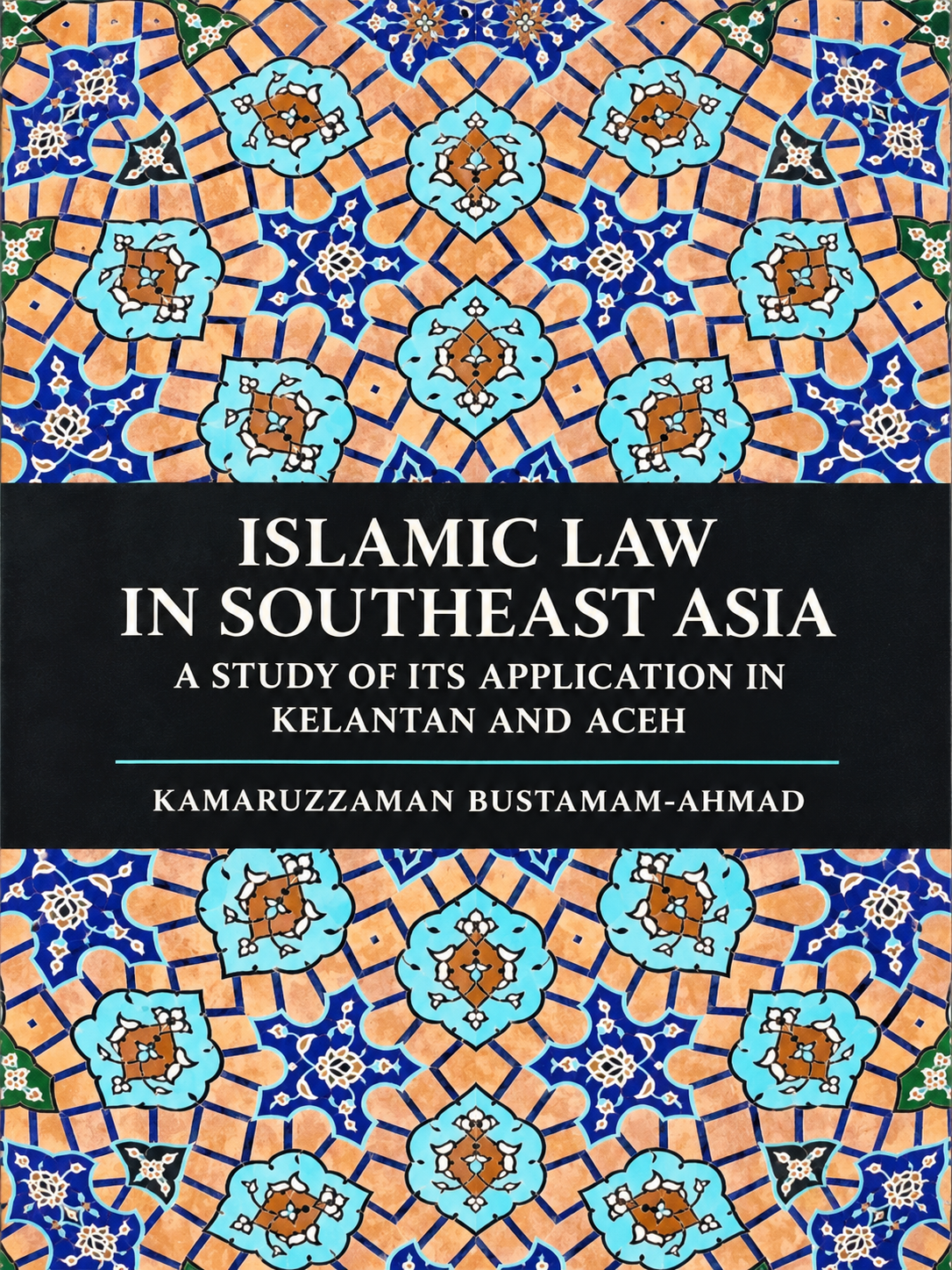
Islamic Law in Southeast Asia: A Study of Its Application in Kelantan and Aceh is a monograph by Kamaruzzaman Bustamam-Ahmad published by Silkworm Books, Chiang Mai, in October 2009 as part of a series of publications on Islam in Southeast Asia. According to the publisher's data, the book measures 14 × 21 centimetres, runs to 88 pages (x + 78 pages), and carries the ISBN 978-974-9511-09-1. The cover shown in this entry displays a Persian-style geometric tile pattern in dark blue, light blue, earthy orange, and green, with a black band in the middle bearing the title in capital letters, the subtitle, and the author's name. This note has been prepared as a curatorial introduction based on the cover and the publisher's data; it is not intended as a summary of the entire contents of the book.
The central problem the book addresses is the dynamics of implementing Islamic law in Southeast Asia and the way this issue has become a source of political tension in two regions: Kelantan in Malaysia and Aceh in Indonesia. The two regions were chosen because both have a long history of relations among Islam, local power, and regional identity. The author combines textual study with fieldwork to compare the collective experience of communities in their efforts to enforce Islamic law. This comparative approach is important because it shows that demands for the application of sharia do not arise in a vacuum, but are rooted in the history, state structure, and political struggles of each place.
The publisher's description emphasises a similar historical trajectory in both regions. Islamic law developed in Kelantan and Aceh from the arrival of Islam in the region around the thirteenth century. Later, during the colonial period, the position of Islamic law was displaced by the legal systems brought by British and Dutch rule. After independence, the national legal systems of Malaysia and Indonesia took over that role. In subsequent developments, demands to revive Islamic law became a dominant political issue in both countries. This trajectory gives readers a framework for understanding why debates about sharia are often intertwined with questions of regional autonomy, centre–region relations, and the legitimacy of power.
In Kelantan, the debate is closely tied to the role of the Pan-Malaysian Islamic Party (Partai Islam Se-Malaysia, PAS), which governed the state, and its efforts to enact the Syariah Criminal Code Enactment (Enakmen Kanun Jenayah Syariah), including hudud provisions, within a Malaysian federal system that limits the authority of the states in the field of criminal law. In Aceh, the implementation of Islamic sharia has taken place within the framework of special autonomy granted by the central government, particularly since the enactment of the laws on special status and special autonomy in 1999 and 2001, and it was further strengthened after the 2005 Helsinki peace agreement. Comparing these two paths helps readers see the difference between sharia implementation pursued through party politics at the state level and sharia implementation granted as part of conflict resolution and decentralisation.
The book's main contribution lies in its sociological reading of religious law as a source of both conflict and identity. The author does not treat Islamic law merely as a set of norms, but as an arena in which various groups negotiate power, honour, and a sense of togetherness. Within this framework, sharia can function as a symbol of regional pride, an instrument of political mobilisation, and a basis for moral claims against the state. At the same time, it can also give rise to tensions with groups holding different views, both within and outside the Muslim community. Readers can use this perspective to assess debates about sharia elsewhere in Southeast Asia.
The book also reflects its author's academic journey. When the book was published, Kamaruzzaman Bustamam-Ahmad was pursuing doctoral studies at La Trobe University, Australia, with a focus on Islamic revival and radicalism in Southeast Asia. He had previously written Wajah Baru Islam di Indonesia (UII Press, 2004) and completed a master's degree in sharia at Universiti Malaya, Kuala Lumpur. His dual background in Aceh and Malaysia gave him familiarity with both research sites. For this reason, the book can be read as part of a series of the author's works that later developed into studies of Acehnology, hukum jinayah (Islamic criminal law), and Islamic studies in the Malay world.
In the Pustaka KBA13 Academy collection, this book is closely related to several other materials, such as Pemberlakuan Hukum Jinayah di Aceh dan Kelantan and Punishment in Islamic Law: An Enquiry into the Hudud Bill of Kelantan. The three can be read side by side to trace the development of the debate on Islamic criminal law in the two regions from the mid-1990s to the following decade. Comparison among these materials helps students see how the analytical framework shifted from normative studies of hudud towards sociological studies of legal implementation, identity, and local politics.
For learning activities, the book can be used in courses on Islamic law, the sociology of law, the anthropology of religion, Southeast Asian politics, and comparative legal studies. Students can construct a comparative table covering the legal basis, the main actors, the implementing institutions, and community responses in Kelantan and Aceh. They can also ask how Malaysia's federal system and Indonesia's system of decentralisation shape the room for manoeuvre in implementing sharia. Questions of this kind encourage a reading that does not stop at the general conclusion that both regions apply sharia, but attends to the differences in mechanisms and their consequences.
A critical reading also needs to take into account the time limits of the research. The book was published in 2009, so later developments, such as the enactment of the Qanun Jinayat of Aceh in 2014 and continuing debates about hudud in Malaysia, lie outside the scope of its discussion. Readers who wish to use the book for contemporary studies should supplement it with more recent sources. In this way, the book retains its value as an analytical portrait of its time as well as a point of comparison for observing the changes that occurred afterwards.
In terms of documentation, the cover image in this entry is an AI-processed version used to clarify the display. Small details such as texture, colour, and signs of use cannot be taken as evidence of the physical condition of the copy. The author's name on the cover is written Kamaruzzaman Bustamam-Ahmad with a hyphen, following the spelling in this publication, while the Pustaka KBA13 Academy catalogue records the author's name as Kamaruzzaman Bustamam Ahmad. This difference in spelling should be borne in mind when searching for the book in other library catalogues or citation databases.
Suitable search subjects include Islamic law, Islamic sharia, Kelantan, Aceh, Southeast Asia, hukum jinayah, hudud, special autonomy, and identity politics. For citation purposes, references should give the author's name as printed, the full title, Silkworm Books, Chiang Mai, the year 2009, and the pages consulted directly. As a work born of research experience in two kindred countries, the book invites readers to see Islamic law not only as text, but as a living part of the history, politics, and identity of Muslim societies in Southeast Asia.
The presence of this book in the collection also shows how studies of Aceh and Kelantan were written from the outset in English for an international readership, so that the local experiences of the two regions entered the global academic conversation about Islam, the state, and law in the Muslim world.
- Rights
-
Koleksi pribadi KBA13 Academy