Periplus Editions (seri Periplus Classics) · Tahun cetak eksemplar belum diketahui; halaman hak cipta belum diperiksa. Terbit pertama kali pada 1937 oleh Alfred A. Knopf, New York. Periplus Editions menerbitkan ulang karya ini antara lain pada 1999 (ISBN 962-593-060-4) dan pada 2008 dengan pengantar Adrian Vickers (ISBN 978-0-7946-0562-9). Identifikasi edisi didasarkan pada sampul dan punggung buku bertanda Periplus Classics. · Tanpa tahun
Abstract
A classic ethnography by the Mexican painter, caricaturist and ethnologist Miguel Covarrubias (1904–1957), first published in 1937, that portrays Bali as an integrated way of life: landscape and wet-rice agriculture, village and banjar organisation, the family, everyday life, art and artists, drama, music and dance, religion, magic and the rites of death. It grew out of Covarrubias's direct observation while living in Bali in the early 1930s and is enriched by his own drawings and paintings. The copy in this collection is a Periplus Classics reprint whose cover reproduces a Covarrubias painting of four Balinese women carrying offerings on their heads. The book remains a foundational reference, and an object of critique, in studies of how Bali came to be imagined in the West.
Identifier
KBA-BKU-TT-0043
Type
Buku
Publisher
Periplus Editions (seri Periplus Classics)
Date Issued
Tanpa tahun
Bibliographic Citation
Tahun cetak eksemplar belum diketahui; halaman hak cipta belum diperiksa. Terbit pertama kali pada 1937 oleh Alfred A. Knopf, New York. Periplus Editions menerbitkan ulang karya ini antara lain pada 1999 (ISBN 962-593-060-4) dan pada 2008 dengan pengantar Adrian Vickers (ISBN 978-0-7946-0562-9). Identifikasi edisi didasarkan pada sampul dan punggung buku bertanda Periplus Classics.
DS647.B2 — Bali: deskripsi, kehidupan sosial dan adat
LCSH Subject
Bali Island (Indonesia) -- Social life and customs; Bali Island (Indonesia) -- Description and travel
BISAC Category
SOC002010 SOCIAL SCIENCE / Anthropology / Cultural & Social
Spatial Coverage
BaliIndonesia
Language
Inggris
Description
Island of Bali by Miguel Covarrubias is one of the most influential books ever written about Bali, and at the same time one of the most important documents of how the outside world learned to look at the island. Covarrubias was born in Mexico City in 1904 and died in 1957. He was widely known as a caricaturist for New York magazines such as Vanity Fair and The New Yorker, as a painter and illustrator, and later as an ethnologist and specialist in pre-Columbian art. With his wife, the dancer and photographer Rosa Rolanda, he first came to Bali in 1930 on their honeymoon, then returned in 1933 with the support of a Guggenheim fellowship to stay longer, observe, draw and take notes. The outcome of that stay was published in New York by Alfred A. Knopf in 1937 under the title Island of Bali, and the book has hardly gone out of circulation since.
The strength of the book lies in the way it treats Bali as a single, interconnected way of life. Covarrubias does not stop at the scenery or the ceremonies that dazzle travellers. He moves from the island's geography, its brief history and the origins of its people, to village organisation, the banjar system, rice fields and the subak irrigation societies, the family and everyday life, and on into art, drama, music, dance, religion, magic and the rites of death. This arrangement reflects his basic conviction that Balinese art cannot be understood apart from work in the fields, customary obligations and the ritual calendar. Art, in his portrayal, is part of ordinary communal life rather than the pursuit of a few individuals detached from society.
The book also grew out of a distinctive intellectual milieu. In the 1930s Bali became a meeting point for a number of foreign artists and researchers, among them the German painter Walter Spies, the Canadian composer Colin McPhee, the American researcher Jane Belo, and the anthropologists Margaret Mead and Gregory Bateson. Covarrubias moved closely within this circle and owed much to Spies's knowledge of Balinese art and village life. Island of Bali can therefore be read as one of the liveliest summaries of that circle's collective knowledge of Bali, written in a freer and more personal style than a purely scholarly report.
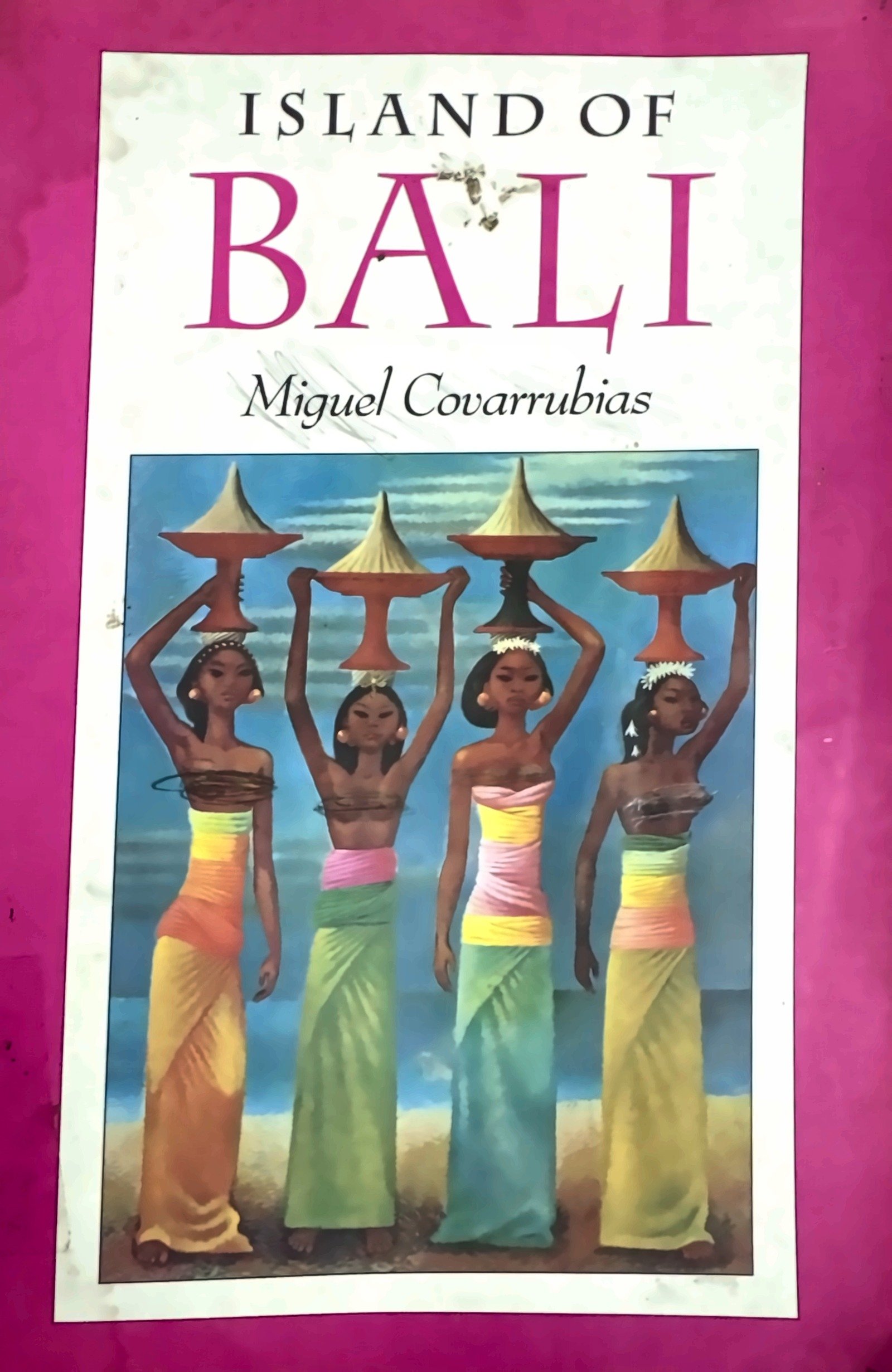
Its visual dimension is another feature that makes the book exceptional. Covarrubias himself produced dozens of line drawings, maps and diagrams, as well as several colour paintings, and editions of the book also carry black-and-white photographs and drawings by Balinese artists. The cover of the copy in this collection reproduces one of his paintings: four Balinese women standing in a row on a beach, wrapped in layered cloth of yellow, orange, pink and green, each balancing a covered offering on her head. The painting shows Covarrubias's style, which blends ethnographic observation with modernist stylisation: elongated figures, bold colour and an almost decorative composition. Images of this kind helped shape the visual icon of Bali that circulated in the West for decades afterwards.
In the history of scholarship on Bali the book holds an ambivalent position. On one hand it is a pioneering work that introduced the complexity of Balinese society to a wide readership with a sympathy and care rarely found in the travel writing of its time. On the other hand, later scholars, including Adrian Vickers in Bali: A Paradise Created, have shown how the writings of the 1930s circle helped build the image of Bali as a harmonious, artistic paradise apparently standing outside history. That image tended to overlook colonial tensions, poverty, caste conflict and the political violence that were also part of Bali's twentieth-century experience. To read Island of Bali today is to read both a rich ethnographic source and a document of the birth of touristic orientalism.
For anthropology in Indonesia the book remains valuable for several reasons. First, it records village life, art and ritual in late-colonial Bali in a detail hard to find in other English-language sources. Second, it shows how an artist's method of observation can produce serious ethnographic knowledge, which makes it relevant to debates about the boundaries between art, travel and science. Third, it offers material for comparing Bali with other societies of the archipelago, for instance on the relations between custom, religion and the state, or on how a regional culture is presented to the outside world. Such comparison also matters for the study of Aceh and other regions whose image was likewise shaped by foreign writing in the colonial period.
The copy in this collection is a reprint in the Periplus Classics series. Periplus Editions has brought the work back into print several times, including in 1999 and in 2008, the latter with a foreword by Adrian Vickers that places the book in context for present-day readers. The printing year of this copy has not yet been confirmed because its copyright page has not been examined, so the catalogue records it as undated. The cover shows ordinary signs of use, such as a small stain above the title, pencil marks around the author's name, and a library label on the spine. The cover image shown here has been straightened, cleared of the photographic background and colour-corrected without altering its content or those marks of use.
For classification, the book is placed in Library of Congress class DS647.B2 for Bali within the history and description of Southeast Asia, with the subject headings Bali Island (Indonesia) -- Social life and customs and Bali Island (Indonesia) -- Description and travel. In BISAC it is grouped under SOC002010, Social Science / Anthropology / Cultural & Social. This dual classification reflects the book's position at the crossroads of ethnography, cultural history and travel writing.
Users of the archive can draw on Island of Bali along several lines of inquiry. Scholars of the anthropology of art can trace Covarrubias's idea of art as communal practice. Scholars of religion can read his account of rituals, temples and death rites as a portrait of Balinese Hinduism before its standardisation by the Indonesian state. Scholars of tourism and representation can use it as a key text for understanding the origins of the image of Bali as paradise. Intellectual historians can compare it with the work of Mead, Bateson, Belo and McPhee to see how one small island became a great laboratory for world anthropology. Along each of these lines the book is most useful when read critically, valuing the richness of its observation without simply accepting the romantic frame that surrounds it.
The presence of this book in the Arsip dan Pustaka KBA13 Academy complements the collection's existing holdings on Bali, including a political history of nineteenth-century Bali and a study of Muslim communities on the island. Together these holdings allow readers to see Bali from several angles: as a set of kingdoms confronting Dutch colonialism, as a plural society in which Muslim communities live alongside a Hindu majority, and as the object of the gaze of foreign artists and researchers. This catalogue description has been compiled from the cover of the copy, publisher information and general bibliographic references, and may be updated once the title page and copyright page have been examined directly.
Miguel Covarrubias, “Island of Bali”, Periplus Editions (seri Periplus Classics), Tahun cetak eksemplar belum diketahui; halaman hak cipta belum diperiksa. Terbit pertama kali pada 1937 oleh Alfred A. Knopf, New York. Periplus Editions menerbitkan ulang karya ini antara lain pada 1999 (ISBN 962-593-060-4) dan pada 2008 dengan pengantar Adrian Vickers (ISBN 978-0-7946-0562-9). Identifikasi edisi didasarkan pada sampul dan punggung buku bertanda Periplus Classics.. KBA13 Academy Archive and Library, KBA-BKU-TT-0043.