Pergolakan Politik Islam: Dari Fundamentalisme, Modernisme hingga Post-Modernisme [Upheavals in Islamic Politics: From Fundamentalism and Modernism to Post-Modernism]
Paramadina, Jakarta · Paramadina, Jakarta, 1996 (tahun terbit menurut keterangan pemilik koleksi); penyunting Abas Al-Jauhari; xii + 277 halaman; 21 cm; ISBN 979-8321-10-3 (menurut katalog perpustakaan, belum diverifikasi pada eksemplar). Sampul mencantumkan nama pengarang sebagai Dr. Azyumardi Azra dan logo Paramadina. · 1996
Abstract
A collection of studies by Azyumardi Azra (1955–2022), the Indonesian Muslim historian and public intellectual, published by Paramadina in Jakarta and edited by Abas Al-Jauhari. As its subtitle indicates, the book traces the upheavals of Islamic politics through three broad currents: fundamentalism, modernism and post-modernism. Azra reads the resurgence of political Islam in the Muslim world and in Indonesia as a diverse historical phenomenon rather than a single bloc, and weighs the relations between Islamic movements, the state and modernity. Published in the mid-1990s, when debates about fundamentalism, democracy and the future of political Islam were intensifying ahead of the fall of the New Order, it is an important reading for the study of Indonesian Islamic political thought.
Identifier
KBA-BKU-1996-0002
Type
Buku
Publisher
Paramadina, Jakarta
Date Issued
1996
Bibliographic Citation
Paramadina, Jakarta, 1996 (tahun terbit menurut keterangan pemilik koleksi); penyunting Abas Al-Jauhari; xii + 277 halaman; 21 cm; ISBN 979-8321-10-3 (menurut katalog perpustakaan, belum diverifikasi pada eksemplar). Sampul mencantumkan nama pengarang sebagai Dr. Azyumardi Azra dan logo Paramadina.
Islam and politics; Islamic fundamentalism; Islamic modernism; Postmodernism -- Religious aspects -- Islam
BISAC Category
REL037000 RELIGION / Islam / General
Spatial Coverage
IndonesiaDunia MuslimTimur Tengah
Language
Indonesia
Description
Pergolakan Politik Islam: Dari Fundamentalisme, Modernisme hingga Post-Modernisme (Upheavals in Islamic Politics: From Fundamentalism and Modernism to Post-Modernism) is one of Azyumardi Azra's early books, and one that introduced him to a broad Indonesian readership as an interpreter of political Islam rather than only as the historian of scholarly networks. Azra was born in Lubuk Alung, West Sumatra, in 1955 and died in 2022. He studied at IAIN Syarif Hidayatullah in Jakarta and earned his doctorate at Columbia University with a dissertation on the networks linking Middle Eastern and Malay-Indonesian scholars in the seventeenth and eighteenth centuries. He later led IAIN Jakarta and steered its transformation into a State Islamic University, and throughout his life he was regarded as one of the most influential voices of moderate Islam in Indonesia. On the cover of this copy his name still appears as Dr. Azyumardi Azra, a marker of the early stage of his academic career before he became a professor.
The book was published by Paramadina, the institution founded by Nurcholish Madjid and his colleagues in 1986, which became one of the centres of the movement for renewal of Islamic thought in Jakarta. Publication under the Paramadina imprint places the book within an intellectual current that stresses openness, rationality and the compatibility of Islam with democracy and pluralism. According to library catalogue data, the book appeared in 1996, edited by Abas Al-Jauhari, with roughly xii and 277 pages. Its character as an anthology can be seen in the way it gathers Azra's writings on various aspects of Islamic politics into a single thematic framework.
That framework is stated plainly in the subtitle: from fundamentalism and modernism to post-modernism. These three terms are not mere labels but a way of mapping Muslim responses to modernity and the modern state. Fundamentalism refers to movements that seek to return literally to the basic sources of Islam and often reject a secular political order. Modernism refers to efforts to reinterpret Islamic teaching so that it accords with science, rationality and modern political institutions. Post-modernism refers to a situation in which the grand narratives of modernity are themselves called into question, opening space for new readings of tradition, identity and religious revival. By laying out all three in one book, Azra invites readers to see Islamic politics as a dynamic field of struggle rather than something static and uniform.
One important contribution of the book is its effort to unpack the overly loose use of the term fundamentalism, particularly in Western discourse. Azra tends to emphasise that the Islamic resurgence has many faces and many causes, ranging from the failures of postcolonial state-building and social inequality to crises of identity and the influence of major events such as the Iranian Revolution. The book is therefore useful for understanding that a single label can conceal movements that differ greatly in their aims, methods and social bases. The historical approach that characterises Azra's work makes him more interested in context and process than in generalisation.
The context of the book's publication also matters. The mid-1990s were a time when the New Order was still in power but beginning to show signs of fragility. At the same time, relations between the state and Indonesian Muslims were shifting, marked among other things by the founding of the Indonesian Association of Muslim Intellectuals in 1990 and the growing presence of Islamic symbols in public life. Globally, debates over the clash of civilisations, the rise of political Islam in Algeria, Egypt, Iran and Afghanistan, and the question of whether Islam is compatible with democracy were at their height. Azra's book entered these debates with a calm, historically grounded voice that sought to connect Indonesian readers with international scholarship on political Islam.
For today's readers the book can be read as an important document of how Indonesian Muslim intellectuals understood the Islamic world before the Reformasi of 1998. Many of the themes it discusses became more concrete after Reformasi, such as the emergence of Islamic parties, debates over implementing sharia, transnational movements and violence in the name of religion. Reading the book lets one see how some of these tendencies had already been recognised and analysed early on, and judge where the expectations of that time proved accurate and where reality moved in other directions.
The book is relevant to the study of Aceh as well. The implementation of Islamic law in Aceh since the early 2000s is often discussed in terms of fundamentalism, formalism or the Islamisation of the state. Azra's framework of diverse Muslim responses to modernity helps readers avoid being trapped in a single label. The Acehnese experience can be read as a combination of identity claims, a history of conflict, negotiation with the state and local scholarly traditions, none of which a single term can adequately explain. In this sense the book offers a useful theoretical starting point for students and researchers examining the relations between religion, law and politics in Aceh.
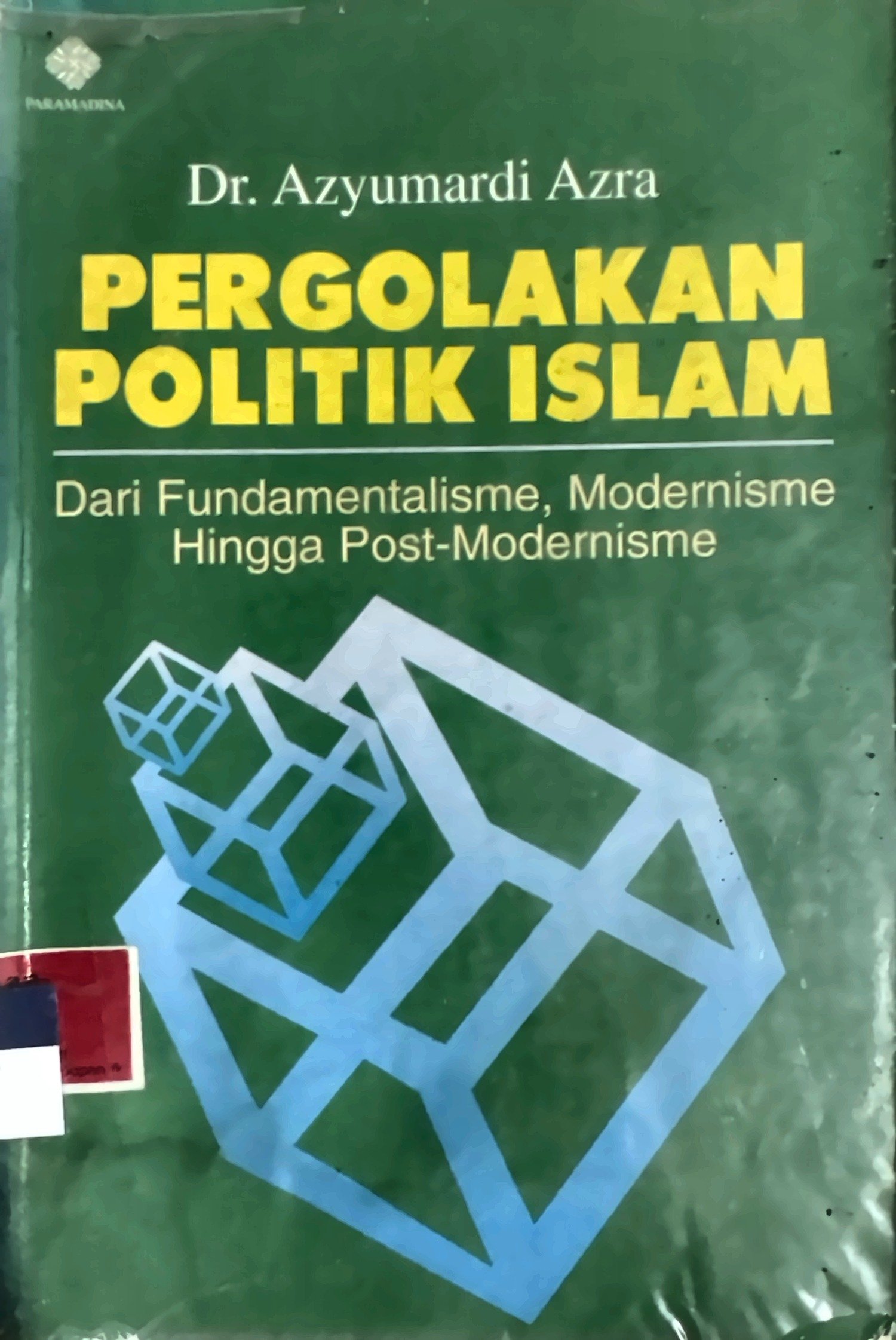
The copy in this collection has a green cover with the title in bold yellow letters and the subtitle in cream, accompanied by a geometric illustration of light-blue cubes stacked on one another. The Paramadina logo appears in the upper left corner and a library label is attached at the lower left of the cover. The cover is wrapped in a protective plastic film, which gives it a slight sheen and texture. The image shown here has been straightened, cut out from the photographic background and corrected for lighting without altering the content of the cover. This copy was published in 1996, the year of Paramadina's first edition.
In the Library of Congress classification the book is placed at BP173.7 for Islam and politics, with the subject headings Islam and politics, Islamic fundamentalism, Islamic modernism, and Postmodernism -- Religious aspects -- Islam. In BISAC it is grouped under REL037000, Religion / Islam / General. This grouping shows that the book can serve both religious studies and political studies.
Within the Arsip dan Pustaka KBA13 Academy the book complements other works by Azyumardi Azra, such as Islam Substantif published in 2000. Reading the two side by side allows readers to trace the development of Azra's thought from the mid-1990s to the early Reformasi period, from an analysis of the major currents of Islamic politics to a call for Muslims to emphasise the substance of values over symbols. This catalogue description has been compiled from the cover of the copy, library catalogue data and the collection owner's information, and may be updated once the title page, table of contents have been examined directly.
Azyumardi Azra, Abas Al-Jauhari (penyunting), “Pergolakan Politik Islam: Dari Fundamentalisme, Modernisme hingga Post-Modernisme [Upheavals in Islamic Politics: From Fundamentalism and Modernism to Post-Modernism]”, Paramadina, Jakarta, Paramadina, Jakarta, 1996 (tahun terbit menurut keterangan pemilik koleksi); penyunting Abas Al-Jauhari; xii + 277 halaman; 21 cm; ISBN 979-8321-10-3 (menurut katalog perpustakaan, belum diverifikasi pada eksemplar). Sampul mencantumkan nama pengarang sebagai Dr. Azyumardi Azra dan logo Paramadina., 1996. KBA13 Academy Archive and Library, KBA-BKU-1996-0002.