Tujuh Mesin Pendulang Suara: Perkenalan, Prediksi, Harapan Pemilu 1999 [Seven Vote-Getting Machines: Introduction, Prediction and Hopes for the 1999 Election]
LKiS, Yogyakarta · Cetakan pertama, LKiS, Yogyakarta, 1999; xxiii + 275 halaman; bibliografi hlm. 271–275; ISBN 979-8966-41-4 (menurut katalog Library of Congress/Open Library, belum diverifikasi pada eksemplar). Pengantar oleh Dr. Lance Castles. Klasifikasi LC asli: JQ779.A45 H35 1999. · 1999
Abstract
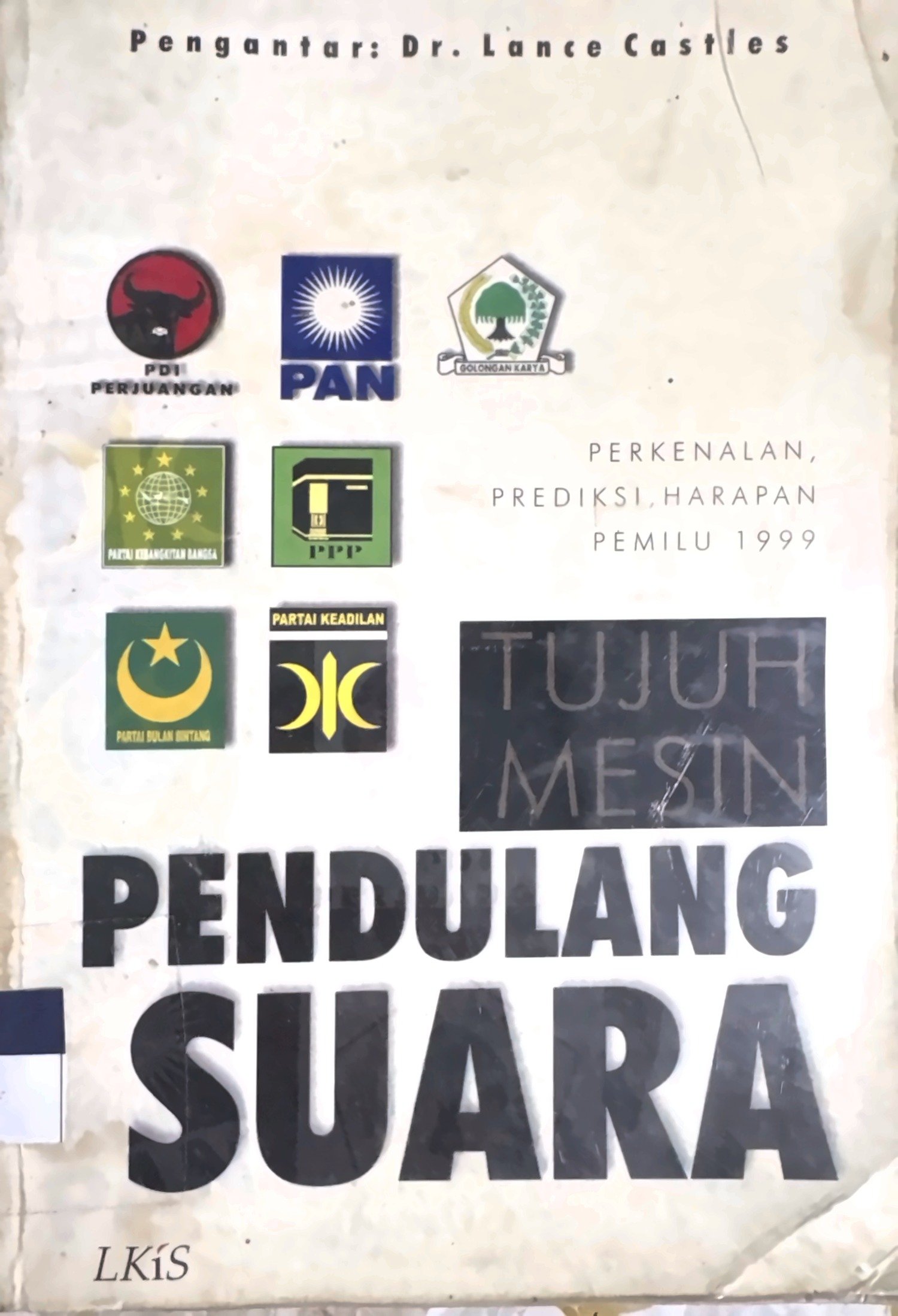
A 1999 book from LKiS in Yogyakarta by Hairus Salim HS, with a foreword by the Australian political scientist Dr. Lance Castles, introducing the seven political parties expected to be the main vote-getters in the general election of 7 June 1999, the first democratic election after the fall of the New Order. The seven parties, whose logos appear on the cover, are PDI Perjuangan, the National Mandate Party (PAN), Golkar, the National Awakening Party (PKB), the United Development Party (PPP), the Crescent Star Party (PBB) and the Justice Party (PK). As its subtitle says, the book offers an introduction, predictions and hopes for each party, and it is now an important document of the political mood of early Reformasi and of how observers read the balance of political forces before the votes were counted.
Identifier
KBA-BKU-1999-0005
Type
Buku
Publisher
LKiS, Yogyakarta
Date Issued
1999
Bibliographic Citation
Cetakan pertama, LKiS, Yogyakarta, 1999; xxiii + 275 halaman; bibliografi hlm. 271–275; ISBN 979-8966-41-4 (menurut katalog Library of Congress/Open Library, belum diverifikasi pada eksemplar). Pengantar oleh Dr. Lance Castles. Klasifikasi LC asli: JQ779.A45 H35 1999.
Political parties -- Indonesia; Elections -- Indonesia -- 1999; Election forecasting -- Indonesia
BISAC Category
POL043000 POLITICAL SCIENCE / Political Process / Political Parties
Spatial Coverage
Indonesia
Language
Indonesia
Description
Tujuh Mesin Pendulang Suara: Perkenalan, Prediksi, Harapan Pemilu 1999 (Seven Vote-Getting Machines: Introduction, Prediction and Hopes for the 1999 Election) was born in one of the most decisive moments in modern Indonesian political history. After President Soeharto stepped down in May 1998, the transitional government of B.J. Habibie opened the way to a free, multiparty general election. The restrictions on the number of parties that had applied throughout the New Order were lifted, and dozens of new parties appeared within a short time. Forty-eight parties eventually contested the election of 7 June 1999. Amid this profusion, voters, journalists and observers needed a guide to understand who the main players were, what their backgrounds were and where Indonesian politics was heading. This book was written to meet that need.
The book was published by LKiS in Yogyakarta, an institution that grew out of a circle of young Nahdlatul Ulama activists and became known as one of the most important publishers of progressive Islamic, democratic and civil-society discourse in the late 1990s. According to Library of Congress catalogue data, its author is Hairus Salim HS, and it appeared as a first printing in 1999 with xxiii and 275 pages. The cover gives prominence to Dr. Lance Castles as the author of the foreword. Castles is an Australian historian and political scientist long engaged in Indonesian studies who taught at Gadjah Mada University. He is known among other things for his study of the kretek cigarette industry in Kudus and its relation to religion and economic behaviour in Javanese society. His foreword lends the book academic weight and a long historical perspective on Indonesian parties.
The title uses a plain metaphor: political parties are imagined as machines for gathering votes. The choice of words reflects a realistic view of electoral politics, in which parties are ultimately judged by their ability to win the support of voters. The seven machines are shown through the logos on the cover: the bull of PDI Perjuangan, the sun of the National Mandate Party, the banyan tree of Golkar, the globe and nine stars of the National Awakening Party, the Kaaba of the United Development Party, the crescent and star of the Crescent Star Party, and the twin crescents of the Justice Party. The choice of these seven reflects the general expectation at the time about which parties had a strong social base, organisational network or leading figure.
The subtitle explains the three layers of the book's content. The first layer is introduction, an account of each party's history, leaders, mass base and platform. The second is prediction, an estimate of each party's prospects in the election. The third is hope, a view of what might be expected from these parties for Indonesian democracy. This combination makes the book more than a list of data; it is also a mirror of the hopes and anxieties of civil society at the start of Reformasi.
The value of the book for today's readers lies precisely in its character as a document written before the results were known. Readers can compare its predictions with what actually happened. In the 1999 election PDI Perjuangan won the most votes, about a third of all valid votes, followed by Golkar, then PKB, PPP and PAN, while PBB and the Justice Party received much smaller shares. That result then produced complicated political dynamics, including the election of Abdurrahman Wahid as president by the People's Consultative Assembly even though his party had not won the election. Reading the book with knowledge of what followed allows readers to judge the accuracy of the observers' analysis and to understand the factors that are hard to predict in transitional politics.
The book also records the early moment of several parties that would later become highly influential. The Justice Party, for example, later became the Prosperous Justice Party and grew into one of the most important Islamic parties in Indonesia. The National Mandate Party and the National Awakening Party show how the two largest Islamic organisations, Muhammadiyah and Nahdlatul Ulama, gave rise to new political channels through their leading figures. Golkar shows the staying power of the New Order's old party amid demands for change. For students of political Islam the book is very useful for seeing how the spectrum of Islamic parties and parties with Muslim mass bases took shape at the beginning of Reformasi.
The book's relevance to the study of Aceh is also clear. The 1999 election took place while the conflict in Aceh was intensifying and demands for a referendum were growing. In several parts of Aceh the conduct of the election faced serious obstacles and voter turnout was very low. Understanding the national party map of that time helps explain why many Acehnese felt distant from the political process in Jakarta, and why demands later arose for local political parties, which were finally accommodated after the Helsinki peace agreement of 2005.
The copy in this collection has an off-white cover with seven party logos on the left and centre, the words Tujuh Mesin in a black box and the words Pendulang Suara in large black letters. The LKiS imprint appears at the lower left and a library label is attached to the left side. The cover shows clear signs of age, such as stains, scratches and worn corners. The image shown here has been straightened, cut out from the photographic background and corrected for lighting and sharpness without removing those signs of age, which are part of the history of the copy.
In the Library of Congress classification the book is placed at JQ779.A45 for political parties in Indonesia, with the subject headings Political parties -- Indonesia, Elections -- Indonesia -- 1999, and Election forecasting -- Indonesia. In BISAC it is grouped under POL043000, Political Science / Political Process / Political Parties. Within the Arsip dan Pustaka KBA13 Academy the book complements the collection on Indonesian politics in the transition period, including clippings and magazines that record the development of the parties year by year, so that readers can follow the course of these parties from their first introduction to the public. This catalogue description has been compiled from the cover of the copy and Library of Congress catalogue data, and may be updated once the title page and table of contents have been examined directly.
Hairus Salim HS, Lance Castles (pengantar), “Tujuh Mesin Pendulang Suara: Perkenalan, Prediksi, Harapan Pemilu 1999 [Seven Vote-Getting Machines: Introduction, Prediction and Hopes for the 1999 Election]”, LKiS, Yogyakarta, Cetakan pertama, LKiS, Yogyakarta, 1999; xxiii + 275 halaman; bibliografi hlm. 271–275; ISBN 979-8966-41-4 (menurut katalog Library of Congress/Open Library, belum diverifikasi pada eksemplar). Pengantar oleh Dr. Lance Castles. Klasifikasi LC asli: JQ779.A45 H35 1999., 1999. KBA13 Academy Archive and Library, KBA-BKU-1999-0005.