Cambridge University Press, Cambridge · Cambridge University Press, Cambridge, 1997; xi + 241 halaman; ilustrasi; 22 cm; ISBN 0-521-62982-9 (sampul lunak), 0-521-62018-X (sampul keras), menurut katalog perpustakaan (belum diverifikasi pada eksemplar). Tahun terbit 1997 sesuai keterangan pemilik koleksi; cetakan eksemplar belum diperiksa. · 1997
Abstract
An introductory textbook by the British anthropologist Robert Layton (born 1944), professor of anthropology at Durham University, published by Cambridge University Press in 1997. It introduces the major schools of social and cultural anthropological theory: functionalism, structuralism, Marxist approaches, interactionism and transactionalism, sociobiology and evolutionary ecology, and postmodernism. Layton explains each school through its philosophical origins, its core ideas and ethnographic examples, then weighs its strengths and weaknesses. Concise, lucid and balanced, the book has been widely used as a basic reading for courses in anthropological theory at many universities, and it remains a useful map for students entering the field's theoretical debates.
Identifier
KBA-BKU-1997-0002
Type
Buku
Publisher
Cambridge University Press, Cambridge
Date Issued
1997
Bibliographic Citation
Cambridge University Press, Cambridge, 1997; xi + 241 halaman; ilustrasi; 22 cm; ISBN 0-521-62982-9 (sampul lunak), 0-521-62018-X (sampul keras), menurut katalog perpustakaan (belum diverifikasi pada eksemplar). Tahun terbit 1997 sesuai keterangan pemilik koleksi; cetakan eksemplar belum diperiksa.
Anthropology -- Philosophy; Ethnology -- Philosophy; Anthropology -- History
BISAC Category
SOC002010 SOCIAL SCIENCE / Anthropology / Cultural & Social
Language
Inggris
Description
An Introduction to Theory in Anthropology by Robert Layton is one of the most widely used introductions to anthropological theory in university classrooms since the late 1990s. Layton was born in 1944 and taught for many years at Durham University in England, where he became professor of anthropology. He is widely known for his research among Aboriginal Australians, especially on rock art, land rights and the history of Uluru, and for his book on the anthropology of art. This long fieldwork experience means that his explanations of theory are always grounded in concrete ethnographic examples rather than in abstract accounts of the ideas of great thinkers.
The book was published by Cambridge University Press in 1997, with roughly xi and 241 pages. Its aim is simple but important: to give students a clear map of the main schools of social and cultural anthropological theory. Layton does not organise the book as a chronicle of names and dates but as an account of different ways of answering anthropology's basic questions: how societies persist and change, how meaning is created and shared, and how individuals act within larger social structures.
The first school discussed is functionalism, rooted in the thought of Émile Durkheim and developed in British anthropology by Bronisław Malinowski and A.R. Radcliffe-Brown. Functionalism sees society as a system whose parts support one another, so that each institution is explained by its contribution to the persistence of the whole. The second is structuralism, above all in the form developed by Claude Lévi-Strauss, which seeks the patterns of human thought underlying myth, kinship systems and classification. Layton explains how structuralism grew out of Ferdinand de Saussure's linguistics and shifted anthropology's focus from social function to the structure of meaning.
The following chapters discuss Marxist approaches, which place relations of production, ownership and inequalities of power at the centre of analysis, and interactionism and transactionalism, which focus on individuals as actors who make choices, negotiate and manipulate social rules. The latter approach is associated, among others, with Fredrik Barth and with the analysis of strategy and exchange. Layton also gives considerable space to sociobiology and evolutionary ecology, which attempt to explain human social behaviour through the principles of natural selection and adaptation. This section shows his openness to dialogue between social anthropology and the biological sciences, something rarely found in introductions of this kind.
The final part of the book discusses postmodernism, which questions the claims of ethnography to objectivity, highlights the relation between knowledge and power, and encourages reflection on how anthropologists write about others. Layton explains the contributions of postmodern critique, such as awareness of the researcher's position and of the voices of the people studied, but he also weighs its limits, particularly when excessive relativism threatens the possibility of comparison and explanation. This balanced stance is one of the book's defining features.
The book's main strength is its clarity. Layton writes in plain language, avoids unnecessary jargon and always links each theory to examples from the field. He also shows that theoretical schools do not arise in a vacuum but respond to, criticise and borrow from one another. In this way students learn not only the content of each theory but also why it emerged, what problems it sought to answer and what later made it the object of criticism. Its weakness, as is usual for an introduction, is the limited space it can give to more recent theoretical developments and to anthropological traditions beyond the English- and French-speaking worlds.
For the teaching of anthropology in Indonesia the book is highly relevant. Courses in anthropological theory, the anthropology of religion and research methodology at many universities need readings that can explain theoretical debates concisely without losing depth. This book can serve as a starting point before students read the classic works directly. Many of its examples can also be compared with Indonesian social realities, for instance in kinship systems, exchange, ritual, and the relation between custom and the state. Students of Acehnese society, for example, can use a functionalist frame to understand the role of customary institutions, a structuralist frame to read hikayat and myth, a Marxist frame to examine the political economy of conflict, or an interactionist frame to observe the strategies of actors in the post-conflict transition.
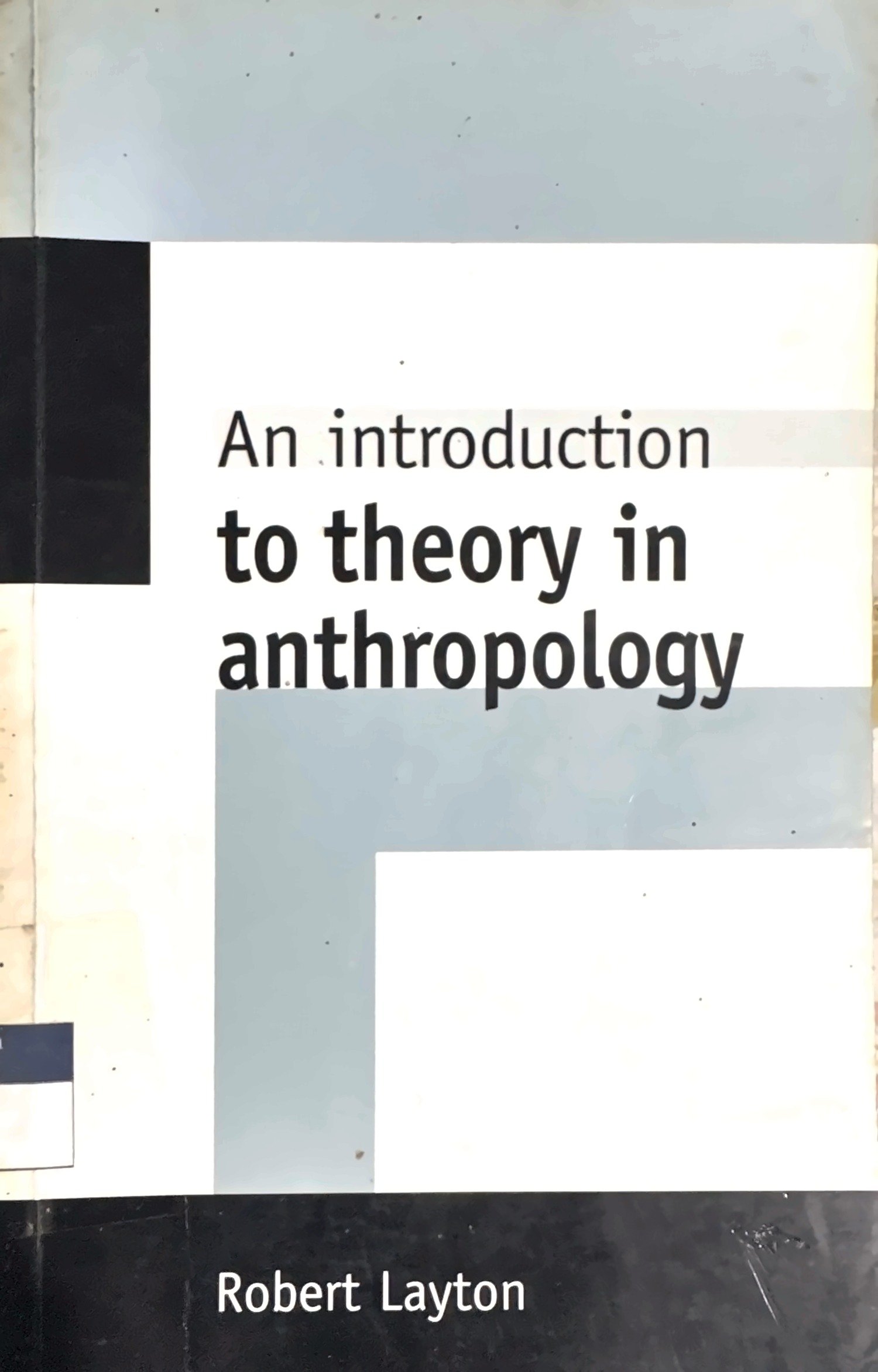
The copy in this collection is a paperback with a clean graphic design made of rectangular fields in blue-grey, white and black. The title is printed in black sans-serif letters, and Robert Layton's name appears in white on a black band at the bottom. A library label is attached to the left side of the cover, and there are small spots and stains from age. The image shown here has been straightened, cut out from the photographic background and corrected for lighting and sharpness without altering the content of the cover.
The book can also be read as part of a wider debate about the direction of anthropology at the end of the twentieth century. When it appeared, the discipline was in a period of reflection following critiques of its relationship with colonialism and the wave of postmodern criticism of ethnographic writing. Some anthropologists moved toward interpretation and narrative, while others returned to scientific explanation, cross-cultural comparison and dialogue with biology and ecology. Layton places himself in the middle of this debate with a calm stance. He does not force readers to choose one school as the most correct, but shows that each illuminates part of social reality while obscuring another. This approach is very useful for students, because it encourages them to choose theory according to their research questions rather than loyalty to a particular school.
In the Library of Congress classification the book is placed at GN33 for the philosophy, theory and methodology of anthropology, with the subject headings Anthropology -- Philosophy, Ethnology -- Philosophy, and Anthropology -- History. In BISAC it is grouped under SOC002010, Social Science / Anthropology / Cultural & Social. Within the Arsip dan Pustaka KBA13 Academy it serves as one of the basic references for anthropology courses and studies, and can be read alongside other introductions to anthropology in the collection, including works on the anthropology of religion in the archipelago, to connect general theory with local social realities. This catalogue description has been compiled from the cover of the copy, library catalogue data and the collection owner's information, and may be updated once the title page, table of contents and copyright page have been examined directly.
Robert Layton, “An Introduction to Theory in Anthropology”, Cambridge University Press, Cambridge, Cambridge University Press, Cambridge, 1997; xi + 241 halaman; ilustrasi; 22 cm; ISBN 0-521-62982-9 (sampul lunak), 0-521-62018-X (sampul keras), menurut katalog perpustakaan (belum diverifikasi pada eksemplar). Tahun terbit 1997 sesuai keterangan pemilik koleksi; cetakan eksemplar belum diperiksa., 1997. KBA13 Academy Archive and Library, KBA-BKU-1997-0002.