Lembaga Studi Agama dan Filsafat (LSAF), Jakarta · Ulumul Qur'an: Jurnal Kebudayaan dan Peradaban, No. 3, Vol. VII, 1997 (sesuai catatan kaki halaman dalam: 'Ulumul Qur'an No 3 VII/1997'). Bulan terbit belum dipastikan. Sudut kanan atas sampul sobek sehingga sebagian penanda nomor hilang; ISSN tercetak kecil di kiri bawah sampul dan tidak terbaca jelas pada foto. · 1997
Abstract
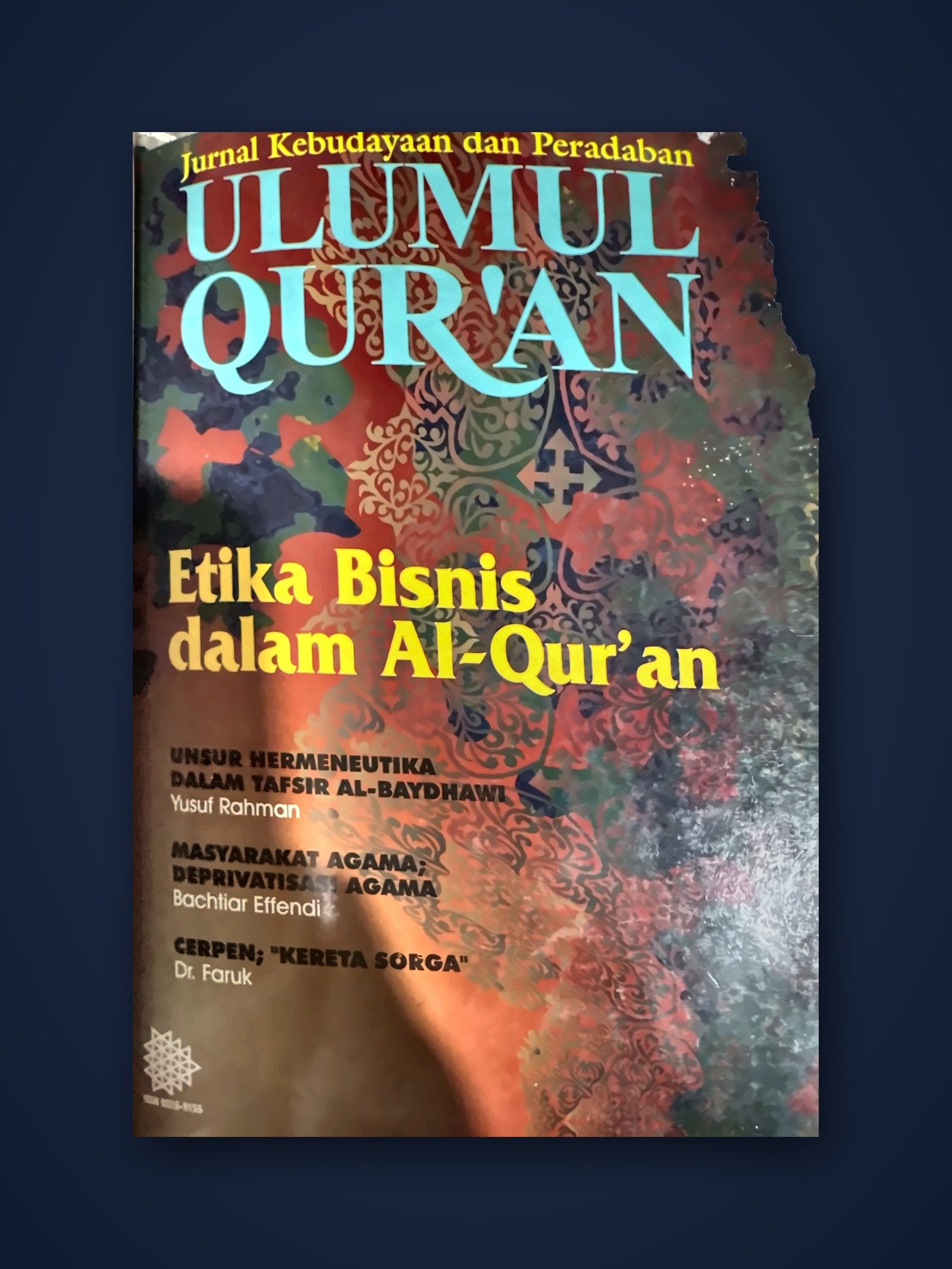
Number 3, Volume VII, 1997 of Ulumul Qur'an: Jurnal Kebudayaan dan Peradaban, a journal of Islamic thought published in Jakarta from 1989 by the Institute for the Study of Religion and Philosophy (LSAF) on the initiative of M. Dawam Rahardjo. The issue's lead theme is Business Ethics in the Qur'an, discussing the principles of honesty, fair measure and the example of the Prophet Muhammad as a trader. The cover also announces Yusuf Rahman's article on hermeneutical elements in al-Baydawi's Qur'an commentary, Bachtiar Effendi's essay on religious society and the deprivatisation of religion, and the short story 'Kereta Sorga' (The Heavenly Carriage) by Dr. Faruk. Published in the last relatively calm year of the New Order before the monetary crisis, the issue reflects Ulumul Qur'an's role as a meeting place for Qur'anic studies, social science and literature.
Identifier
KBA-MJL-1997-0001
Type
Majalah
Publisher
Lembaga Studi Agama dan Filsafat (LSAF), Jakarta
Date Issued
1997
Bibliographic Citation
Ulumul Qur'an: Jurnal Kebudayaan dan Peradaban, No. 3, Vol. VII, 1997 (sesuai catatan kaki halaman dalam: 'Ulumul Qur'an No 3 VII/1997'). Bulan terbit belum dipastikan. Sudut kanan atas sampul sobek sehingga sebagian penanda nomor hilang; ISSN tercetak kecil di kiri bawah sampul dan tidak terbaca jelas pada foto.
Business ethics -- Religious aspects -- Islam; Qur'an -- Hermeneutics; Religion and sociology -- Indonesia; Islam -- Indonesia -- Periodicals
BISAC Category
REL037000 RELIGION / Islam / General
Spatial Coverage
Indonesia
Language
Indonesia
Description
Ulumul Qur'an was one of the most influential journals of Islamic thought in Indonesia in the 1990s. It began publication in Jakarta in April 1989 on the initiative of M. Dawam Rahardjo, who also led its editorial board in the early years, and it was published by the Institute for the Study of Religion and Philosophy (Lembaga Studi Agama dan Filsafat, LSAF). Over time the journal also became connected with the milieu of the Association of Indonesian Muslim Intellectuals (ICMI), founded in 1990. Its full name was adjusted several times, and on the cover of this issue it appears as Ulumul Qur'an: Jurnal Kebudayaan dan Peradaban (Journal of Culture and Civilisation). A study of the journal's history records that it declined in 1998 and then ceased publication for lack of funds and human resources, so the issues of 1997 belong to the final phase of its life.
The name Ulumul Qur'an, meaning the sciences of the Qur'an, signals the journal's aspiration to place the Qur'an at the centre of intellectual conversation, yet its content was far broader than Qur'anic exegesis in the narrow sense. The journal brought together writers from many disciplines, from exegesis, philosophy and history to economics, political science, sociology and literature. It became a space where a generation of Muslim intellectuals who had grown up in pesantren, State Institutes of Islamic Studies and general universities encountered the ideas of modern social science. Dawam Rahardjo's own intellectual profile, combining writing on the Indonesian economy with the compilation of a Qur'anic encyclopaedia built on key concepts, is strongly reflected in the character of the journal.
Number 3, Volume VII, 1997 carries a lead report entitled Etika Bisnis dalam Al-Qur'an (Business Ethics in the Qur'an). The theme was highly relevant to the mid-1990s, when the Indonesian economy was growing quickly, the Muslim middle class was expanding and Islamic financial institutions were beginning to appear after the founding of Bank Muamalat Indonesia in 1991. Questions about how Islam views trade, profit, honesty and economic justice were becoming more pressing. The inside pages show the direction of the discussion, for example the treatment of the prohibition against short-changing in weights and measures as the clearest example of Islamic business ethics, honesty as the highest value in trade, and the example of the Prophet Muhammad, who before his prophethood was trusted to carry Khadija's merchandise to Syria and honestly showed prospective buyers both the merits and the defects of the goods.
The cover also introduces three other contributions. The first is Unsur Hermeneutika dalam Tafsir al-Baydhawi (Hermeneutical Elements in al-Baydawi's Commentary) by Yusuf Rahman. Anwar al-Tanzil wa Asrar al-Ta'wil by Nasir al-Din al-Baydawi, a scholar of the seventh Islamic century, is one of the most widely studied Qur'an commentaries in the Muslim world, including in the pesantren of the archipelago. Reading that classical work through the lens of hermeneutics shows a tendency in Indonesian Qur'anic studies of the 1990s to connect the old exegetical heritage with modern theories of interpretation, an effort that later spread widely in Islamic higher education.
The second is Masyarakat Agama; Deprivatisasi Agama (Religious Society; the Deprivatisation of Religion) by Bachtiar Effendi, a political scientist later widely known for his work on the relationship between Islam and the state in Indonesia. The term deprivatisation of religion belongs to a debate in the sociology of religion about the return of religion to public life, formulated among others by José Casanova in his 1994 book on public religions in the modern world. The idea challenges the old assumption that modernisation would make religion an increasingly private matter. The appearance of this theme in Ulumul Qur'an shows how quickly Indonesian Muslim intellectuals followed international theoretical debates and applied them to the Islamic resurgence at home.
The third is the short story Kereta Sorga (The Heavenly Carriage) by Dr. Faruk, a literary scholar from Gadjah Mada University. Publishing fiction in a journal of Islamic studies was a hallmark of Ulumul Qur'an, which regarded literature as an important part of culture and civilisation. By placing a short story alongside exegetical study and sociological analysis, the journal affirmed that religious thought speaks not only through argument but also through imagination and aesthetic sensibility.
The context of 1997 adds historical value to this issue. That year was the last relatively calm year of the New Order before the Asian financial crisis struck in mid-1997 and became one of the triggers of Soeharto's fall in May 1998. The discussion of business ethics, honesty in trade and economic justice in this issue can be read as part of a moral unease about economic practices riddled with collusion and corruption, which later became a central target of the Reformasi movement. The magazine thus records the voices of Muslim intellectuals on the threshold of great change.
The copy in this collection is part of a bound volume of issues, so its cover was photographed open within the binding. The cover has a background of red, green and dark-blue arabesque ornament, with the journal's name in large light-blue letters and the lead title in yellow. The upper right corner is torn, so part of the issue marking is missing, and there are shadows and scratches from age. The number, volume and year were confirmed from the running footer on an inside page reading Ulumul Qur'an No 3 VII/1997. The image shown here has been cut out from the surrounding pages, straightened, evened in lighting and placed on a plain background, while the torn edge has been left as it is as part of the history of the copy.
In the Library of Congress classification the issue is placed at BP1 for periodicals on Islam, with the subject headings Business ethics -- Religious aspects -- Islam, Qur'an -- Hermeneutics, Religion and sociology -- Indonesia, and Islam -- Indonesia -- Periodicals. In BISAC it is grouped under REL037000, Religion / Islam / General.
Users of the Arsip dan Pustaka KBA13 Academy can draw on this issue along several lines of inquiry. Scholars of Islamic economics can trace the roots of Islamic business-ethics discourse in Indonesia before the rapid growth of the sharia finance industry. Scholars of exegesis can observe an early stage in the entry of hermeneutics into Indonesian Qur'anic studies. Scholars of the sociology of religion and politics can read how the idea of public religion was used to explain Indonesian Islam at the end of the New Order. The issue can also be read alongside works by Dawam Rahardjo and other Ulumul Qur'an writers in the collection, revealing the network of ideas that shaped Indonesian Islamic discourse on the eve of Reformasi. This catalogue description has been compiled from the cover and an inside page of the copy and from references on the journal's history, and may be updated once the full table of contents has been examined.
Yusuf Rahman, Bachtiar Effendi, Faruk (ed.), “Ulumul Qur'an No. 3 Vol. VII, 1997: Etika Bisnis dalam Al-Qur'an [Business Ethics in the Qur'an]”, Lembaga Studi Agama dan Filsafat (LSAF), Jakarta, Ulumul Qur'an: Jurnal Kebudayaan dan Peradaban, No. 3, Vol. VII, 1997 (sesuai catatan kaki halaman dalam: 'Ulumul Qur'an No 3 VII/1997'). Bulan terbit belum dipastikan. Sudut kanan atas sampul sobek sehingga sebagian penanda nomor hilang; ISSN tercetak kecil di kiri bawah sampul dan tidak terbaca jelas pada foto., 1997. KBA13 Academy Archive and Library, KBA-MJL-1997-0001.