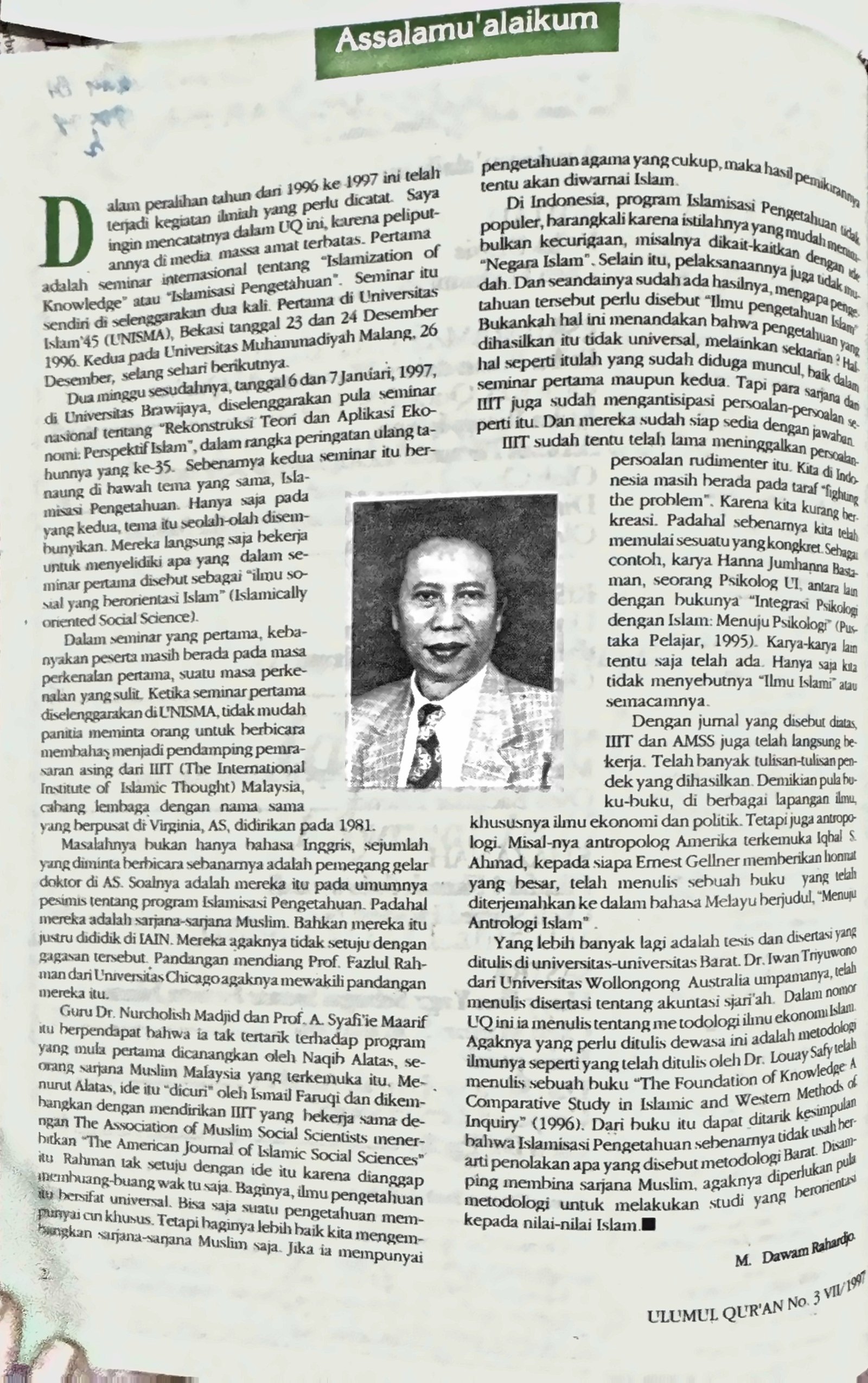
Ulumul Qur'an: Jurnal Kebudayaan dan Peradaban — Lembaga Studi Agama dan Filsafat (LSAF), Jakarta · Ulumul Qur'an No. 3 Vol. VII, 1997, rubrik 'Assalamu'alaikum', hlm. 2; ditulis M. Dawam Rahardjo. Bagian dari entri majalah Ulumul Qur'an No. 3 Vol. VII, 1997 dalam arsip ini. · 1997
Abstract
The editorial (the 'Assalamu'alaikum' column) by M. Dawam Rahardjo in Ulumul Qur'an No. 3 Vol. VII, 1997. Dawam records three seminars at the turn of 1996–1997 on the Islamization of Knowledge: at Universitas Islam 45 in Bekasi (23–24 December 1996), Universitas Muhammadiyah Malang (26 December 1996), and a seminar on 'Reconstructing Economic Theory and Practice: An Islamic Perspective' at Universitas Brawijaya (6–7 January 1997). He discusses the pessimism of some Indonesian Muslim scholars, the view of Fazlur Rahman, Naquib al-Attas's claim to the idea developed by Ismail Faruqi through the IIIT, then points to concrete work in psychology, anthropology and sharia accounting, concluding that the Islamization of Knowledge need not mean rejecting Western methodology.
Identifier
KBA-KLP-1997-0007
Type
Kliping
Publisher
Ulumul Qur'an: Jurnal Kebudayaan dan Peradaban — Lembaga Studi Agama dan Filsafat (LSAF), Jakarta
Date Issued
1997
Bibliographic Citation
Ulumul Qur'an No. 3 Vol. VII, 1997, rubrik 'Assalamu'alaikum', hlm. 2; ditulis M. Dawam Rahardjo. Bagian dari entri majalah Ulumul Qur'an No. 3 Vol. VII, 1997 dalam arsip ini.
Islamization of knowledge; Islam and science; Knowledge, Theory of (Islam); Islamic economics -- Methodology
BISAC Category
REL037000 RELIGION / Islam / General
Spatial Coverage
IndonesiaMalaysiaAmerika Serikat
Language
Indonesia
Description
This page is the editorial of Ulumul Qur'an Number 3, Volume VII, 1997, printed in the regular column titled Assalamu'alaikum on page 2 and signed by M. Dawam Rahardjo. Dawam founded the journal in 1989 and was one of the most prolific Indonesian Muslim intellectuals of his time, known as an economist, social thinker, NGO activist and compiler of an encyclopaedia of the Qur'an. In columns of this kind he set out his reading of current developments in Islamic discourse and explained the direction of the issue in question. The page also carries a portrait photograph of Dawam in a jacket, a sign that the editorial is the personal voice of the journal's leader rather than an anonymous editorial note.
The theme is the Islamization of Knowledge, an idea that in the 1980s and 1990s became one of the most ambitious intellectual projects in the Muslim world. Dawam opens by recording scholarly events at the turn of 1996 to 1997 that, in his view, had received little media coverage. The first was an international seminar on the Islamization of Knowledge held twice, first at Universitas Islam 45 (UNISMA) in Bekasi on 23 and 24 December 1996, then at Universitas Muhammadiyah Malang on 26 December 1996. Two weeks later, on 6 and 7 January 1997, Universitas Brawijaya held a national seminar on Reconstructing Economic Theory and Practice: An Islamic Perspective to mark its 35th anniversary. Dawam notes that both events in fact shared the same theme, except that in the second the theme was as if concealed, and participants went straight to work examining what the first seminar had called Islamically oriented social science.
Dawam then describes the atmosphere of the first seminar as a difficult period of introduction. The organisers found it hard to recruit Indonesian speakers willing to accompany the foreign presenters from the International Institute of Islamic Thought (IIIT) Malaysia, a branch of the institution of the same name headquartered in Virginia in the United States and founded in 1981. The problem, Dawam writes, was not only English. Many holders of American doctorates, including those educated at the State Institutes of Islamic Studies, were pessimistic about the Islamization of Knowledge programme. He cites the view of the late Fazlur Rahman of the University of Chicago as representative of that attitude. For Rahman, knowledge is universal, so it is better to cultivate Muslim scholars with adequate religious knowledge, whose thinking will naturally be coloured by Islam.
Dawam also notes that this teacher of Nurcholish Madjid and Ahmad Syafii Maarif was not drawn to the programme first proclaimed by Syed Muhammad Naquib al-Attas, the eminent Malaysian Muslim scholar. According to al-Attas, the idea was taken by Ismail Raji al-Faruqi and developed through the founding of the IIIT, which worked with the Association of Muslim Social Scientists to publish The American Journal of Islamic Social Sciences. This brief note records one of the well-known controversies in the history of the Islamization of Knowledge movement, the dispute over who first formulated the idea and how it should be developed.
The second part of the editorial explains why the programme was not popular in Indonesia. Dawam suggests that the term easily aroused suspicion, for instance by being associated with the idea of an Islamic state, and that it was not easy to implement. He raises the familiar critical question: if the knowledge produced is called Islamic science, does that not imply that it is not universal but sectarian? Yet he notes that IIIT scholars had anticipated such objections, and that in Indonesia concrete work already existed even if it was not labelled Islamic science. He cites the book by Hanna Djumhana Bastaman, a psychologist at the University of Indonesia, Integrasi Psikologi dengan Islam: Menuju Psikologi Islami, published by Pustaka Pelajar in 1995, as well as the work of a leading anthropologist translated into Malay as Menuju Antropologi Islam (Toward Islamic Anthropology).
Dawam then points to theses and dissertations written at Western universities as further evidence. He gives the example of Iwan Triyuwono of the University of Wollongong in Australia, who wrote a dissertation on sharia accounting and who, in this issue of Ulumul Qur'an, writes on the methodology of Islamic economics. He also refers to Louay Safi's book The Foundation of Knowledge: A Comparative Study in Islamic and Western Methods of Inquiry (1996). From that book Dawam concludes that the Islamization of Knowledge need not mean rejecting what is called Western methodology. Besides cultivating Muslim scholars, he argues, a methodology is also needed for conducting studies oriented toward Islamic values.
The historical value of this page lies in its record of the map of the Islamization of Knowledge debate in Indonesia at a decisive moment. A few years later, the idea of the integration of knowledge became the basis for transforming several State Institutes of Islamic Studies into State Islamic Universities, with models such as integration-interconnection and the tree of knowledge. Dawam's editorial shows that this debate was already alive in the mid-1990s, and that Indonesian intellectuals chose a more pragmatic path: accepting modern methodology while directing it toward Islamic values, rather than building an entirely separate rival science.
The page also offers an entry point to the issue as a whole. The lead report on business ethics in the Qur'an, the article on the methodology of Islamic economics, the hermeneutical study of al-Baydawi's commentary and the essay on the deprivatisation of religion can all be read as part of the same concern: how Islamic teaching can speak in the language of modern science without losing its normative character.
The page image shown here has been straightened, cut away from the facing page and processed to even out the originally greenish paper tone and strengthen the letterforms so that the text can be read clearly. Dawam Rahardjo's portrait photograph has been kept in black and white. The pencil marks in the upper left corner and the footer reading Ulumul Qur'an No. 3 VII/1997 remain visible as part of the history of the copy.
In the Library of Congress classification this clipping is placed at BP190.5.L5 for Islam and science, with the subject headings Islamization of knowledge, Islam and science, Knowledge, Theory of (Islam), and Islamic economics -- Methodology. In BISAC it is grouped under REL037000, Religion / Islam / General. The clipping is linked to the entry for the magazine Ulumul Qur'an No. 3 Vol. VII, 1997 in the Arsip dan Pustaka KBA13 Academy, so readers can move from this editorial to the cover and description of the issue. This catalogue description has been compiled from the original page and may be updated if other pages of the same issue are added to the archive.
M. Dawam Rahardjo, “Assalamu'alaikum: Islamisasi Pengetahuan [The Islamization of Knowledge] (editorial, Ulumul Qur'an No. 3 Vol. VII, 1997)”, Ulumul Qur'an: Jurnal Kebudayaan dan Peradaban — Lembaga Studi Agama dan Filsafat (LSAF), Jakarta, Ulumul Qur'an No. 3 Vol. VII, 1997, rubrik 'Assalamu'alaikum', hlm. 2; ditulis M. Dawam Rahardjo. Bagian dari entri majalah Ulumul Qur'an No. 3 Vol. VII, 1997 dalam arsip ini., 1997. KBA13 Academy Archive and Library, KBA-KLP-1997-0007.