PT Serambi Ilmu Semesta, Jakarta · Cetakan I, Mei 2011; hak cipta Arafat Nur 2011; ISBN 978-979-024-354-5. Penyunting Adi Toha dan M. Sidik Nugraha; pewajah isi Dinar Ramdhani Nugraha. PT Serambi Ilmu Semesta, Jl. Kemang Timur Raya No. 16, Jakarta 12730. Sampul: Pemenang Unggulan Sayembara Menulis Novel Dewan Kesenian Jakarta 2010. · 2011
Abstract
A novel by Arafat Nur that was named a leading winner of the Jakarta Arts Council Novel Writing Competition 2010 and went on to receive the Khatulistiwa Literary Award 2011 for prose, published by Serambi Ilmu Semesta in May 2011. Set in a village in Aceh during the armed conflict, it portrays villagers caught between the violence of armed groups and state forces, through the figure of a heavily moustached armed man who terrorises the village. With bitter humour and satire, Lampuki is one of the most important literary works about the Aceh conflict.
Identifier
KBA-BKU-2011-0003
Type
Buku
Publisher
PT Serambi Ilmu Semesta, Jakarta
Date Issued
2011
Bibliographic Citation
Cetakan I, Mei 2011; hak cipta Arafat Nur 2011; ISBN 978-979-024-354-5. Penyunting Adi Toha dan M. Sidik Nugraha; pewajah isi Dinar Ramdhani Nugraha. PT Serambi Ilmu Semesta, Jl. Kemang Timur Raya No. 16, Jakarta 12730. Sampul: Pemenang Unggulan Sayembara Menulis Novel Dewan Kesenian Jakarta 2010.
Indonesian fiction -- 21st century; Aceh (Indonesia) -- Fiction; Aceh (Indonesia) -- History -- Autonomy and independence movements -- Fiction
BISAC Category
FIC014000 FICTION / Historical / General
Spatial Coverage
Aceh
Language
Indonesia
Description
Lampuki is a novel by Arafat Nur, a writer who grew up and works in Aceh, published by PT Serambi Ilmu Semesta in Jakarta in May 2011. The cover states that the novel was a leading winner of the Jakarta Arts Council Novel Writing Competition 2010, one of Indonesia's most prestigious literary competitions. In its year of publication Lampuki also won the Khatulistiwa Literary Award for prose, establishing Arafat Nur as one of the important voices in Indonesian literature from Aceh. The copyright page records copyright in Arafat Nur's name from 2011, with editors Adi Toha and M. Sidik Nugraha and interior design by Dinar Ramdhani Nugraha.
The novel is set in a village called Lampuki in Aceh during the armed conflict between the Free Aceh Movement and the Indonesian government. At its centre is a heavily moustached man who carries a gun and makes himself a petty ruler of the village, recruiting young men, collecting contributions to the struggle and spreading fear. Around him, villagers go about their daily lives under constant threat: violence from armed groups on one side and operations by state forces on the other. The story is told from a perspective that allows sharp observation, cynical commentary and bitter humour about human behaviour in chaotic times.
Lampuki's strength lies in its courage in presenting the Aceh conflict without romanticisation. The novel does not offer a simple heroic tale of struggle or betrayal but shows how violence corrodes the moral order of a community from within. Ordinary villagers, religious teachers, women and children appear not only as victims but as human beings with their own weaknesses, fears and ways of surviving. Through satire, Arafat Nur criticises both the arbitrariness of state forces and the arrogance of some armed men who act in the name of the struggle.
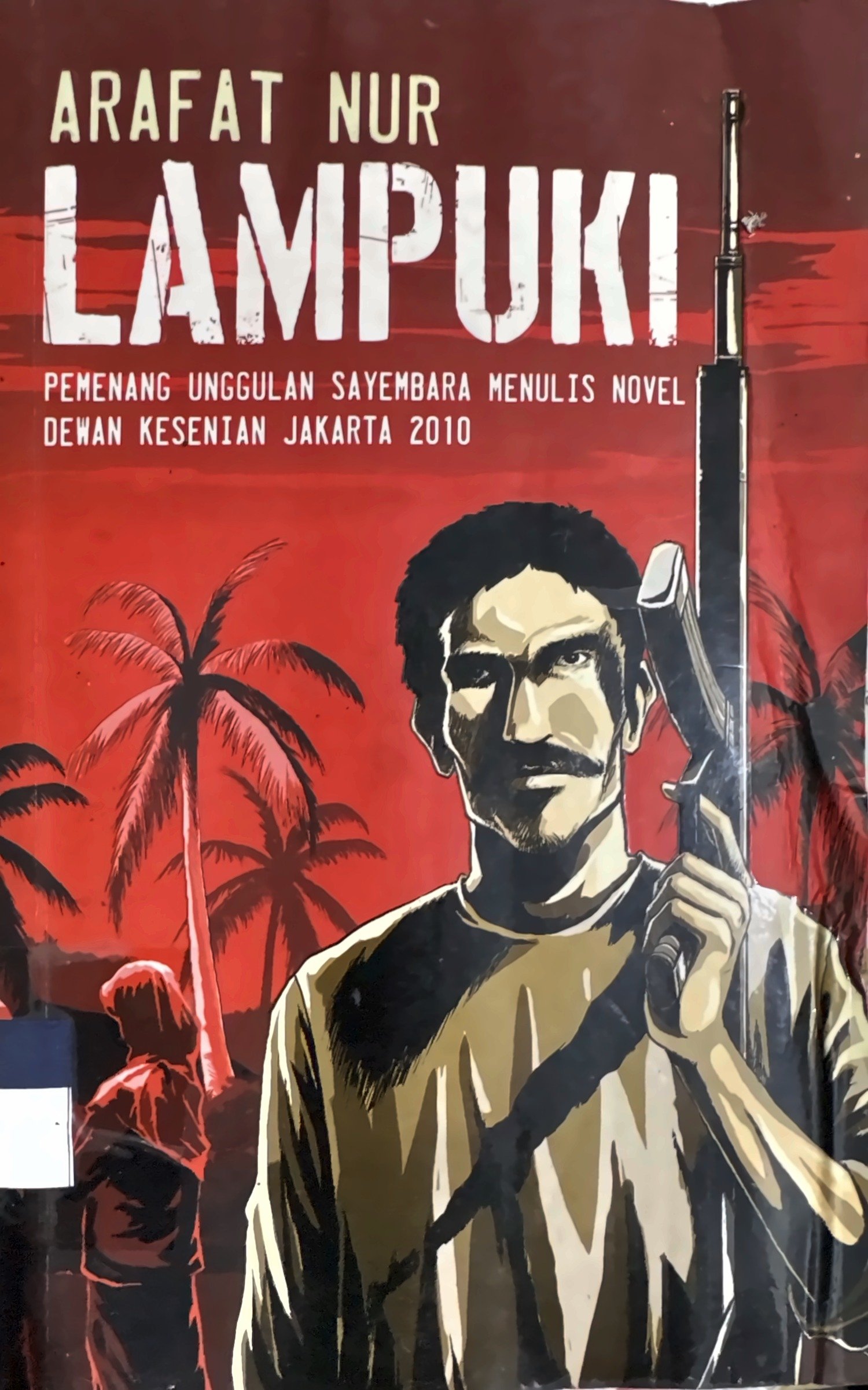
The cover of this edition shows an illustration of a heavily moustached man with a long rifle on his shoulder, standing before a blazing red background with silhouettes of coconut palms and shadowy figures. The red that dominates the cover evokes violence and fire, while the coconut palms recall the coastal landscape of Aceh. The title LAMPUKI is printed in cracked white stencil lettering, as if painted on a village wall.
In the landscape of Indonesian literature, Lampuki belongs to the wave of works that took up the experience of conflict regions after Reformasi, when writers from various regions began to write histories of violence that had previously been difficult to discuss. For readers from Aceh the novel is a sometimes painful mirror of a shared past. For readers outside Aceh it is a window onto the understanding that conflict does not happen only on the battlefield but seeps into homes, village prayer halls, coffee shops and everyday conversation.
For the anthropology and sociology of Aceh, Lampuki offers rich material. Literature can often capture dimensions of experience missed by official reports and quantitative research, such as inner moods, humour as a survival mechanism, power relations at the village level and changing values in a society beset by prolonged violence. The novel can be read alongside ethnographic studies of conflict and peace in Aceh to weigh the relationship between fiction and reality, and between collective memory and the writing of history.
Arafat Nur is known as a writer who consistently writes about Aceh, in novels and short stories alike, and his work often addresses justice, violence and the lives of ordinary people. Lampuki is one of the most widely discussed and studied of his works in literary research at Indonesian universities, especially within the framework of conflict literature and social criticism.
The copy in this collection is a paperback with a slightly glossy surface from its plastic wrapping, some creases and a library label on the left. The image shown here has been straightened, cut out from the photographic background and corrected for colour and sharpness without removing signs of use.
Stylistically, Lampuki stands out for combining realism with irony. Its sentences often carry sharp satire of the hypocrisy, arrogance and folly that surface in conflict, so readers laugh and wince at once; this lets the author address traumatic experience without lapsing into lament, and invites a reflective distance. The novel is also a document of post-conflict memory: after the Helsinki peace agreement of 2005, Aceh entered a period of reconstruction and reintegration, yet memories of the conflict lived on in families and communities, and works such as Lampuki help shape how those memories are processed, debated and handed on to generations who did not live through the conflict. Recognition by the Jakarta Arts Council and the Khatulistiwa Literary Award showed that the Acehnese experience had found a place in the national literary mainstream.
As part of a private collection now opened to the public, this copy also has value as a historical object: its library label, signs of use and marks of age show that it was read, borrowed and cited in academic work. For archive users working on literature and the Aceh conflict, this entry can serve as a starting point, and readers are encouraged to connect it with clippings and books on the Aceh conflict in the collection for a fuller picture.
In teaching, Lampuki suits courses on modern Indonesian literature, cultural studies and peace studies, where students can examine how character, setting and point of view convey the experience of conflict.
In the Library of Congress classification the book is placed at PL5089.A72 for Indonesian literature by modern authors, with the subject headings Indonesian fiction -- 21st century, Aceh (Indonesia) -- Fiction, and Aceh (Indonesia) -- History -- Autonomy and independence movements -- Fiction. In BISAC it is grouped under FIC014000, Fiction / Historical / General.
Within the Arsip dan Pustaka KBA13 Academy, Lampuki can be read with books on conflict and humanitarian concerns in the collection, such as Jembatan Air Mata on East Timorese refugees and Neraca Gus Dur di Panggung Kekuasaan, which touches on policy toward Aceh in the early Reformasi years. This catalogue description has been compiled from the cover and copyright page of the copy and general references on the novel's reception, and may be updated once the text has been examined in more detail.
Rights
Koleksi pribadi KBA13 Academy
Contributor
Adi Toha (penyunting)M. Sidik Nugraha (penyunting)Dinar Ramdhani Nugraha (pewajah isi)
Arafat Nur, Adi Toha (penyunting), M. Sidik Nugraha (penyunting), Dinar Ramdhani Nugraha (pewajah isi), “Lampuki”, PT Serambi Ilmu Semesta, Jakarta, Cetakan I, Mei 2011; hak cipta Arafat Nur 2011; ISBN 978-979-024-354-5. Penyunting Adi Toha dan M. Sidik Nugraha; pewajah isi Dinar Ramdhani Nugraha. PT Serambi Ilmu Semesta, Jl. Kemang Timur Raya No. 16, Jakarta 12730. Sampul: Pemenang Unggulan Sayembara Menulis Novel Dewan Kesenian Jakarta 2010., 2011. KBA13 Academy Archive and Library, KBA-BKU-2011-0003.