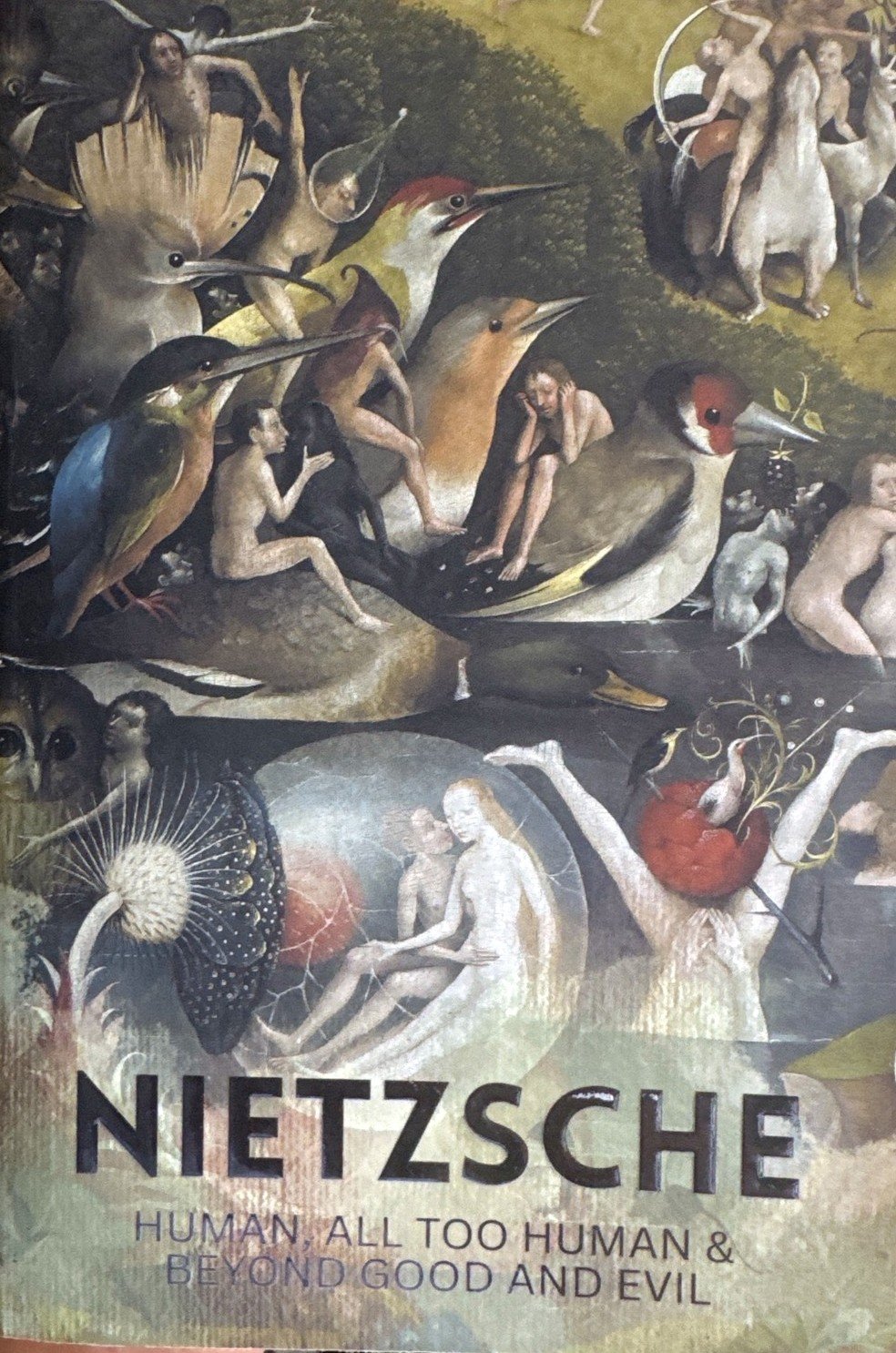
Wordsworth Editions, Ware, Hertfordshire (penerbit edisi pertama; edisi eksemplar ini belum diperiksa) · Sampul depan memperlihatkan nama NIETZSCHE dan judul HUMAN, ALL TOO HUMAN & BEYOND GOOD AND EVIL dengan ilustrasi detail lukisan The Garden of Earthly Delights karya Hieronymus Bosch; ciri ini sesuai dengan edisi omnibus Wordsworth Classics of World Literature (terjemahan Helen Zimmern dan Paul V. Cohn, pengantar Raymond Furness), tetapi identifikasi edisi ini masih berdasarkan sampul saja. Karya aslinya terbit 1878–1880 (Menschliches, Allzumenschliches) dan 1886 (Jenseits von Gut und Böse); edisi Wordsworth beredar sejak sekitar 2008 (ISBN 9781840220834) dan dicetak ulang sekitar 2015 (ISBN 9781840225914, xxiii + 693 hlm.). Tahun cetak, ISBN, dan jumlah halaman eksemplar ini belum diverifikasi. Buku bersampul lunak, tampak usang; tidak terlihat label perpustakaan pada sampul. · 2008
Abstract
This omnibus volume brings together two works by Friedrich Nietzsche from two phases of his thought. Human, All Too Human (1878–1880), a book of aphorisms for free spirits dedicated to Voltaire, marks Nietzsche's break with German Romanticism, Schopenhauer and Wagner, and his psychological and historical approach to morality, religion and art. Beyond Good and Evil (1886), a prelude to a philosophy of the future, attacks the dogmatism of philosophers, questions claims to objectivity, and develops the ideas of the will to power, perspectivism and the distinction between master and slave morality. This copy appears to be the Wordsworth Classics of World Literature edition, using the classic translations by Helen Zimmern and Paul V. Cohn from the Oscar Levy edition, with an introduction by Raymond Furness. The book is relevant to the study of modern philosophy, the critique of religion, and comparison between Western thought and Islamic traditions.
Identifier
KBA-BKU-2008-0001
Type
Buku
Publisher
Wordsworth Editions, Ware, Hertfordshire (penerbit edisi pertama; edisi eksemplar ini belum diperiksa)
Date Issued
2008
Bibliographic Citation
Sampul depan memperlihatkan nama NIETZSCHE dan judul HUMAN, ALL TOO HUMAN & BEYOND GOOD AND EVIL dengan ilustrasi detail lukisan The Garden of Earthly Delights karya Hieronymus Bosch; ciri ini sesuai dengan edisi omnibus Wordsworth Classics of World Literature (terjemahan Helen Zimmern dan Paul V. Cohn, pengantar Raymond Furness), tetapi identifikasi edisi ini masih berdasarkan sampul saja. Karya aslinya terbit 1878–1880 (Menschliches, Allzumenschliches) dan 1886 (Jenseits von Gut und Böse); edisi Wordsworth beredar sejak sekitar 2008 (ISBN 9781840220834) dan dicetak ulang sekitar 2015 (ISBN 9781840225914, xxiii + 693 hlm.). Tahun cetak, ISBN, dan jumlah halaman eksemplar ini belum diverifikasi. Buku bersampul lunak, tampak usang; tidak terlihat label perpustakaan pada sampul.
B3313.M52 — Filsafat Jerman modern: karya-karya Friedrich Nietzsche (Menschliches, Allzumenschliches)
LCSH Subject
Nietzsche, Friedrich Wilhelm, 1844-1900; Philosophy, German--19th century; Ethics; Good and evil
BISAC Category
PHI016000 PHILOSOPHY / History & Surveys / Modern; PHI005000 PHILOSOPHY / Ethics & Moral Philosophy
Language
Inggris
Description
Friedrich Wilhelm Nietzsche (1844–1900) is the German philosopher whose name appears in almost every serious discussion of the crisis of values, of modernity, and of the fate of religion in the Western world. Born at Röcken in Prussian Saxony into a family of Lutheran pastors, he studied classical philology at Bonn and Leipzig. In 1869, at a remarkably young age, he was appointed professor of classical philology at the University of Basel in Switzerland, a post he resigned in 1879 because of steadily worsening health. For the next decade he lived as an independent writer, moving between Switzerland, Italy and southern France, and produced the works that would reshape twentieth-century philosophy. In early 1889 he suffered a mental collapse in Turin from which he never recovered, and he died in Weimar in 1900. The book in this collection brings together two important works from two different phases of his intellectual life: Menschliches, Allzumenschliches (Human, All Too Human) and Jenseits von Gut und Böse (Beyond Good and Evil).
Judging from its cover, this copy is almost certainly the omnibus edition in the Wordsworth Classics of World Literature series, published by Wordsworth Editions of Ware, Hertfordshire, England. Bookseller data and library catalogues indicate that the edition first appeared around 2008 (ISBN 9781840220834) and was reissued around 2015 with ISBN 9781840225914 and a physical description of xxiii + 693 pages. The translations are the classic early twentieth-century versions from the Complete Works of Friedrich Nietzsche edited by Oscar Levy: Helen Zimmern translated Beyond Good and Evil and the first part of Human, All Too Human, while Paul V. Cohn translated the second part of Human, All Too Human. According to booksellers, the introduction is by Raymond (Ray) Furness, a British Germanist who taught for many years at the University of St Andrews. Because only the cover is visible, the printing year and ISBN of this particular copy cannot yet be confirmed.
Helen Zimmern (1846–1934) is herself an interesting figure in the history of Nietzsche's reception in the English-speaking world. Born in Hamburg and raised in England, she was a writer and translator who knew Nietzsche personally in the 1880s at Sils-Maria. Her translation of Beyond Good and Evil was among the earliest in English and remained in circulation for a very long time, so that the first generations of English-language readers met Nietzsche through her somewhat Victorian prose. Later translators such as Walter Kaufmann and R. J. Hollingdale offered philologically stricter versions, but Zimmern's translation has endured because it is in the public domain and easily reprinted in inexpensive editions such as this Wordsworth series.
Human, All Too Human was first published in 1878, the centenary of the death of Voltaire, to whose memory the first edition was dedicated. The book marks Nietzsche's break with German Romanticism, with the metaphysics of Schopenhauer, and with his early admiration for Richard Wagner. Subtitled as a book for free spirits, it adopts the short, sharp aphoristic form that would become a hallmark of his writing. The first part is arranged in nine sections dealing, among other things, with first and last things, the history of the moral sentiments, the religious life, the soul of artists and writers, signs of higher and lower culture, man in society, woman and child, the state, and man alone with himself. The second part combines two collections of aphorisms published afterwards, Mixed Opinions and Maxims (1879) and The Wanderer and His Shadow (1880).
The phase represented by Human, All Too Human is often called the positivist or enlightenment period of Nietzsche's thought. Here he treats morality, religion and art as human phenomena that can be explained psychologically and historically rather than as truths descended from heaven. He places great trust in science, in the scepticism of French moralists such as La Rochefoucauld, and in the careful observation of hidden human motives. Many ideas that develop in his mature works, such as the critique of the origins of morality and the analysis of human willing, are already sown in these aphorisms, although in a calmer and more analytical tone.
Beyond Good and Evil appeared in 1886 with the subtitle prelude to a philosophy of the future, and it is often read as a more systematic summary of ideas that had been expressed poetically in Thus Spoke Zarathustra. After a famous preface that imagines truth as a woman, the book is divided into nine parts: on the prejudices of philosophers, the free spirit, the religious disposition, epigrams and interludes, the natural history of morals, we scholars, our virtues, peoples and fatherlands, and what is noble, closing with an aftersong in verse. Nietzsche attacks the dogmatism of philosophers, who in his view quietly defend their own moral prejudices; he questions claims to objectivity; and he introduces more openly the idea of the will to power.
Key concepts found across the two works include perspectivism, the view that all knowledge arises from a particular point of view; the will to power as a basic drive of life; the distinction between master morality and slave morality, later developed in On the Genealogy of Morality; the critique of metaphysics and of the notion of a unified subject; and the ideal of the free spirit and the philosopher of the future who dares to create values. Reading the two works in a single volume allows one to trace Nietzsche's movement from a cool, sceptical analyst towards a more polemical and prophetic thinker.
The reception of Nietzsche has been highly varied and contested. In the first half of the twentieth century his legacy was distorted by German nationalists and the Nazis, partly because of the role of his sister, Elisabeth Förster-Nietzsche, in controlling his archive and editing his manuscripts. After the Second World War, scholars such as Walter Kaufmann worked to restore his image as a humane critic of antisemitism and nationalism. In continental philosophy, Heidegger, Foucault, Deleuze and Derrida read Nietzsche as a key thinker of power, language and truth, while in the analytic tradition he is now also studied as a serious moral psychologist. Criticism of Nietzsche remains sharp, especially regarding his elitism, his remarks about women, and his disdain for ideals of equality.
For readers in Indonesia, Southeast Asia and the Muslim world, Nietzsche is no stranger. Muhammad Iqbal, the great South Asian Muslim thinker, engaged in a critical dialogue with Nietzsche, admiring his emphasis on self-affirmation while rejecting his atheism. In Indonesia, Nietzsche's works are widely read among students of philosophy, literature and religious studies, and various translations and studies of him circulate in Indonesian. His critique of religion, morality and the origin of values is important material for comparative study between modern Western philosophy and Islamic traditions of thought, including the Sufi and ethical traditions alive in Aceh. The presence of this book in the private library of an anthropologist of religion can be understood as part of an effort to understand the genealogy of secularism and the critique of religion in the West, without any need to claim a direct influence of Nietzsche on Acehnese society.
Physically, this copy is a paperback that shows clear signs of wear from use. Its front cover carries the name NIETZSCHE and the title HUMAN, ALL TOO HUMAN & BEYOND GOOD AND EVIL, illustrated with a detail from The Garden of Earthly Delights, the triptych by the Netherlandish painter Hieronymus Bosch of the late fifteenth and early sixteenth centuries. The choice of image fits the book's themes of desire, morality and the limits of the human. No library label is visible on the front cover. The printing year, ISBN, page count and title page of this copy have not yet been examined directly.
As part of the KBA13 Academy Archive and Library, this book serves as a reference for the study of nineteenth-century German philosophy, the critique of morality and religion in modern thought, and the genealogy of Western secularism and its encounter with Islamic thought. The archive also provides material that informs the studies of KBA13 Academy and KBA13 Insight.
Rights
Koleksi pribadi KBA13 Academy
Contributor
Helen Zimmern (penerjemah)Paul V. Cohn (penerjemah)Raymond Furness (penulis pengantar)
Friedrich Nietzsche, Helen Zimmern (penerjemah), Paul V. Cohn (penerjemah), Raymond Furness (penulis pengantar), “Human, All Too Human & Beyond Good and Evil”, Wordsworth Editions, Ware, Hertfordshire (penerbit edisi pertama; edisi eksemplar ini belum diperiksa), Sampul depan memperlihatkan nama NIETZSCHE dan judul HUMAN, ALL TOO HUMAN & BEYOND GOOD AND EVIL dengan ilustrasi detail lukisan The Garden of Earthly Delights karya Hieronymus Bosch; ciri ini sesuai dengan edisi omnibus Wordsworth Classics of World Literature (terjemahan Helen Zimmern dan Paul V. Cohn, pengantar Raymond Furness), tetapi identifikasi edisi ini masih berdasarkan sampul saja. Karya aslinya terbit 1878–1880 (Menschliches, Allzumenschliches) dan 1886 (Jenseits von Gut und Böse); edisi Wordsworth beredar sejak sekitar 2008 (ISBN 9781840220834) dan dicetak ulang sekitar 2015 (ISBN 9781840225914, xxiii + 693 hlm.). Tahun cetak, ISBN, dan jumlah halaman eksemplar ini belum diverifikasi. Buku bersampul lunak, tampak usang; tidak terlihat label perpustakaan pada sampul., 2008. KBA13 Academy Archive and Library, KBA-BKU-2008-0001.