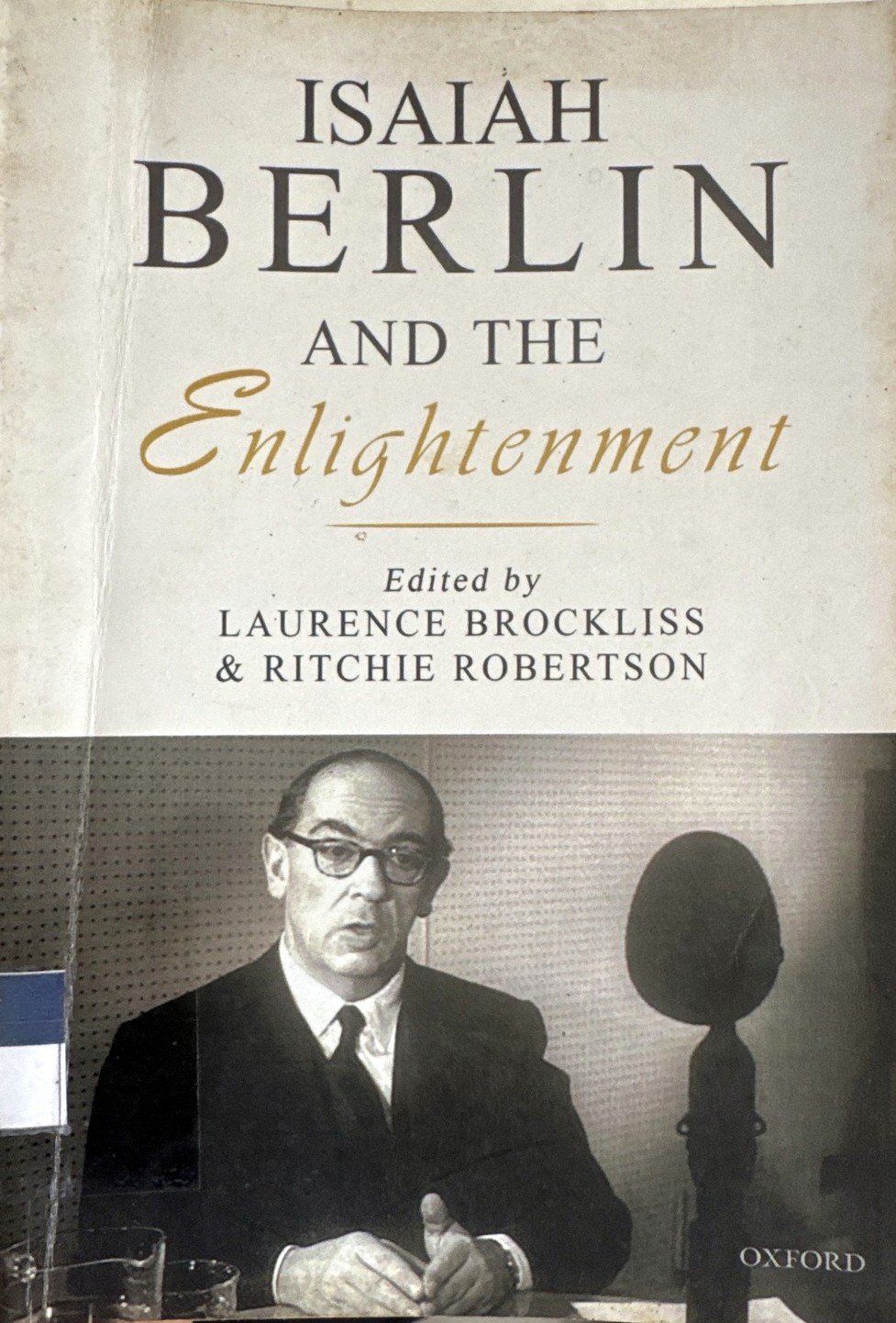
Oxford University Press, Oxford (penerbit edisi pertama; edisi eksemplar ini belum diperiksa) · Sampul depan memperlihatkan judul Isaiah Berlin and the Enlightenment, nama penyunting Laurence Brockliss dan Ritchie Robertson, logo OXFORD, serta foto hitam-putih Isaiah Berlin di depan mikrofon. Edisi pertama terbit 2016 oleh Oxford University Press (bersampul keras, ISBN 9780198783930, xiv + 258 hlm.). Eksemplar ini tampak bersampul lunak; apakah ini cetakan bersampul lunak tersendiri belum dapat dipastikan, dan tahun cetak, ISBN, serta jumlah halaman eksemplar ini belum diverifikasi. Terdapat label perpustakaan berwarna biru-putih pada tepi kiri sampul depan. · 2016
Abstract
Edited by Laurence Brockliss and Ritchie Robertson, this collection grew out of a conference at Wolfson College, Oxford, and reassesses Isaiah Berlin as a historian of ideas. The contributors examine Berlin's conception of a long Enlightenment, from Machiavelli and Vico to Marx and Mill, and the concept of the Counter-Enlightenment he associated with Hamann and Herder. Chapters on Hume, Montesquieu, Rousseau, Diderot, Kant, Moses Hess and the Russian intelligentsia show that Berlin's portraits were often partial, indebted to a German historicist tradition represented by Meinecke, and that some figures he assigned to the Counter-Enlightenment were closer to the Enlightenment than he recognised. A final part, with contributions by Jeremy Waldron and Michael Ignatieff, considers Berlin's legacy for political theory and constitutionalism. The book is important for the history of ideas, value pluralism and debates about modernity.
Identifier
KBA-BKU-2016-0003
Type
Buku
Publisher
Oxford University Press, Oxford (penerbit edisi pertama; edisi eksemplar ini belum diperiksa)
Date Issued
2016
Bibliographic Citation
Sampul depan memperlihatkan judul Isaiah Berlin and the Enlightenment, nama penyunting Laurence Brockliss dan Ritchie Robertson, logo OXFORD, serta foto hitam-putih Isaiah Berlin di depan mikrofon. Edisi pertama terbit 2016 oleh Oxford University Press (bersampul keras, ISBN 9780198783930, xiv + 258 hlm.). Eksemplar ini tampak bersampul lunak; apakah ini cetakan bersampul lunak tersendiri belum dapat dipastikan, dan tahun cetak, ISBN, serta jumlah halaman eksemplar ini belum diverifikasi. Terdapat label perpustakaan berwarna biru-putih pada tepi kiri sampul depan.
B802 — Filsafat modern: Pencerahan dan filsafat abad ke-18
LCSH Subject
Berlin, Isaiah, 1909-1997; Enlightenment; Philosophy, Modern--18th century; Intellectual history
BISAC Category
PHI016000 PHILOSOPHY / History & Surveys / Modern; PHI019000 PHILOSOPHY / Political
Language
Inggris
Description
Isaiah Berlin and the Enlightenment is an academic collection edited by Laurence Brockliss and Ritchie Robertson, two leading intellectual historians at the University of Oxford. Laurence Brockliss is a historian of early modern France and Europe, with particular interests in the history of education, science and medicine, and was for many years a Fellow of Magdalen College, Oxford. Ritchie Robertson is a Germanist and historian of ideas who held the Taylor Professorship of German at Oxford and is widely known for his work on Kafka, German-Jewish literature and the Enlightenment; he is also a Fellow of the British Academy. Together they gathered specialists from philosophy, political theory, history, German and Russian literature and Jewish studies to reassess Isaiah Berlin's legacy as a historian of ideas.
Isaiah Berlin (1909–1997), the figure at the centre of the book, was born in Riga, witnessed the Russian Revolution in Petrograd as a child, and emigrated with his family to England. He spent almost his entire career at Oxford, where he became Chichele Professor of Social and Political Theory, founding President of Wolfson College, and later President of the British Academy. His essay on two concepts of liberty, his defence of value pluralism, and his writings on Vico, Hamann, Herder and the Russian thinkers made him one of the most influential public intellectuals of the twentieth-century English-speaking world. The concept of the Counter-Enlightenment, which he popularised, became one of the most widely used and most contested frameworks in modern intellectual history.
The book grew out of a conference on Isaiah Berlin's Enlightenment organised by the two editors and hosted at Wolfson College, Oxford, the college Berlin himself founded. The results were published by Oxford University Press in 2016 in hardback (ISBN 9780198783930), with a physical description of xiv + 258 pages, and also made available electronically through Oxford Scholarship Online. Searchable catalogues record it as a first edition. The cover of this copy shows the OXFORD logo, so the publisher is certain, but whether this copy is a separate paperback printing or another form cannot be confirmed, since online catalogues mainly record the hardback edition.
The book is organised in four main parts: the idea in context, Enlightenment thinkers, the question of Counter-Enlightenments, and Berlin's legacy. Laurence Brockliss's introduction observes that Berlin tends to be neglected by professional philosophers and intellectual historians while being greatly admired by the educated public; the volume therefore chooses to assess Berlin mainly as a historian of ideas rather than as a philosopher or a spokesman for liberalism. The contextual part includes Avi Lifschitz's study of Berlin's position between Friedrich Meinecke and Ernst Cassirer, which shows how much Berlin inherited from the German historicist tradition, and T. J. Reed's essay on Kant and the Enlightenment, which criticises Berlin's simplifications of Kant, especially his reading of the phrase about the crooked timber of humanity.
To understand the background of this book, it should be noted that Berlin's views on the Enlightenment are scattered across many essays and lectures rather than set out in a single systematic monograph. The anthology The Age of Enlightenment (1956), which he compiled for a series on the philosophers of the eighteenth century, contains his introduction and commentary on Locke, Voltaire, Berkeley, Hume and their contemporaries. His essays on Vico, Hamann and Herder were later collected by Henry Hardy, the principal editor of Berlin's works, in Three Critics of the Enlightenment (2000). Because of this scattered character, the contributors to this volume set out to reconstruct Berlin's conception from a range of texts, while comparing it with more recent scholarship on the Enlightenment.
The part on Enlightenment thinkers tests how Berlin read key figures. David Leopold assesses Berlin's reading of Marx; P. J. E. Kail discusses Hume; Karen O'Brien examines Montesquieu; Christopher Brooke discusses Rousseau, whom, he argues, Berlin never treated as a serious theorist; and Alan Ryan compares Berlin's liberalism with that of John Stuart Mill. Most contributors find that Berlin's portraits of these thinkers are often inaccurate or partial, even if intuitively sharp.
The part on the Counter-Enlightenment focuses on the figures Berlin placed on the far side of the Enlightenment. Ritchie Robertson writes on Machiavelli; John Robertson examines Vico and questions the historical coherence of Berlin's portrait of him; Marian Hobson discusses Diderot and Hamann and resists any overly simple categorisation; Kevin Hilliard assesses Berlin's reading of Herder; Ken Koltun-Fromm discusses Moses Hess; and Derek Offord examines Berlin's relationship to the Russian intelligentsia, a field very close to Berlin's own biography. The two editors also contribute a joint study arguing that Berlin's dichotomy between Enlightenment and Counter-Enlightenment is too crude, excludes German thinkers such as Kant from the Enlightenment, and contains an element of myth-making.
The concluding part on Berlin's legacy features Jeremy Waldron, who argues that Berlin's focus on moral and political concepts pushed political theory away from the study of institutional design, and that Enlightenment constitutionalism was in fact pluralist. Michael Ignatieff, Berlin's biographer, offers a defence, suggesting that Berlin took the lessons of Enlightenment constitutionalism for granted. Recurring key concepts throughout the book are the Counter-Enlightenment, value pluralism versus monism, historicism, Romanticism, liberalism, and the question of how the history of ideas can be written fairly without falling into polemic.
The scholarly reception of the book shows that it has been read as a serious critical study. Charles Blattberg's review in Notre Dame Philosophical Reviews (2017) noted that most contributors find serious problems in Berlin's historical work and that many of their criticisms are convincing. The review also argued, however, that Berlin's history of ideas cannot be separated from his philosophy, since in his work the Enlightenment stands for monism and the Counter-Enlightenment for pluralism, and that Berlin deserves great credit for reviving the question of the one and the many. The review also questioned parts of Waldron's interpretation and Ignatieff's defence, and doubted a psychological explanation, offered in one chapter, that links Berlin's views to childhood trauma.
The book's relevance to Indonesia, Southeast Asia and the Muslim world lies in the wider debate about the Enlightenment, modernity and pluralism. The Enlightenment and Counter-Enlightenment framework is often used, directly or indirectly, to read tensions between universal values and cultural particularity, including in debates on democracy, human rights and the role of religion in public life. Berlin's idea of value pluralism is also frequently cited in discussions of plural societies, including in Indonesia. For the study of Aceh, the book does not discuss the region, but it offers conceptual tools for thinking more carefully about the relationship between law, local tradition and the universal claims of modernity. The book also complements the library owner's interest in the thought of Isaiah Berlin.
Physically, this copy appears from its cover to be a paperback, with the OXFORD logo on the front cover. The cover illustration is a black-and-white photograph of Isaiah Berlin speaking at a microphone. A blue and white library label is attached on the left edge of the front cover. The printing year, ISBN and page count of this copy have not yet been checked directly against the title page or copyright page.
As part of the KBA13 Academy Archive and Library, this book serves as a reference for the study of Isaiah Berlin's thought, the history of the Enlightenment and the Counter-Enlightenment, value pluralism, and the historiography of modern political ideas. The archive also provides material that informs the studies of KBA13 Academy and KBA13 Insight.
Laurence Brockliss (editor), Ritchie Robertson (editor) (ed.), “Isaiah Berlin and the Enlightenment”, Oxford University Press, Oxford (penerbit edisi pertama; edisi eksemplar ini belum diperiksa), Sampul depan memperlihatkan judul Isaiah Berlin and the Enlightenment, nama penyunting Laurence Brockliss dan Ritchie Robertson, logo OXFORD, serta foto hitam-putih Isaiah Berlin di depan mikrofon. Edisi pertama terbit 2016 oleh Oxford University Press (bersampul keras, ISBN 9780198783930, xiv + 258 hlm.). Eksemplar ini tampak bersampul lunak; apakah ini cetakan bersampul lunak tersendiri belum dapat dipastikan, dan tahun cetak, ISBN, serta jumlah halaman eksemplar ini belum diverifikasi. Terdapat label perpustakaan berwarna biru-putih pada tepi kiri sampul depan., 2016. KBA13 Academy Archive and Library, KBA-BKU-2016-0003.