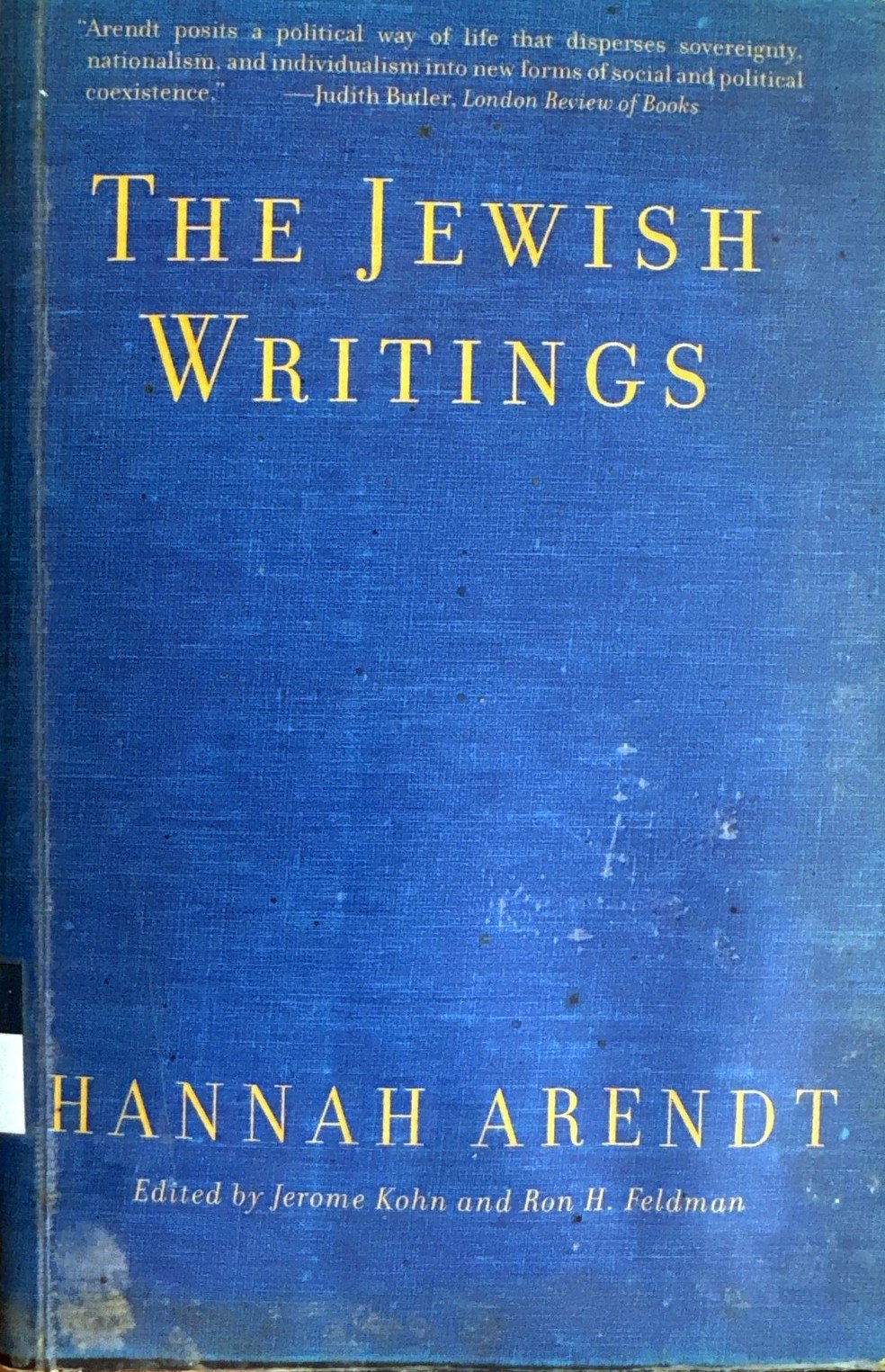
Schocken Books, New York (penerbit edisi pertama; edisi eksemplar ini belum diperiksa) · Pada sampul depan terlihat judul, nama Hannah Arendt, nama penyunting Jerome Kohn dan Ron H. Feldman, serta kutipan pujian dari Judith Butler (London Review of Books), dengan sampul biru bertekstur kain dan huruf emas. Ciri ini sesuai dengan terbitan Schocken Books; edisi sampul keras (2007) atau sampul lunak (2008, ISBN 9780805211948) belum dapat dipastikan. Tahun cetak eksemplar ini, ISBN, dan jumlah halaman belum diperiksa. Sampul tampak aus dan terdapat label perpustakaan pada tepi kiri. · 2007
Abstract
This collection gathers Hannah Arendt's writings on the Jewish question, antisemitism, Zionism and Jewish politics from the early 1930s to the mid-1960s. Edited by Jerome Kohn and Ron H. Feldman and published by Schocken Books in 2007, it contains early essays on the Enlightenment and Rahel Varnhagen, a manuscript on antisemitism unpublished in Arendt's lifetime, her columns for the newspaper Aufbau, well-known essays such as We Refugees, The Jew as Pariah and Zionism Reconsidered, and documents from the controversy over Eichmann in Jerusalem. Many of its German texts appeared in English for the first time. The book shows how central the Jewish experience was to Arendt's political thought, especially her ideas of the pariah and the parvenu, the political action of minorities, the fate of stateless people, and the proposal of an Arab-Jewish federation in Palestine. The collection remains a point of debate on Zionism, nationalism and refugee rights today.
Identifier
KBA-BKU-2007-0001
Type
Buku
Publisher
Schocken Books, New York (penerbit edisi pertama; edisi eksemplar ini belum diperiksa)
Date Issued
2007
Bibliographic Citation
Pada sampul depan terlihat judul, nama Hannah Arendt, nama penyunting Jerome Kohn dan Ron H. Feldman, serta kutipan pujian dari Judith Butler (London Review of Books), dengan sampul biru bertekstur kain dan huruf emas. Ciri ini sesuai dengan terbitan Schocken Books; edisi sampul keras (2007) atau sampul lunak (2008, ISBN 9780805211948) belum dapat dipastikan. Tahun cetak eksemplar ini, ISBN, dan jumlah halaman belum diperiksa. Sampul tampak aus dan terdapat label perpustakaan pada tepi kiri.
DS141 .A6993 2007 — Yahudi: sejarah politik dan sosial, antisemitisme, dan persoalan Yahudi
LCSH Subject
Jews--Politics and government--20th century; Jews--Identity; Antisemitism; Zionism; Jewish question
BISAC Category
HIS022000 HISTORY / Jewish; PHI019000 PHILOSOPHY / Political
Language
Inggris
Description
The Jewish Writings gathers Hannah Arendt's (1906–1975) writings on the Jewish question, antisemitism, Zionism and Jewish politics, composed over four decades, from the early 1930s to the mid-1960s. Arendt was born in Hanover and raised in Königsberg, studied philosophy at Marburg, Freiburg and Heidelberg, and wrote a dissertation on the concept of love in Augustine under the supervision of Karl Jaspers. After the Nazis came to power in 1933 she was briefly detained, then fled to Paris, where she worked for Jewish organisations helping young Jews emigrate to Palestine. In 1941 she reached the United States as a stateless refugee, and she became an American citizen only a decade later. She is widely known for The Origins of Totalitarianism (1951), The Human Condition (1958) and Eichmann in Jerusalem (1963), and she taught at, among other institutions, the University of Chicago and the New School for Social Research in New York.
The volume was edited by Jerome Kohn and Ron H. Feldman. Kohn was once Arendt's teaching assistant at the New School, later became a trustee of the Hannah Arendt Bluecher Literary Trust, and has edited several posthumous collections of her work, such as Essays in Understanding and Responsibility and Judgment. Feldman had earlier edited The Jew as Pariah (1978), the first English anthology to collect Arendt's Jewish essays and to introduce a side of her thought that had until then received little attention. The Jewish Writings can be read as a major expansion of that project: much of its material, especially the texts originally written in German, became available in English for the first time, with many of the translations done by John E. Woods.
The first edition was published in hardcover by Schocken Books, New York, in 2007, as part of that publisher's series of new editions of Arendt's work. A Schocken paperback followed in early 2008 with the ISBN 9780805211948. Both editions contain Kohn's preface, A Jewish Life: 1906–1975, a note on the text, a publication history for each piece, and Feldman's introduction, which takes its title from the theme of the pariah. At the end comes an afterword by Edna Brocke, Arendt's niece, offering personal recollections of her aunt.
The book is arranged by decade. The first part, on the 1930s, contains early essays such as The Enlightenment and the Jewish Question and a piece on Rahel Varnhagen, the nineteenth-century Berlin Jewish woman who was the subject of Arendt's biography. This part also includes notes on the education of Jewish youth, a review of Martin Buber, and a long manuscript on antisemitism that was not published in Arendt's lifetime and can be read as early material for the first part of The Origins of Totalitarianism. The second part, on the 1940s, is by far the largest. It contains Arendt's columns for the New York German-language newspaper Aufbau, which among other things called for a Jewish army to fight Hitler, together with the well-known essays We Refugees, The Jew as Pariah: A Hidden Tradition, Zionism Reconsidered, The Jewish State: Fifty Years After, and To Save the Jewish Homeland.
The third and fourth parts, on the 1950s and 1960s, are shorter. They include the essay Peace or Armistice in the Near East?, a tribute to Judah L. Magnes, a review of Léon Poliakov's work on the Holocaust, and a set of documents from the controversy over Eichmann in Jerusalem, including Arendt's letter to Gershom Scholem, her answers to questions put by the journalist Samuel Grafton, a conversation with Thilo Koch, and her reply to Jacob Robinson. Readers can therefore trace the development of Arendt's thought from a critical Zionist activist in the 1930s, to a sharp critic of mainstream Zionism's direction in the 1940s, to a figure widely denounced in many Jewish circles after 1963.
Several key concepts stand out in the collection. First is the pairing of pariah and parvenu, which Arendt took from Bernard Lazare: the parvenu seeks acceptance by majority society by denying his origins, whereas the conscious pariah chooses a place at the margins and turns it into a critical vantage point. Second is the idea that Jews must act politically as a Jewish people rather than rely on the protection of philanthropists or states. Third is the critique of the nation-state's inability to protect minorities and stateless people, which she later formulated as the right to have rights. Fourth is the proposal of an Arab-Jewish federation or binational arrangement in Palestine, as an alternative to a Jewish state that, in her view, would depend on great powers and live in permanent hostility with its neighbours.
The book's reception has been wide and contested. Judith Butler wrote a long review in the London Review of Books in 2007, part of which is printed on the cover, reading Arendt as a resource for a Jewish critique of nationalism and for thinking about plural coexistence. Such readings were welcomed in some quarters on the left, but rejected by critics who argue that Arendt misread the situation in Palestine in the 1940s and that her treatment of the Jewish councils in the Eichmann book was unfair. Arendt scholars broadly agree that the collection shows how central the Jewish experience was to her political thought, something often set aside in readings focused on her philosophy of action and the public realm. Some reviewers also noted that several of the journalistic pieces are occasional and repetitive.
The book's relevance to Indonesia, Southeast Asia and the Muslim world should be stated honestly. Arendt did not write about Islam or about this region, and her views of the Arabs in some pieces reflect the limits of her time. Yet her analysis of refugees, statelessness and the fate of minorities within the nation-state offers a useful framework for reading present-day problems in the region, for example the Rohingya refugee crisis, in which boats have repeatedly landed on the coast of Aceh and prompted public debate about humanitarian duty and the limits of what local communities can bear. Her critique of state Zionism and her binational proposal are also often cited in discussions of Palestine, an issue that commands great attention in Indonesia. For Muslim readers, her writings on antisemitism are at the same time a reminder of the need to distinguish carefully between criticism of Israeli state policy and hatred of Jews as a group.
For legal studies and political anthropology in Aceh, Arendt's ideas about the relationship between group identity, political action and legal protection can also serve as comparative material. Aceh has long experience of armed conflict, internal displacement and peace negotiation, and of the question of how a community with a strong historical identity negotiates its place within the nation-state. Such comparisons must of course be made with care, since the context of twentieth-century European Jewry is very different; but the categories of pariah, parvenu and the right to have rights can help sharpen research questions about minorities, refugees and citizenship.
Physically, this copy has a blue cover with a cloth-like texture and gold lettering, and it carries a blurb from Judith Butler taken from the London Review of Books. These features match the Schocken Books publication, but whether this copy is the 2007 hardcover or the 2008 paperback cannot be determined from the front-cover photograph alone. It looks worn from use, and there is a library label on the left edge of the cover. The title page, copyright page, ISBN and page count of this copy have not yet been checked.
As part of the Arsip dan Pustaka KBA13 Academy, this book serves as a reference for the study of Hannah Arendt's political thought, the history of antisemitism and Zionism, the problems of refugees and statelessness, and the relationship between religious identity, minorities and the nation-state. The archive also provides material that informs the studies carried out at KBA13 Academy and KBA13 Insight.
Rights
Koleksi pribadi KBA13 Academy
Contributor
Jerome Kohn (editor)Ron H. Feldman (editor)John E. Woods (penerjemah sebagian teks dari bahasa Jerman)Edna Brocke (penulis kata penutup)
Hannah Arendt, Jerome Kohn (editor), Ron H. Feldman (editor), John E. Woods (penerjemah sebagian teks dari bahasa Jerman), Edna Brocke (penulis kata penutup), “The Jewish Writings”, Schocken Books, New York (penerbit edisi pertama; edisi eksemplar ini belum diperiksa), Pada sampul depan terlihat judul, nama Hannah Arendt, nama penyunting Jerome Kohn dan Ron H. Feldman, serta kutipan pujian dari Judith Butler (London Review of Books), dengan sampul biru bertekstur kain dan huruf emas. Ciri ini sesuai dengan terbitan Schocken Books; edisi sampul keras (2007) atau sampul lunak (2008, ISBN 9780805211948) belum dapat dipastikan. Tahun cetak eksemplar ini, ISBN, dan jumlah halaman belum diperiksa. Sampul tampak aus dan terdapat label perpustakaan pada tepi kiri., 2007. KBA13 Academy Archive and Library, KBA-BKU-2007-0001.