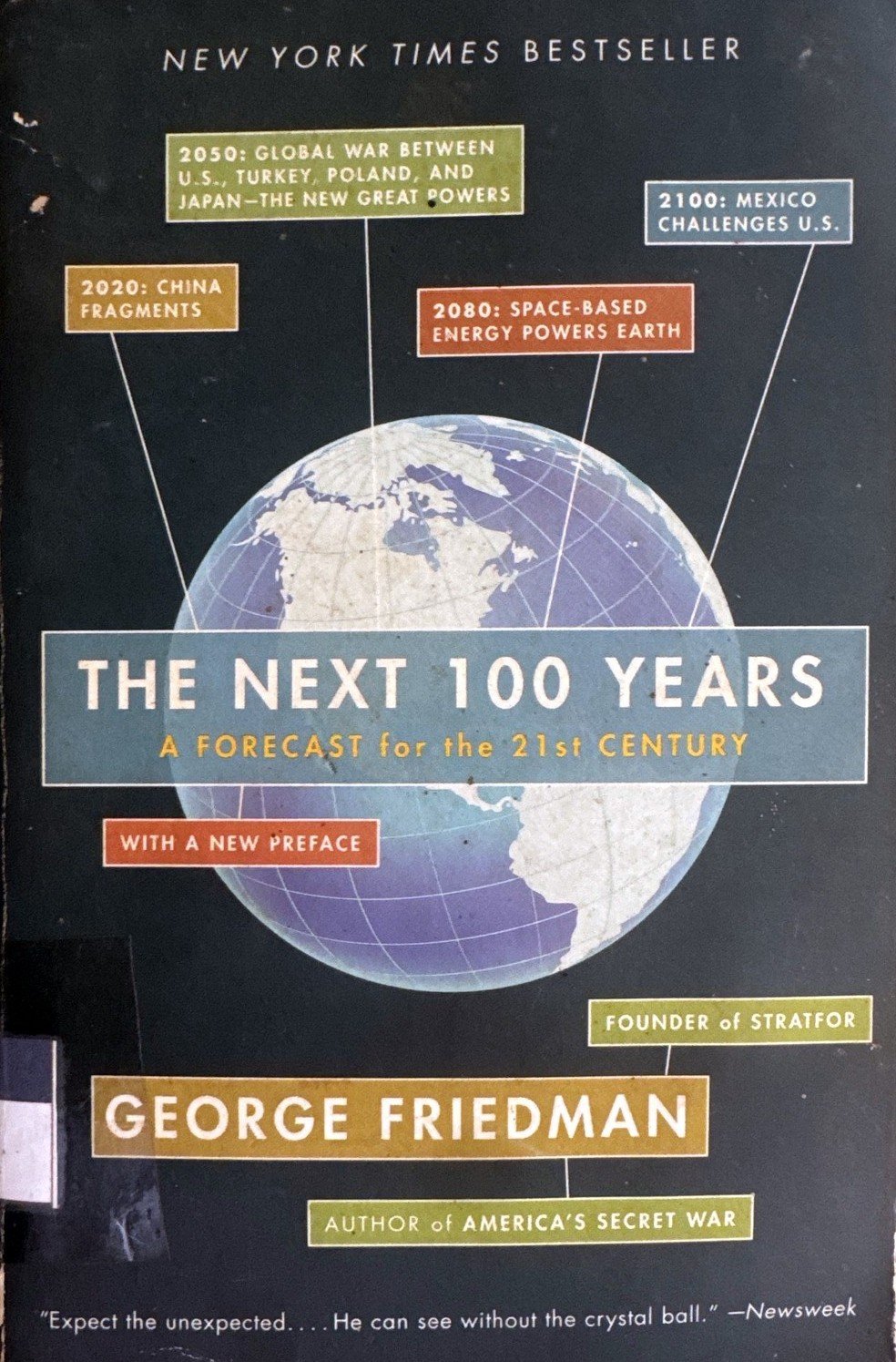
Doubleday, New York (penerbit edisi pertama; edisi eksemplar ini belum diperiksa) · Pada sampul depan terlihat judul, nama George Friedman dengan keterangan pendiri Stratfor dan penulis America's Secret War, frasa tentang kata pengantar baru, label buku laris New York Times, serta label ramalan untuk tahun 2020, 2050, 2080, dan 2100. Frasa kata pengantar baru menunjukkan edisi sampul lunak 2010, yang lazim tercatat sebagai terbitan Anchor Books (ISBN 9780767923057), tetapi penerbit, tahun cetak eksemplar ini, ISBN, dan jumlah halaman belum diperiksa. Terdapat label perpustakaan di sisi kiri sampul dan cap di pojok kanan atas. · 2009
Abstract
In this book George Friedman, founder of the geopolitical analysis firm Stratfor, forecasts the course of world politics across the twenty-first century. Starting from the thesis that geography, demography and long-term interest constrain the choices of states, he argues that this will remain an American century because the United States controls the world's sea lanes. Friedman forecasts the waning of the war against jihadists, a second cold war with Russia, the possible fragmentation of China, the rise of Japan, Turkey and Poland, a limited global war around 2050 decided by control of space, and a Mexican challenge to the United States towards 2100. The first edition was published by Doubleday in 2009, and a paperback with a new preface followed in 2010. Seen from 2026, some forecasts have proved wrong, notably on China and Russia, while others, such as the rise of Poland and Turkey, look closer to reality.
Identifier
KBA-BKU-2009-0003
Type
Buku
Publisher
Doubleday, New York (penerbit edisi pertama; edisi eksemplar ini belum diperiksa)
Date Issued
2009
Bibliographic Citation
Pada sampul depan terlihat judul, nama George Friedman dengan keterangan pendiri Stratfor dan penulis America's Secret War, frasa tentang kata pengantar baru, label buku laris New York Times, serta label ramalan untuk tahun 2020, 2050, 2080, dan 2100. Frasa kata pengantar baru menunjukkan edisi sampul lunak 2010, yang lazim tercatat sebagai terbitan Anchor Books (ISBN 9780767923057), tetapi penerbit, tahun cetak eksemplar ini, ISBN, dan jumlah halaman belum diperiksa. Terdapat label perpustakaan di sisi kiri sampul dan cap di pojok kanan atas.
CB161 .F77 2009 — Peradaban: ramalan dan studi masa depan
LCSH Subject
Twenty-first century--Forecasts; Geopolitics--Forecasting; World politics--21st century--Forecasting; Economic forecasting
BISAC Category
POL011000 POLITICAL SCIENCE / International Relations / General; POL040000 POLITICAL SCIENCE / American Government / General
Language
Inggris
Description
The Next 100 Years: A Forecast for the 21st Century is George Friedman's attempt to forecast the direction of world politics across the twenty-first century using a geopolitical approach. Friedman was born in Budapest in 1949 to a Hungarian Jewish family that had survived the Holocaust and later emigrated to the United States. He studied at the City College of New York and earned a doctorate in government from Cornell University, then taught political science for about two decades at Dickinson College in Pennsylvania. In 1996 he founded Stratfor (Strategic Forecasting), a private intelligence and geopolitical analysis company based in Austin, Texas, and led it until 2015, when he left to found Geopolitical Futures. Before this book he had written, among others, The Coming War with Japan (1991, with Meredith LeBard), The Future of War (1996, with Meredith Friedman), and America's Secret War (2004), whose title appears on the cover of this copy.
The first edition was published in hardcover by Doubleday, New York, in January 2009, and quickly reached the New York Times bestseller list. A paperback edition appeared in January 2010 with a new preface, widely recorded as an Anchor Books publication, the paperback line within the Knopf Doubleday group, with the ISBN 9780767923057; the Penguin Random House website now lists it under the Vintage imprint. The wording on this copy's cover, namely the phrase about a new preface, indicates that this copy is that paperback edition or a reprint of it. The book was followed by The Next Decade (2011), which narrowed the forecast's horizon to the 2010s, and it has been translated into many languages.
The book falls into two parts. The opening part sets out the method and basic framework: Friedman argues that long-range forecasting becomes possible when the analyst sets aside the intentions of leaders and focuses on the geographic, demographic and economic constraints that force states to act in particular ways. He begins with the thesis that the world's centre of gravity has shifted from the North Atlantic to North America, and that the twenty-first century will be an American century because the United States controls both of the world's great oceans. He then discusses the American war with jihadist groups, falling birth rates in developed countries, changes in computing technology, and the culture wars that accompany changes in family structure. The later part is arranged chronologically by decade, from the 2010s and 2020s to the end of the century.
For the 2010s and early 2020s, Friedman forecast that the war against the jihadists would subside and be replaced by a shorter second cold war between the United States and Russia, as Russia sought to restore its influence over the former Soviet space. He expected that Russia would eventually collapse under the weight of demography and military spending. For China he set out two possibilities, an iron-fisted crackdown by the central government or fragmentation driven by inequality between the coast and the interior, and he leaned towards the second; the cover of this copy carries a label about China fragmenting in 2020. Three new powers would then emerge, Japan, Turkey and Poland, each filling a vacuum left by China and Russia.
By mid-century, in Friedman's scenario, this rivalry culminates in a global war around 2050, in which Japan and Turkey, in alliance, confront the United States, Poland with its Eastern European bloc, and several other partners. Friedman himself stresses that he cannot possibly know the details or the timing of this war, and the scenario serves more as an illustration of geopolitical logic than as a literal prediction. He describes a limited war, with far fewer casualties than earlier world wars, decided by control of space, hypersonic weapons and orbital bases. After the war he imagines a golden economic decade for the United States, a shift to solar energy beamed from space around 2080, and finally a challenge from Mexico to American dominance of North America towards 2100.
The book's key concept is a soft geopolitical determinism: state action is constrained by geography and long-term interest, so that behaviour can be anticipated even when specific events cannot. Friedman also stresses the weight of demography, especially falling birth rates and ageing populations, as a driver of migration and political change. He emphasises, too, that American power rests on control of the sea lanes, and that American foreign policy aims less at creating order than at preventing the rise of a dominant power in Eurasia. Within this framework, small and middle powers matter because of their geographic position.
Seen from 2026, Friedman's forecasting record is mixed and must be judged honestly. China did not fragment by 2020; on the contrary, under Xi Jinping power became more centralised, so that the iron-fist scenario he thought less likely turned out closer to reality, and Stratfor itself revised that forecast in 2015. Russia did not collapse in the early 2020s; it instead launched a full-scale invasion of Ukraine in 2022, a development partly in line with Friedman's picture of a Russia trying to win back influence in the former Soviet space and provoking a new confrontation with the West. Poland has indeed raised its military spending sharply and plays a growing role on NATO's eastern flank, and Turkey has become more active in its neighbourhood, including in Syria after the fall of the Assad regime in late 2024. Japan has also begun to enlarge its defence budget. Yet the idea of a Japanese-Turkish alliance against the United States shows no real sign of emerging, and the forecasts for the second half of the century obviously cannot yet be tested.
The book's reception has been divided. Many general readers and some reviewers praised it as a stimulating way to think about the long-term structure of world politics, and it was widely read in policy circles; a 2012 press report, for instance, noted that Mitt Romney had read it. Critics, meanwhile, judged Friedman's approach too America-centred, too confident in geographic determinism, and too dismissive of the role of ideology, leadership and unexpected events. The record of The Coming War with Japan, which forecast an American-Japanese conflict that never happened, is also often raised as grounds for scepticism. The fairest reading probably treats the book not as a calendar of events but as a methodological exercise in how geographic forces shape the choices of states.
The book's relevance to Indonesia and Southeast Asia is indirect. Friedman does not make Indonesia a principal actor, but his framework of control over sea lanes, rivalry in the Western Pacific and Japan's maritime resurgence bears directly on the Strait of Malacca and the South China Sea, where Indonesian interests are at stake. For the Muslim world, his forecast of Turkey as a great power extending its influence into the Arab world, the Caucasus and the Balkans invites comparison with the course of Turkish foreign policy after 2010. For Aceh, which sits at the entrance to the Strait of Malacca and on the trade routes of the Indian Ocean, the book is a reminder that geographic position always carries strategic meaning in the calculations of great powers. These links, however, are material for analytical comparison, not a claim that Friedman discusses Aceh specifically.
Physically, this copy is a paperback. The front cover describes Friedman as the founder of Stratfor and the author of America's Secret War, carries the phrase about a new preface, and bears a New York Times bestseller label. The cover also lists forecast labels: China fragments in 2020; a global war between the United States, Turkey, Poland and Japan in 2050; space-based energy in 2080; and Mexico challenges the United States in 2100. There is a library label on the left side of the cover and a stamp in the top right corner. The copyright page, year of this printing, ISBN and page count of this copy have not yet been checked.
As part of the Arsip dan Pustaka KBA13 Academy, this book serves as a reference for the study of geopolitics, long-range strategic forecasting, great-power politics in the twenty-first century and the methodology of private intelligence analysis, as well as material for a critical assessment of the limits of geopolitical forecasting. The archive also provides material that informs the studies carried out at KBA13 Academy and KBA13 Insight.
George Friedman, “The Next 100 Years: A Forecast for the 21st Century”, Doubleday, New York (penerbit edisi pertama; edisi eksemplar ini belum diperiksa), Pada sampul depan terlihat judul, nama George Friedman dengan keterangan pendiri Stratfor dan penulis America's Secret War, frasa tentang kata pengantar baru, label buku laris New York Times, serta label ramalan untuk tahun 2020, 2050, 2080, dan 2100. Frasa kata pengantar baru menunjukkan edisi sampul lunak 2010, yang lazim tercatat sebagai terbitan Anchor Books (ISBN 9780767923057), tetapi penerbit, tahun cetak eksemplar ini, ISBN, dan jumlah halaman belum diperiksa. Terdapat label perpustakaan di sisi kiri sampul dan cap di pojok kanan atas., 2009. KBA13 Academy Archive and Library, KBA-BKU-2009-0003.