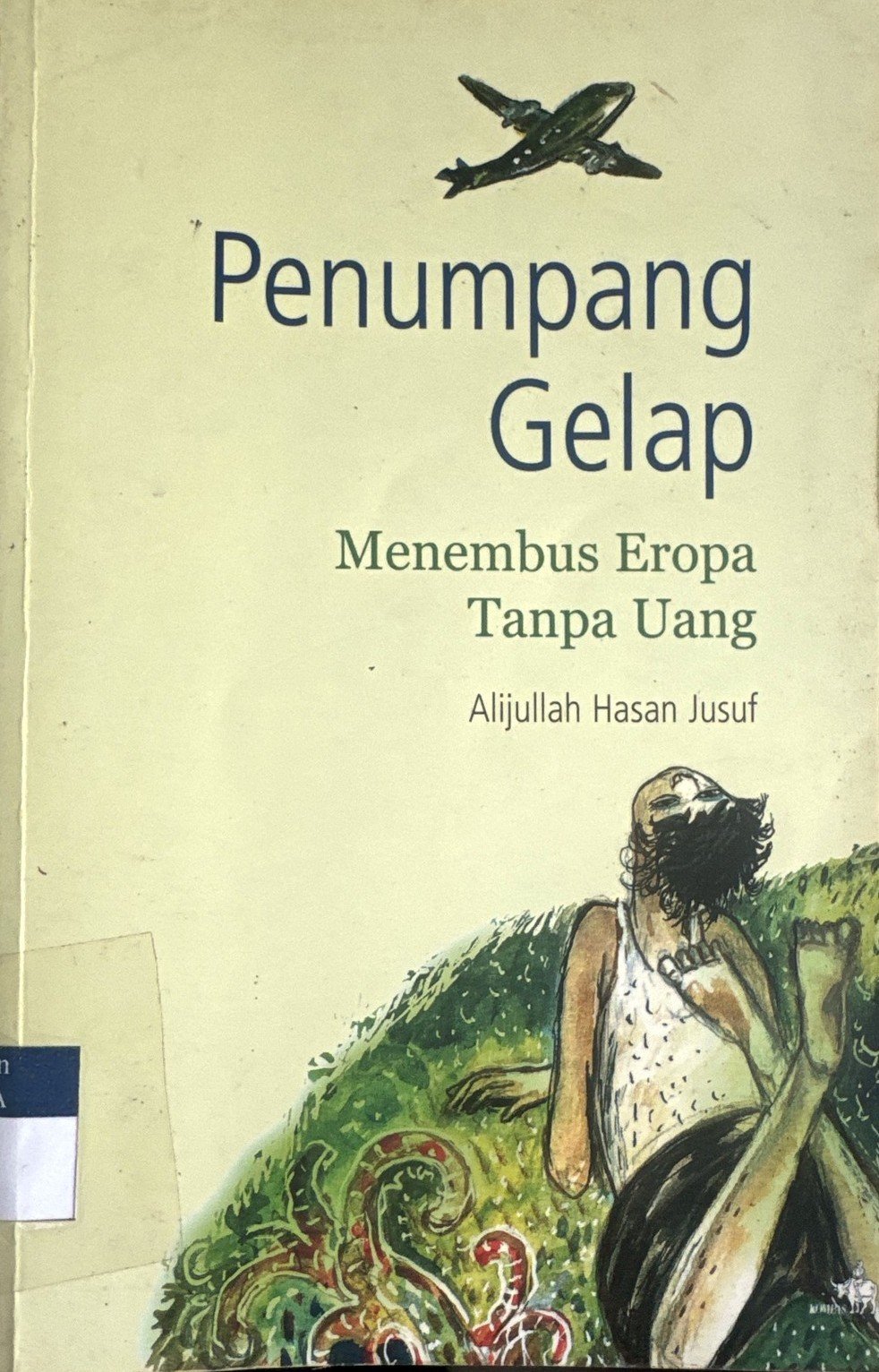
Penerbit Buku Kompas (PT Kompas Media Nusantara), Jakarta · Jusuf, Alijullah Hasan. Penumpang Gelap: Menembus Eropa Tanpa Uang. Penyunting Mulyawan Karim. Jakarta: Penerbit Buku Kompas (PT Kompas Media Nusantara), Oktober 2015. 312 hlm.; 21 cm. ISBN 978-979-709-978-7. Jilid pertama seri Penumpang Gelap. Data ini dicocokkan dengan katalog Perpustakaan Riset BPK RI (Jakarta: Kompas, 2015) dan katalog Dinas Perpustakaan dan Kearsipan Provinsi Kepulauan Riau (312 hlm.; 21 cm; nomor panggil DDC 899.221 3), yang mencatat cetakan 2016 dengan ISBN yang sama. Dalam beberapa daftar toko buku, judul ini juga tercatat dengan subjudul "Jakarta - Paris Lewat Amsterdam" (ISBN sama). Sampul depan eksemplar ini berwarna kuning kehijauan muda dengan ilustrasi pesawat dan pemuda berjanggut berbaring di bukit berumput; logo Penerbit Buku Kompas di kanan bawah; label perpustakaan di tepi kiri sampul. Tahun cetak eksemplar ini belum diperiksa. · 2015
Abstract
This book is the memoir of Alijullah Hasan Jusuf, an emigrant from Blang Paseh, Sigli, Aceh, who later worked for decades as local staff at the Indonesian Embassy in Paris and became known as "Lurah Paris". Published by Penerbit Buku Kompas in 2015, it tells of his adolescence in Jakarta in 1967, when he lived alone, sold newspapers and slept in a cigarette box amid waves of demonstrations. The roar of aircraft from Kemayoran Airport fed his dream of flying abroad without money. Using a discarded boarding pass, he slipped aboard a Garuda flight to Amsterdam as a stowaway, but was sent back because he had no documents. Written from 1974 onward and published four decades later, the story is the first volume of a memoir series continued in Paris Je Reviendrai (2016) and Lurah Paris. It is personal testimony about daring to dream and about late-1960s Indonesia.
Identifier
KBA-BKU-2015-0003ISBN 978-979-709-978-7
Type
Buku
Publisher
Penerbit Buku Kompas (PT Kompas Media Nusantara), Jakarta
Date Issued
2015
Bibliographic Citation
Jusuf, Alijullah Hasan. Penumpang Gelap: Menembus Eropa Tanpa Uang. Penyunting Mulyawan Karim. Jakarta: Penerbit Buku Kompas (PT Kompas Media Nusantara), Oktober 2015. 312 hlm.; 21 cm. ISBN 978-979-709-978-7. Jilid pertama seri Penumpang Gelap. Data ini dicocokkan dengan katalog Perpustakaan Riset BPK RI (Jakarta: Kompas, 2015) dan katalog Dinas Perpustakaan dan Kearsipan Provinsi Kepulauan Riau (312 hlm.; 21 cm; nomor panggil DDC 899.221 3), yang mencatat cetakan 2016 dengan ISBN yang sama. Dalam beberapa daftar toko buku, judul ini juga tercatat dengan subjudul "Jakarta - Paris Lewat Amsterdam" (ISBN sama). Sampul depan eksemplar ini berwarna kuning kehijauan muda dengan ilustrasi pesawat dan pemuda berjanggut berbaring di bukit berumput; logo Penerbit Buku Kompas di kanan bawah; label perpustakaan di tepi kiri sampul. Tahun cetak eksemplar ini belum diperiksa.
DS644.1.A45 — Indonesia: biografi tokoh (perkiraan nomor kelas; belum diverifikasi)
LCSH Subject
Alijullah Hasan Jusuf, 1951-; Stowaways--Indonesia--Biography; Indonesians--France--Paris--Biography; Voyages and travels; Aceh (Indonesia)--Emigration and immigration
BISAC Category
BIO026000 BIOGRAPHY & AUTOBIOGRAPHY / Personal Memoirs; TRV009000 TRAVEL / Europe / General
Language
Indonesia
Description
Penumpang Gelap: Menembus Eropa Tanpa Uang is the memoir of Alijullah Hasan Jusuf, an Acehnese emigrant who spent most of his life in Paris. According to interviews in Serambi Indonesia (October 2015) and detikNews (April 2016), he comes from Blang Paseh, Sigli, in Pidie Regency, and was born around 1951. As a boy he left his village, travelling by train to Brandan, then to Medan, and crossing to Java by ship. In Jakarta he finished secondary school while selling newspapers. After reaching Europe he settled in Paris, continued his education, and worked as local staff at the Indonesian Embassy (KBRI) in France for decades, retiring in March 2013. Because he habitually looked after the needs of Indonesians there, he was nicknamed "Lurah Paris", the village head of Paris. He is not a professional writer or academic, but the witness and protagonist of an extraordinary life story.
The book was published by Penerbit Buku Kompas in Jakarta in October 2015. The National Library of Indonesia catalogue records Mulyawan Karim as its editor, and library catalogues record it at 312 pages, 21 cm, with ISBN 978-979-709-978-7. According to Serambi Indonesia, it was launched at the Gramedia bookstore in Grand Indonesia, Jakarta, on 17 October 2015, with the senior Kompas journalist Budiarto Shambazy as discussant. The author has said that he began writing the story in 1974, first by hand and then on a typewriter, so the manuscript waited some four decades before publication. A review in LPM Progress states that he wrote it in response to encouragement from Mohammad Hatta and Soemitro Djojohadikusumo to share his experience. The book is the first volume of a series: the second, Paris Je Reviendrai: Aku Kan Kembali, appeared in 2016, followed later by Lurah Paris: 43 Tahun Berkelana di Paris.
It should be stressed that the term penumpang gelap in the title means a stowaway, an air passenger without a ticket or official documents, not a hitchhiker on the road. The heart of the story is a clandestine journey by air. According to the publisher's synopsis, the story begins in April 1967, when Alijullah, a teenager from Sigli, is living alone in Jakarta amid the wave of demonstrations after 1965. He sells newspapers on the pavement, joins the flow of protests, and sleeps in a cigarette box. Every night he hears the roar of aircraft from Kemayoran Airport, and from this grows his dream of flying abroad, something that in those days only the rich could afford. He then looks for a shortcut.
The climax of this first volume is his attempt to slip aboard a Garuda Indonesia flight to Amsterdam using a discarded boarding pass. According to detikNews, he did reach the Netherlands in 1967, but because he had no documents he was treated as a stowaway, sent back to Jakarta and detained. The synopsis of the second volume explains that less than a year later he tried again, this time on a Qantas aircraft, and managed to enter Paris, where he lived without papers for about a year. The first volume therefore deals mainly with his adolescence in Jakarta, his dream of flight and the Amsterdam adventure, while the Paris story is developed further in the next volume. The individual chapter titles of this book could not be verified and are therefore not given here.
The key concepts that emerge from the book are the courage to dream amid poverty, perseverance, and the conviction that where there is a will there is a way. The story also touches on merantau, the tradition of leaving home to seek one's fortune that is very strong in Acehnese and Sumatran culture, and on the social mobility of a village boy who eventually moves among officials and national figures. At the same time, the book carries a complicated ethical layer, since its success rests on breaking aviation and immigration rules. Today's readers, at a time when aircraft stowaways are still reported as a security threat, need to read the story in the context of its time, the late 1960s, when airport security was far looser.
The book's reception is visible mainly in popular media and reader communities. Serambi Indonesia and detikNews profiled the author as an inspiring figure, and the book was listed among the nonfiction titles in the selection pool for the 2016 Anugerah Pembaca Indonesia, an award run by the Goodreads Indonesia community. On Goodreads it has an average rating of about 3.9 from a few dozen readers. A student review of the second volume praised its relaxed and easy-to-follow language, but also cautioned that some passages are unsuitable for child readers, who might imitate them. As far as could be found, no academic study has discussed the book specifically.
Within Indonesian literature, the book can be read alongside the wave of travel memoirs and stories of young people going abroad that has grown rapidly since the 2000s, such as backpackers' accounts and the stories of scholarship students in Europe. The difference is that this book is not a tourist travelogue but the life story of an emigrant in the late 1960s, so it belongs more to the genre of memoir and autobiography. Its historical value lies in its picture of Jakarta during the transition from the Old Order to the New Order and in its portrayal of Indonesian diaspora life in France.
Its relevance to Aceh is direct. The author is a son of Pidie, and his story adds to the record of the Acehnese diaspora in Europe and of the Acehnese tradition of merantau. Serambi Indonesia notes that he once looked after Teungku Muhammad Daud Beureueh when the Acehnese leader was in Paris, including being photographed with him in front of a Concorde aircraft, a small detail of interest for Aceh's social history. For Indonesia, the book shows the role of local embassy staff, who are rarely recorded in official diplomatic history. For the Muslim world and Southeast Asia, the story offers a picture of the experience of Asian Muslim migrants in Western Europe before the era of mass migration, although the book was not designed as a study of religion or migration.
Physically, the cover of this copy is light yellow-green, with an illustration of an airplane and a bearded young man lying on a grassy hill, decorated with batik-like motifs. At the bottom right is a small publisher's logo showing an ox or bull; this matches the identity of Penerbit Buku Kompas, the publisher recorded in online sources, although the logo on this copy has not been checked directly. On the left edge of the cover is a library label, which indicates that this copy was once part of another library's collection before entering this archive. The printing year, ISBN and page count of this copy have not yet been checked.
For researchers, the book is useful as a primary source in the form of personal testimony, not as a scholarly work. Its claims, for example about the journeys, encounters with prominent figures and events at airports, are the author's memories written down decades later, so they need to be read critically and compared with other sources when used in historical research. That is precisely where its value lies, since memoirs like this preserve the voices of ordinary people that are often lost from official history.
As part of the Arsip dan Pustaka KBA13 Academy, this book serves as a reference for studies of the Acehnese tradition of merantau, the Indonesian diaspora in Europe, Indonesian memoir and autobiography, and the social history of Jakarta in the late 1960s. The archive also provides material that informs the studies of KBA13 Academy and KBA13 Insight.
Alijullah Hasan Jusuf, Mulyawan Karim (editor), “Penumpang Gelap: Menembus Eropa Tanpa Uang [The Stowaway: Breaking Through to Europe Without Money]”, Penerbit Buku Kompas (PT Kompas Media Nusantara), Jakarta, Jusuf, Alijullah Hasan. Penumpang Gelap: Menembus Eropa Tanpa Uang. Penyunting Mulyawan Karim. Jakarta: Penerbit Buku Kompas (PT Kompas Media Nusantara), Oktober 2015. 312 hlm.; 21 cm. ISBN 978-979-709-978-7. Jilid pertama seri Penumpang Gelap. Data ini dicocokkan dengan katalog Perpustakaan Riset BPK RI (Jakarta: Kompas, 2015) dan katalog Dinas Perpustakaan dan Kearsipan Provinsi Kepulauan Riau (312 hlm.; 21 cm; nomor panggil DDC 899.221 3), yang mencatat cetakan 2016 dengan ISBN yang sama. Dalam beberapa daftar toko buku, judul ini juga tercatat dengan subjudul "Jakarta - Paris Lewat Amsterdam" (ISBN sama). Sampul depan eksemplar ini berwarna kuning kehijauan muda dengan ilustrasi pesawat dan pemuda berjanggut berbaring di bukit berumput; logo Penerbit Buku Kompas di kanan bawah; label perpustakaan di tepi kiri sampul. Tahun cetak eksemplar ini belum diperiksa., 2015. KBA13 Academy Archive and Library, KBA-BKU-2015-0003.