
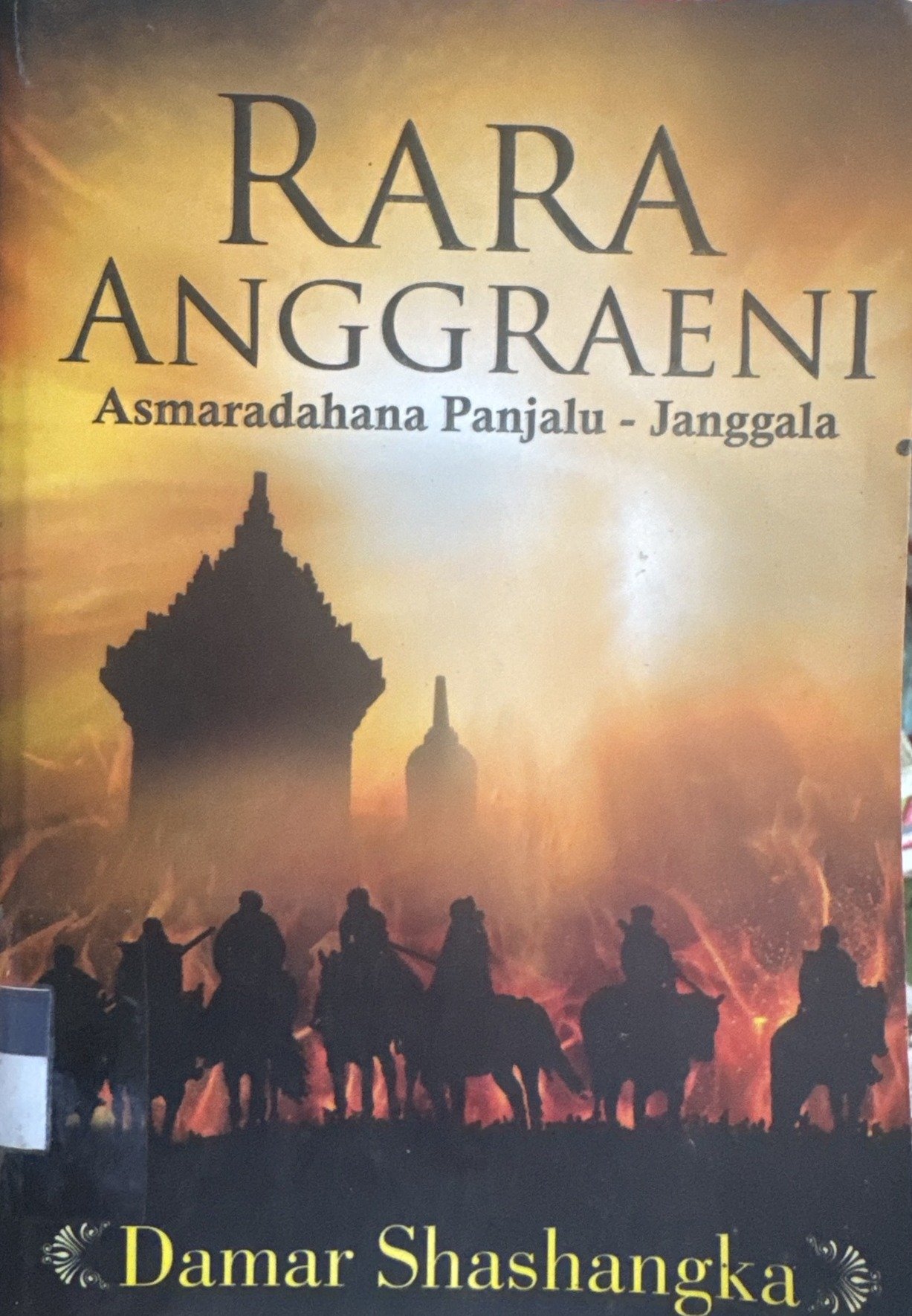
Rara Anggraeni: Asmaradahana Panjalu - Janggala [English translation]
By Damar Shashangka, Damaika Saktiani (editor)
Narasi, Yogyakarta · Shashangka, Damar. Rara Anggraeni: Asmaradahana Panjalu - Janggala. Disunting oleh Damaika Saktiani. Yogyakarta: Narasi, 2016. · 2016
Abstract
This historical novel by Damar Shashangka retells the love story of Rara Anggraeni and Prince Kuda Rawisrengga, one of the best-known episodes of the Javanese Panji cycle. Set against the rivalry of Panjalu (Daha) and Janggala, the two kingdoms that inherited old Medhang, it weaves romance, dynastic ambition and court intrigue into a tragic narrative about power. Rara Anggraeni's refusal to become a mere concubine, and the demand that she be made principal queen, set off a political crisis that ends in war and rebellion by former Janggala soldiers.
- Identifier
- KBA-BKU-2016-0004 ISBN 978-979-168-491-0
- Type
- Buku
- Publisher
- Narasi, Yogyakarta
- Date Issued
- 2016
- Bibliographic Citation
- Shashangka, Damar. Rara Anggraeni: Asmaradahana Panjalu - Janggala. Disunting oleh Damaika Saktiani. Yogyakarta: Narasi, 2016.
- Creator
- Damar Shashangka
- Subject
- Novel sejarah Fiksi Indonesia Cerita Panji Kerajaan Kadiri Panjalu Janggala Sastra Jawa Jayabhaya Jawa Timur -- Sejarah
- LC Classification
- PL5089.S53 R37 2016 — Sastra Indonesia; novel sejarah (perkiraan nomor kelas; belum diverifikasi)
- LCSH Subject
- Panji (Legendary character) -- Fiction; Kadiri (Kingdom) -- History -- Fiction; Java (Indonesia) -- History -- To 1478 -- Fiction; Indonesian fiction -- 21st century; Historical fiction, Indonesian
- BISAC Category
- FIC014000 FICTION / Historical / General; FIC027050 FICTION / Romance / Historical / General; FIC010000 FICTION / Fairy Tales, Folk Tales, Legends & Mythology
- Language
- Indonesia
- Description
- Rara Anggraeni: Asmaradahana Panjalu - Janggala is an Indonesian-language historical novel by Damar Shashangka, published by Penerbit Narasi in Yogyakarta in 2016. It runs to 488 pages in a 14 x 21 cm format, and Damaika Saktiani is credited as its editor. Damar Shashangka is widely read in Indonesia as a writer of historical fiction and of books on Javanese spirituality. Bookshop and library catalogues list several of his titles, including the Sabda Palon series on the twilight of Majapahit, Darmagandhul, and Ilmu Jawa Kuno. His Darmagandhul has itself become the subject of academic work, for example a master's thesis on Javanese mythology at Universitas Muhammadiyah Surabaya. Detailed biographical information about the author, such as his place and date of birth or his education, could not be found in verifiable sources and is therefore not given here. The title combines two important elements. Rara Anggraeni is a female character from the Panji tales, an indigenous Javanese story cycle that developed from the Majapahit period onward and spread across Southeast Asia, to Bali, the Malay Peninsula, Thailand and Cambodia. The word asmaradahana, literally the fire of love, recalls the classical story of the burning of the love god Kamajaya and serves as a metaphor for a passion that consumes and destroys. The phrase Panjalu - Janggala names the political setting: two East Javanese kingdoms that, according to tradition, arose when Airlangga divided his realm in the eleventh century. According to the publisher's synopsis on the Gramedia product page, the story takes place in the reign of King Jayabhaya, after the Medhang kingdom had been reunited following its division into Daha, or Panjalu, and Janggala. Rara Anggraeni is portrayed as a beautiful woman whom the prince Rawisrengga wishes to take as a concubine. She refuses that position and asks instead to be made his principal queen. Her refusal does not remain a private matter. It grows into a political conflict over the right to the throne, while former soldiers of Janggala secretly support a rebel plan. The love story thus becomes a way into a narrative about power and dynastic legitimacy. A literary study deposited in the repository of Universitas PGRI Adi Buana Surabaya, which examines the transformation of the Rara Anggraeni story from the sung verse of Serat Panji Asmarabangun into the modern novel using Sapardi Djoko Damono's concept of alih wahana (transfer of medium), gives a more detailed outline of the plot. In its summary, after Daha conquers Janggala, the ruler of Janggala, Prabhu Sarwesywara or Lembu Amiluhur, secretly covets the throne of Daha for his eldest son, Rahadyan Kuda Rawisrengga. Envoys are sent to ask for the hand of Dyah Ayu Sasi Kirana of Daha, and the proposal is accepted. On the journey home, however, Kuda Rawisrengga falls in love with Rara Anggraeni, daughter of the high official Rakryan Kanuruhan Kudanawarsa. Her father refuses to let his daughter become a secondary consort and insists that she be made paramesywari, the principal queen. Other characters include Dyah Ayu Pramesthi and Mapanji Aryesywara, or Lembu Amerdadu, while Jayabhaya appears as the great king in the background of the story. The same study identifies three main themes: love, government and power, and devotion or service. All three rest on a tension at the heart of the Panji tradition, the clash between personal desire and the politics of marriage alliances between kingdoms. In traditional versions the Anggraeni episode usually ends tragically, because the prince's love for a woman of lower rank threatens the arranged marriage that is meant to secure dynastic unity. Damar Shashangka turns this pattern into a long narrative with dialogue, descriptions of court life and ceremonial detail, so that modern readers can enter the world of old Java without having to read the original macapat verse. The novel's distinctive feature is its attempt to bridge historiography and literature. Panjalu and Janggala are historical polities known from inscriptions and kakawin poetry, whereas the Panji stories are literary works whose characters cannot simply be identified with historical kings. The novel combines the two layers, placing legendary figures within the frame of kingdoms that really existed and using old titles of office such as rakryan kanuruhan and paramesywari. Readers should bear in mind that it is historical fiction: many details are the author's invention, and the book is not intended as a primary historical source. In terms of reception, the novel has circulated widely through national bookshop chains and is listed on Goodreads with a modest number of reader ratings. Its use as a case study of medium transfer in university research suggests that it is regarded as an interesting example of reviving classical Javanese literature in the form of a popular novel. Interest in the Panji cycle also grew after Panji manuscripts were inscribed on UNESCO's Memory of the World Register in 2017, and works of this kind help widen public access to that heritage. For a library focused on Islamic studies and Aceh studies, the novel does not deal directly with Islam or with Aceh, since its setting is pre-Islamic, Hindu-Buddhist Java. It is nevertheless useful as comparative material. The Panji cycle is also known in the Malay tradition through texts such as Hikayat Panji Semirang and Hikayat Cekel Waneng Pati, so scholars of Malay-Indonesian literature can use the novel to trace how Panji themes continue to live and be reinterpreted today. It also helps readers understand the pre-Islamic cultural layer that formed the background to Islamisation in Java, including ideas of power, royal legitimacy and the role of women in court politics. For teachers of anthropology and cultural history, the novel can open a discussion of how contemporary Indonesians imagine their past. The rise of Javanese historical fiction over the last two decades, with novels about Majapahit, Singhasari and Kadiri, reflects a search for identity and cultural roots in the midst of modernity. Damar Shashangka is one of the writers who work in this field with a particular interest in Javanese spirituality, so his novel also shows how kejawen values are read and popularised in the present-day Indonesian book market. This record describes the copy held in the private collection of KBA13 Academy and was catalogued from its cover. The publisher, year, page count and ISBN are taken from the Gramedia product page for the 2016 Narasi edition, whose cover matches this copy, and have not been checked against the copyright page of the physical book.
- Rights
- Koleksi pribadi KBA13 Academy
- Contributor
- Damaika Saktiani (editor)
- Extent
- 488 hlm.; 21 cm
- Collection
- Books
How to cite
Damar Shashangka, Damaika Saktiani (editor), “Rara Anggraeni: Asmaradahana Panjalu - Janggala [English translation]”, Narasi, Yogyakarta, Shashangka, Damar. Rara Anggraeni: Asmaradahana Panjalu - Janggala. Disunting oleh Damaika Saktiani. Yogyakarta: Narasi, 2016., 2016. KBA13 Academy Archive and Library, KBA-BKU-2016-0004.