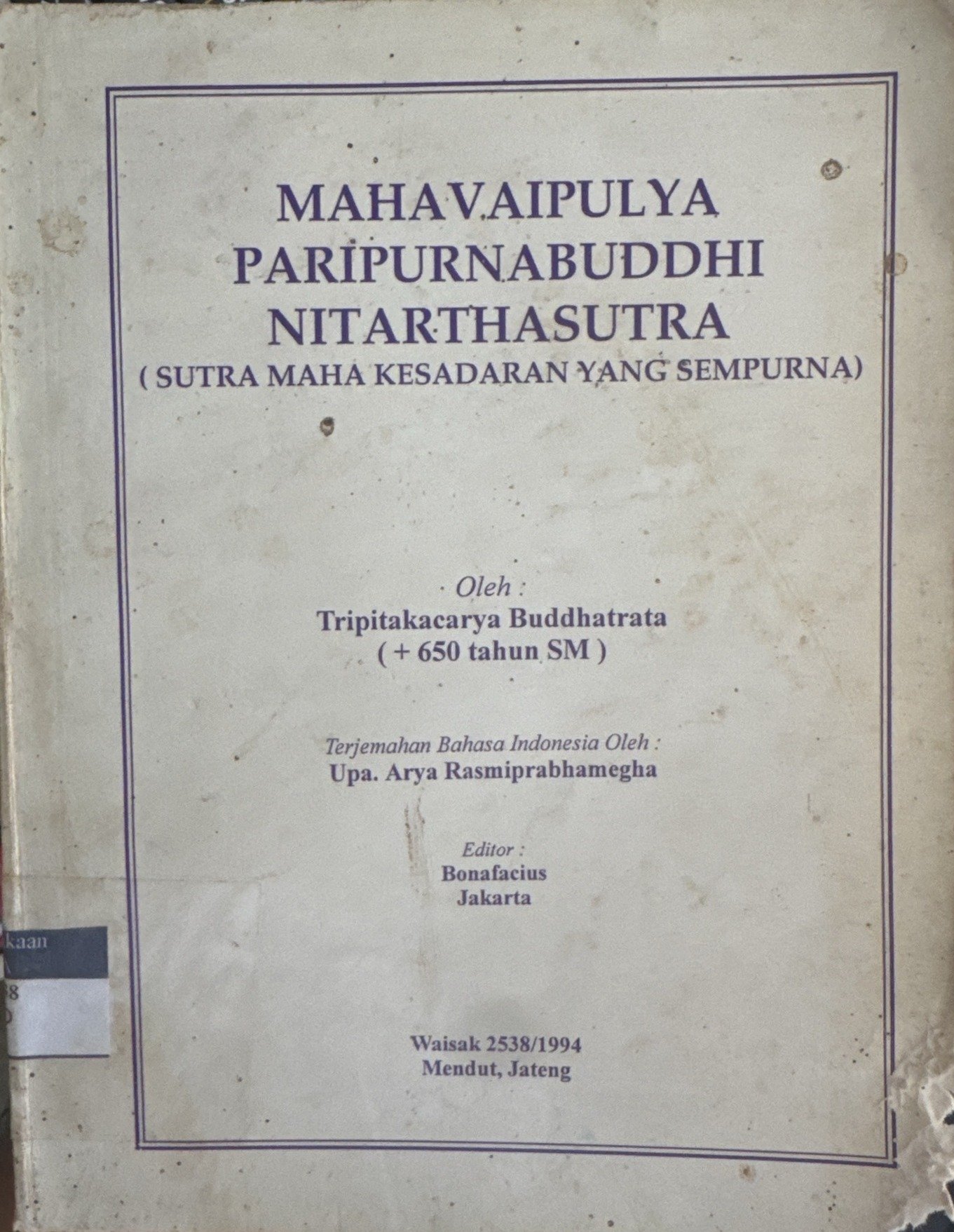
[penerbit tidak tercantum di sampul], Jakarta · Buddhatrata, trans. Mahavaipulya Paripurnabuddhi Nitarthasutra (Sutra Maha Kesadaran yang Sempurna). Diterjemahkan ke dalam bahasa Indonesia oleh Upa. Arya Rasmiprabhamegha. Disunting oleh Bonafacius. Jakarta, 1994. · 1994
Abstract
This is an Indonesian translation of the Sutra of Perfect Enlightenment (Yuanjue jing, Taisho 842), a Chinese Mahayana scripture traditionally credited to the Tang-dynasty translator Buddhatrata. Translated by the lay devotee Arya Rasmiprabhamegha and edited by Bonafacius, this edition is dated Vesak 2538/1994, Mendut, Central Java. The sutra consists of dialogues between the Buddha and a series of bodhisattvas on the pure awareness that all beings already possess and on overcoming ignorance (avidya). The date '+650 BCE' printed on the cover is the translator's claim.
Identifier
KBA-BKU-1994-0002
Type
Buku
Publisher
[penerbit tidak tercantum di sampul], Jakarta
Date Issued
1994
Bibliographic Citation
Buddhatrata, trans. Mahavaipulya Paripurnabuddhi Nitarthasutra (Sutra Maha Kesadaran yang Sempurna). Diterjemahkan ke dalam bahasa Indonesia oleh Upa. Arya Rasmiprabhamegha. Disunting oleh Bonafacius. Jakarta, 1994.
Mahavaipulya Paripurnabuddhi Nitarthasutra, with the Indonesian title Sutra Maha Kesadaran yang Sempurna, is an Indonesian translation of the Chinese Mahayana Buddhist text known as the Da fangguang yuanjue xiuduoluo liaoyi jing, or Yuanjue jing for short, and in English as the Sutra of Perfect Enlightenment. The text is listed in the Taisho canon as number 842 in volume 17, consists of a single fascicle, and is attributed in Chinese tradition to a translator named Buddhatrata during the Tang dynasty. This Indonesian edition was translated by the lay devotee (upasaka) Arya Rasmiprabhamegha and edited by Bonafacius in Jakarta, and its cover bears the statement Waisak 2538/1994, Mendut, Central Java. The cover gives no publisher's name, ISBN or page count.
The Sanskrit title on the cover, Mahavaipulya Paripurnabuddhi Nitarthasutra, is a reconstruction from the Chinese. Mahavaipulya marks an extensive Mahayana sutra, paripurnabuddhi means perfect awareness or enlightenment, and nitartha means definitive meaning, a teaching that needs no further interpretation. Such reconstructions are common in Chinese Buddhist tradition and do not by themselves prove the existence of a Sanskrit original.
Beneath the name Tripitakacarya Buddhatrata the cover prints the date plus 650 BCE. This claim must be read with care. The preface in a digital version of the same translation states that Buddhatrata translated the sutra from Sanskrit into Chinese, but gives no basis for the date. According to traditional accounts, Buddhatrata's translation was made around 693 CE at the White Horse Temple in Luoyang, and Lancaster's catalogue, as cited in the NTI Reader database, likewise gives 693. Buddhatrata himself is almost unknown in historical sources apart from this attribution. Since the late nineteenth century, beginning with Mochizuki Shinko, many scholars have regarded the text as a Chinese apocryphon, composed in China probably in the late seventh or early eighth century and drawing heavily on the Awakening of Faith in the Mahayana and the Surangama Sutra. Hu Shih once suggested Zongmi as its author, while Lu Cheng stressed its dependence on the Awakening of Faith. A 2023 study by Henry Shiu offers a more nuanced view, arguing for a substantial Indian lineage in the sutra's four-stage meditation practice. The date of 650 BCE on the cover is therefore the translator's or publisher's claim; it does not agree with scholarly dating and differs by more than thirteen centuries from the traditional date of the Chinese translation.
Structurally, the sutra consists of an introduction and twelve chapters. The introduction depicts the Buddha in a great samadhi before an assembly of some hundred thousand bodhisattvas. In each chapter a bodhisattva rises, pays homage and poses a question, and the Buddha answers in prose followed by a verse summary, or gatha. The digital version of the first volume of this Indonesian translation contains the chapters in which the questioners are Manjusri, Samantabhadra, Samantanetra, Vajragarbha, Maitreya and Vimalamati, and its preface says that the translation was issued in two volumes. The cover of this copy does not state a volume number, so it is not yet certain whether the copy in the collection is the first volume, the second, or a combined edition.
The core teaching of the sutra, as the translator's preface summarises it, is that all beings already possess a pure and perfect awareness, but that this awareness is obscured by avidya, or ignorance, so that beings keep revolving in samsara. In the dialogue with Manjusri the Buddha explains the origin of enlightenment and the illusory nature of ignorance. The dialogue with Samantabhadra asks how practice is possible if everything is illusory. The dialogue with Samantanetra gives practical instruction, including calming meditation (samatha) and contemplation of the four elements and the sense bases. Vajragarbha asks why beings who have Buddha-nature are still covered by ignorance, Maitreya asks about desire and the five spiritual lineages, and Vimalamati asks how the awareness of ordinary beings, bodhisattvas and Tathagatas differs. The later chapters deal with methods of meditation and the pitfalls of practice.
The sutra has had great influence in the history of East Asian Buddhism. It was valued by the Huayan and Chan schools, and its most important commentary was written in the ninth century by Zongmi, a figure who brought those two traditions together. In Korea it became one of the core texts of the Seon monastic curriculum, and the Korean commentator Gihwa divided its chapters according to the capacities of practitioners. Widely cited English translations include A. Charles Muller's The Sutra of Perfect Enlightenment: Korean Buddhism's Guide to Meditation, published by SUNY Press in 1999, and Peter N. Gregory's translation in Apocryphal Scriptures, published by the Numata Center in 2005.
The appearance of this Indonesian translation in 1994 also reflects the dynamics of Indonesia's Buddhist community under the New Order, when various groups, including Buddhists of Chinese descent, worked to make Mahayana scriptures available in Indonesian. The reference to Vesak and Mendut on the cover points to the Vesak celebrations around the Mendut and Borobudur temples in Central Java, the centre of national Vesak observance. The abbreviation Upa. before the translator's name stands for upasaka, the term for a male lay follower who has taken the precepts.
For a library of Islamic studies and Aceh studies, the book has no direct connection with Islam or with Aceh. It is nonetheless valuable for comparative religion, especially for the study of mysticism and theories of consciousness. The idea of a pure awareness veiled by ignorance can be compared with Sufi discussions of the primordial nature (fitra) and of veils (hijab), for example in the wahdat al-wujud tradition that once flourished in Aceh through Hamzah Fansuri and Shamsuddin al-Sumatrani, although such comparisons call for methodological caution. The book is also a document of the history of Buddhist scripture translation in Indonesia and of the diversity of religious life in the archipelago.
This record describes the copy held in the private collection of KBA13 Academy and was catalogued from its cover. Information on the contents, the number of volumes and the preface is taken from a digital version of the same translation on the Internet Archive, while the scholarly dating is based on the Taisho catalogue data and the academic studies cited.
Buddhatrata, Upa. Arya Rasmiprabhamegha (penerjemah), Bonafacius (editor), “Mahavaipulya Paripurnabuddhi Nitarthasutra: Sutra Maha Kesadaran yang Sempurna [English translation]”, [penerbit tidak tercantum di sampul], Jakarta, Buddhatrata, trans. Mahavaipulya Paripurnabuddhi Nitarthasutra (Sutra Maha Kesadaran yang Sempurna). Diterjemahkan ke dalam bahasa Indonesia oleh Upa. Arya Rasmiprabhamegha. Disunting oleh Bonafacius. Jakarta, 1994., 1994. KBA13 Academy Archive and Library, KBA-BKU-1994-0002.