Kalangwan: Sastra Jawa Kuno Selayang Pandang [English translation]
By P.J. Zoetmulder, Dick Hartoko (penerjemah), W.A.L. Stokhof (editor seri ILDEP)
Djambatan, Jakarta · Zoetmulder, P. J. Kalangwan: Sastra Jawa Kuno Selayang Pandang. Diterjemahkan oleh Dick Hartoko. Seri ILDEP. Jakarta: Djambatan, 1983. · 1983
Abstract
The Indonesian edition of Kalangwan: A Survey of Old Javanese Literature (1974), P.J. Zoetmulder's comprehensive survey of Old Javanese literature, translated by Dick Hartoko and published by Djambatan in 1983 in the ILDEP series. Taking the concept of beauty (kalangwan) as its key, the book discusses parwa prose, kakawin and kidung from the Old Mataram period to Majapahit, and also explains writing materials, the making of texts and the relationship between poets and their royal patrons. It remains a basic reference in Javanese philology.
- Identifier
- KBA-BKU-1983-0002
- Type
- Buku
- Publisher
- Djambatan, Jakarta
- Date Issued
- 1983
- Bibliographic Citation
- Zoetmulder, P. J. Kalangwan: Sastra Jawa Kuno Selayang Pandang. Diterjemahkan oleh Dick Hartoko. Seri ILDEP. Jakarta: Djambatan, 1983.
- Creator
- P.J. Zoetmulder
- Subject
- Sastra Jawa Kuno Sastra Kawi Kakawin Kidung Parwa Filologi Jawa Sejarah sastra Kebudayaan Jawa Majapahit Nusantara pra-Islam
- LC Classification
- PL5158 .Z6 — Sastra Kawi (Jawa Kuno): sejarah dan kritik; nomor kelas diambil dari catatan katalog edisi asli Inggris 1974 (perkiraan nomor kelas; belum diverifikasi)
- LCSH Subject
- Kawi literature -- History and criticism; Javanese literature -- History and criticism
- BISAC Category
- LIT008000 Literary Criticism / Asian / General; LIT004190 Literary Criticism / Ancient & Classical; HIS003000 History / Asia / General
- Language
- Indonesia
- Description
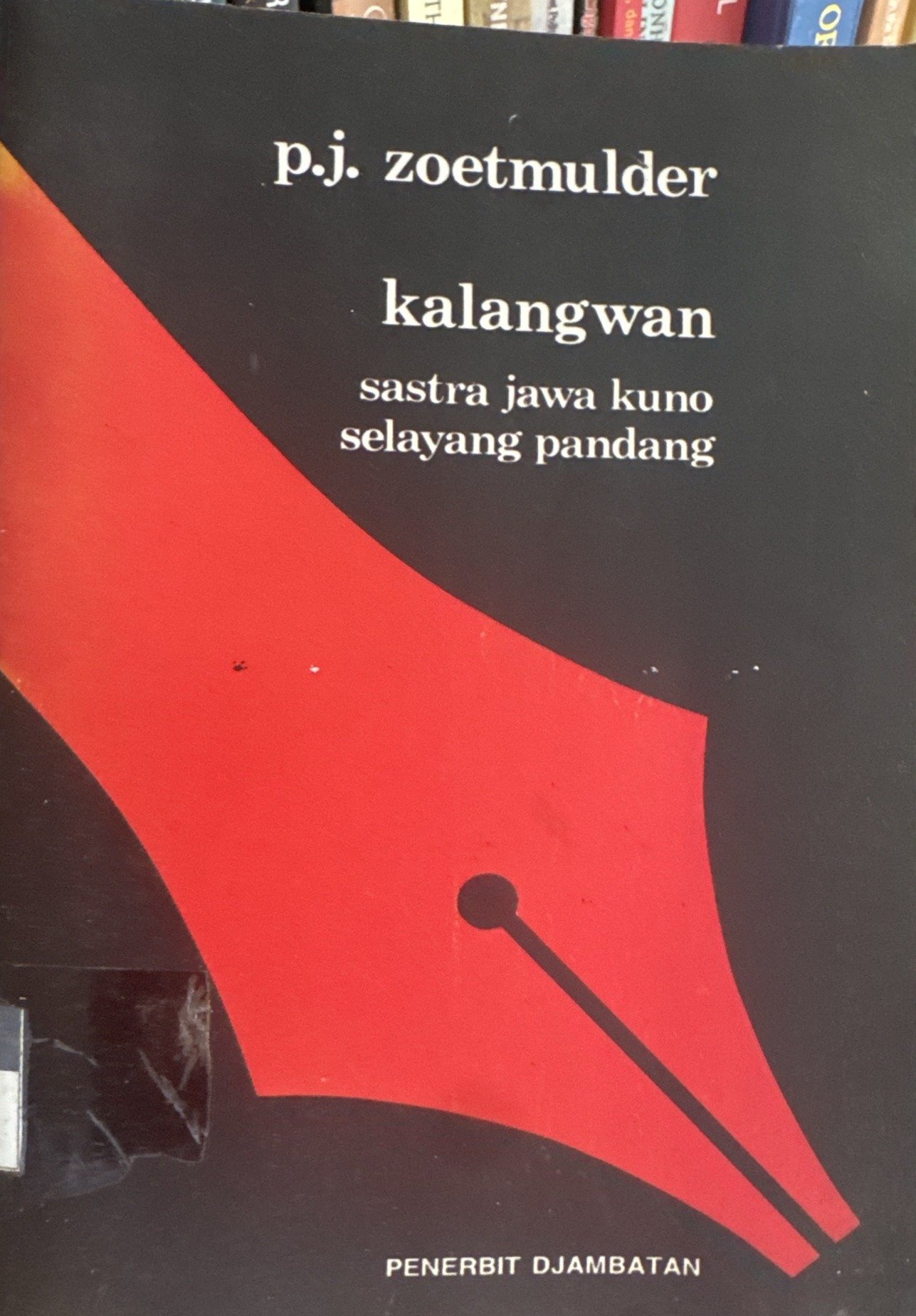
- Kalangwan: Sastra Jawa Kuno Selayang Pandang is the Indonesian edition of Kalangwan: A Survey of Old Javanese Literature, the standard reference work on Old Javanese literature by Petrus Josephus Zoetmulder. The original English edition was published in 1974 in The Hague by Martinus Nijhoff as number 16 of the Translation Series of the Koninklijk Instituut voor Taal-, Land- en Volkenkunde (KITLV). The Indonesian edition was translated by Dick Hartoko and published by Penerbit Djambatan in Jakarta in 1983 in the ILDEP series, a joint Indonesian-Dutch publishing programme in Indonesian studies edited by W.A.L. Stokhof. Library records describe it as xiii plus 648 pages, with illustrations, a bibliography and an index. The book was later reprinted, including in 1985 and 1994. The author, P.J. Zoetmulder, was born in Utrecht in the Netherlands on 29 January 1906 and died in Yogyakarta on 8 July 1995. He entered the Society of Jesus in 1925, studied Old Javanese under C.C. Berg, and took his doctorate at Leiden University in 1935 with a dissertation on pantheism and monism in Javanese suluk literature. From 1945 he taught at Gadjah Mada University, where he later became a professor, and he became an Indonesian citizen in 1951. His other works include a study of Old Javanese grammar based on the Adiparwa, the textbook Bahasa Parwa written with I.R. Poedjawijatna, the text anthology Sekar Sumawur and, most influential of all, the Old Javanese-English Dictionary (1982), compiled with S.O. Robson. Kalangwan grew out of decades of work with Old Javanese manuscripts, and Zoetmulder himself recalled that writing it was difficult because much of the material had to be gathered from microfilms of manuscripts held in Leiden. The title comes from the Old Javanese word kalangwan, which literally means beauty and derives from the root langö. The choice is not decorative. For the kawi, the poets of Old Javanese literature, the experience of beauty stood at the centre of literary practice and could even be understood as a religious path. Zoetmulder made this aesthetic concept the key for reading the tradition as a whole, and also the measure he used in deciding which works to treat at length and which to mention only briefly. The book is therefore not intended as a complete inventory of every text from the Old Mataram period to Majapahit, but as a survey that weighs the quality and place of these works within Javanese court culture. In broad terms, the book covers the three main genres of Old Javanese literature. The first is parwa prose, Old Javanese renderings of parts of the Mahabharata such as the Adiparwa and the Wirataparwa. The second is the kakawin, long poems in Indian metres that represent the peak of court literature, such as the Old Javanese Ramayana, the Arjunawiwaha of Mpu Kanwa, and the Desawarnana or Nagarakertagama of Prapanca. The third is the kidung, poetry in indigenous Javanese metres that developed in the late Majapahit period and survived largely through the manuscript tradition of Bali. Alongside the discussion of individual works, Zoetmulder addresses the material and social side of this literary world: writing materials such as palm leaves and other implements, the processes of composing and copying texts, and the relationship between poets and their royal patrons, such as Mpu Kanwa and Airlangga or Prapanca and Hayam Wuruk. In this way the book shows that Old Javanese texts did not arise in a vacuum. They were products of the court, developed under royal patronage, and are full of images of nature, journeys and values that can be read as sources for cultural history. Zoetmulder's account of nature imagery in the kakawin, for instance, is often cited by scholars tracing ideas of harmony between people and their environment in Javanese literature. The summaries of kakawin that he provides also make the book an entry point for readers who cannot read the original texts. When the English edition appeared it was reviewed in leading Asian studies journals, including the Journal of Asian Studies, the Journal of the Royal Asiatic Society and the Bulletin of the School of Oriental and African Studies, and it has since become a basic text in Javanese philology and literary studies. The Indonesian edition made the work accessible to students and researchers in Indonesia, and the book is still held by many university libraries. A review in Poetika: Jurnal Ilmu Sastra (2014) by Arif Kurniar Rakhman valued the wealth of information the book offers on Old Javanese texts and the power relations around them, but also noted its limits: it does little to connect court literature with minor and oral traditions, and it does not trace the manuscript genealogy of the texts it discusses, which makes it harder for readers to assess its sources and methods. For a library focused on Islamic studies and Aceh studies, the book matters as comparative background. Old Javanese literature is one of the richest witnesses to the Hindu-Buddhist cultural world of the archipelago before the wide spread of Islam, and many forms, terms and ideas from that tradition continued in Javanese and Malay literature of the Islamic period. Researchers of Malay hikayat and syair, including the written traditions of Aceh, can use the book to understand the Indic heritage that was reworked within the Islamic literature of the archipelago, for example in stories drawn from the Ramayana and the Mahabharata. Zoetmulder's own scholarly background, his dissertation on pantheism and monism in Javanese suluk literature, also touches on the debates over wujudiyah Sufism that form an important part of the intellectual history of Aceh. The book does not deal with Aceh directly, but it offers a framework for comparing pre-Islamic court literature with the Islamic literary traditions of the Malay world. In terms of method, Kalangwan is also an example of classical philology combined with aesthetic sensitivity. Zoetmulder reads texts closely, weighs their language and metre, and then places them in their historical and social context. This approach is useful for readers who want to learn how a literary tradition that is distant in time can be presented in an orderly and responsible way, without exaggeration and without separating texts from the society that produced them. Together with the Old Javanese dictionary he compiled, the book forms a foundation for later generations of scholars of Old Javanese in Indonesia and abroad. The book's limits should also be stated plainly. As a work written in the early 1970s, some of its datings, attributions of authorship and interpretations of particular works have been revised by later research. Its selection of works according to Zoetmulder's own judgement of beauty also means that a number of texts receive only brief treatment. Yet precisely as a comprehensive survey written by one of the greatest specialists in the field, it remains a natural starting point for anyone studying Old Javanese literature. This record describes the copy held in the private collection of KBA13 Academy, catalogued from its cover. The cover of this copy carries the name P.J. Zoetmulder, the title Kalangwan with the subtitle Sastra Jawa Kuno Selayang Pandang, a red pen-nib design on a black ground, and the name Penerbit Djambatan, but it gives no printing year. The year recorded here is therefore that of the first Indonesian edition, 1983, with the caveat that this copy may be a later reprint.
- Rights
- Koleksi pribadi KBA13 Academy
- Contributor
- Dick Hartoko (penerjemah) W.A.L. Stokhof (editor seri ILDEP)
- Extent
- xiii + 648 hlm.
- Collection
- Books
How to cite
P.J. Zoetmulder, Dick Hartoko (penerjemah), W.A.L. Stokhof (editor seri ILDEP), “Kalangwan: Sastra Jawa Kuno Selayang Pandang [English translation]”, Djambatan, Jakarta, Zoetmulder, P. J. Kalangwan: Sastra Jawa Kuno Selayang Pandang. Diterjemahkan oleh Dick Hartoko. Seri ILDEP. Jakarta: Djambatan, 1983., 1983. KBA13 Academy Archive and Library, KBA-BKU-1983-0002.