
Agama dan Kebudayaan Orang Hakka di Singkawang: Memuja Leluhur dan Menanti Datangnya Rezeki [English translation]
Penerbit Buku Kompas, Jakarta · Tanggok, M. Ikhsan. Agama dan Kebudayaan Orang Hakka di Singkawang: Memuja Leluhur dan Menanti Datangnya Rezeki. Jakarta: Penerbit Buku Kompas, 2016. · 2016
Abstract
An anthropological study by M. Ikhsan Tanggok, professor of anthropology at UIN Syarif Hidayatullah Jakarta, of the religion and culture of the Hakka Chinese community in Singkawang, West Kalimantan. Responding to a literature that has focused mostly on history, the book highlights ancestor worship as the core of Hakka family religiosity and the hope for fortune that shapes ritual and festivals. Published by Penerbit Buku Kompas for general readers, it is useful for religious studies and the study of interreligious relations.
- Identifier
- KBA-BKU-2016-0005 ISBN 978-602-412-173-0
- Type
- Buku
- Publisher
- Penerbit Buku Kompas, Jakarta
- Date Issued
- 2016
- Bibliographic Citation
- Tanggok, M. Ikhsan. Agama dan Kebudayaan Orang Hakka di Singkawang: Memuja Leluhur dan Menanti Datangnya Rezeki. Jakarta: Penerbit Buku Kompas, 2016.
- Creator
- M. Ikhsan Tanggok
- Subject
- Hakka Tionghoa Indonesia Singkawang Kalimantan Barat Pemujaan leluhur Agama Tionghoa Konghucu Tatung Cap Go Meh Antropologi agama
- LC Classification
- DS632.C5 — Orang Tionghoa di Indonesia (perkiraan nomor kelas; belum diverifikasi)
- LCSH Subject
- Hakka (Chinese people) -- Indonesia -- Singkawang -- Religion; Hakka (Chinese people) -- Indonesia -- Singkawang -- Social life and customs; Ancestor worship -- Indonesia -- Kalimantan Barat; Chinese -- Indonesia -- Kalimantan Barat -- Religion
- BISAC Category
- SOC002010 Social Science / Anthropology / Cultural & Social; REL018000 Religion / Confucianism; REL017000 Religion / Comparative Religion
- Language
- Indonesia
- Description
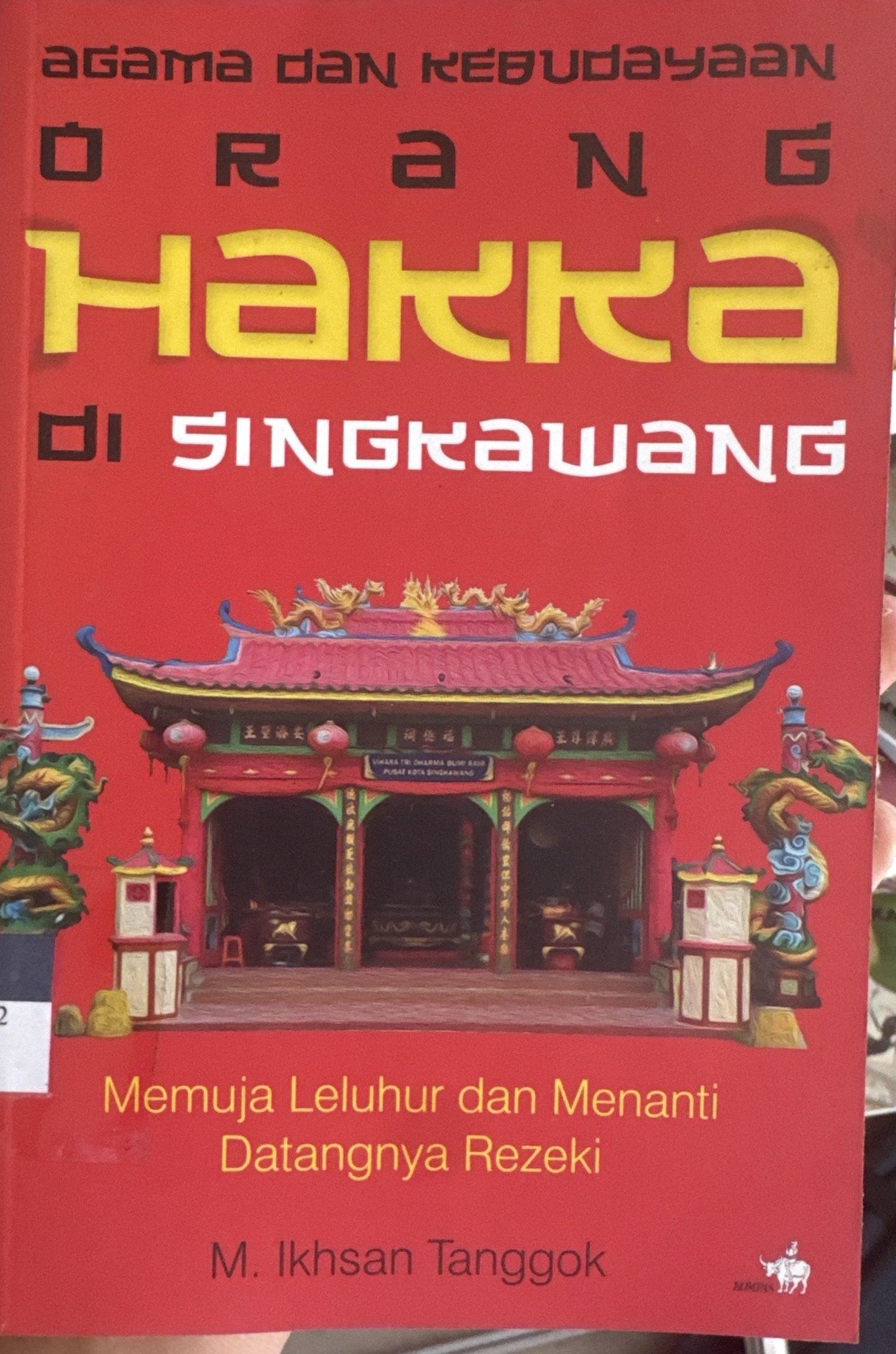
- Agama dan Kebudayaan Orang Hakka di Singkawang: Memuja Leluhur dan Menanti Datangnya Rezeki (Religion and Culture of the Hakka People in Singkawang: Worshipping Ancestors and Awaiting Fortune) is an anthropological study by M. Ikhsan Tanggok of the religious and cultural life of the Hakka Chinese community in Singkawang, West Kalimantan. The book was published by Penerbit Buku Kompas in Jakarta. The Gramedia bookshop lists its publication date as 27 December 2016, with 236 pages, a soft cover and ISBN 978-602-412-173-0. The subtitle sums up the two axes of the book: ancestor worship as the core of Hakka family religiosity, and the hope for fortune that colours ritual, festivals and everyday economic life. The author, M. Ikhsan Tanggok, is a professor of anthropology in the Faculty of Ushuluddin and Philosophy at Syarif Hidayatullah State Islamic University (UIN) Jakarta. In an interview published in 2008 he explained that he was born in Sungai Purun, Pontianak, West Kalimantan, and attended a private primary school that had formerly been a Chinese school. That childhood environment sparked his interest in Chinese culture. After finishing secondary school in 1987 he studied Comparative Religion at IAIN Jakarta, where he first studied Confucianism in depth. He went on to teach Confucianism and Taoism to Muslim students for many years, speaks the Hakka dialect, and is often invited to lecture at temples, so that among Confucians he is known by the title Haksu. In the same interview he argued that religion should be studied as a cultural phenomenon rather than judged true or false, and that the researcher should try to understand the insider's point of view while remaining an outsider. That methodological stance is visible in this book. According to the publisher's synopsis, Chinese people have lived in Indonesia for centuries, and the Hakka of Singkawang have long been present there, living in harmony with their neighbours. Even so, writing about their presence, culture and religion remains limited, and most existing works concentrate on history. The book aims to give general readers a fuller picture of Hakka religion and culture and to complement earlier publications. It therefore starts not from the history of migration or ethnic politics alone, but from religious practice as it is lived in families and in the community. The theme of ancestor worship, the first part of the subtitle, is also developed in Tanggok's journal article on the cult of the dead in Hakka family and society in Singkawang, published in Refleksi: Jurnal Kajian Agama dan Filsafat. There he discusses burial rituals and the rites performed before and after burial, and argues that Hakka beliefs about the afterlife remain closely tied to everyday life in the real world. This reciprocal relationship between the living and the ancestors is what makes ancestor worship more than a symbolic act of respect: it is part of how Hakka families arrange their welfare, safety and fortune. The second part of the subtitle, awaiting fortune, concerns the way religion and ritual are interwoven with hopes for luck and prosperity. One of the best known examples in Singkawang is the tatung tradition of the Cap Go Meh festival. In another article in Refleksi (2013), Tanggok describes the tatung performance as an element regarded as indispensable to the festival. People believe that tatung can provide help, and they respond with offerings. According to his findings, the performance serves several functions at once: warding off harmful spirits, stimulating the local economy, raising the standing of the performers, and promoting tourism in Singkawang. These findings show how religiosity, economics and civic identity meet in a single ritual event. Readers may expect the themes of these articles to inform the book as well, although its full table of contents could not be verified from available sources. The cover shows the Vihara Tri Dharma Bumi Raya in the centre of Singkawang, one of the best known Chinese places of worship in the city. The choice underlines that the Tri Dharma temple, where Confucian, Taoist and Buddhist elements meet in Chinese religious practice, is the focal point of the religious life the book discusses. Political context also matters for reading a book of this kind. Under the New Order, public expressions of Chinese culture were restricted; after Reformasi, especially under President Abdurrahman Wahid, those restrictions were lifted, Chinese New Year became a national holiday, and Confucianism was again recognised as a religion. Studies of local Chinese religion and culture such as this one grew out of that new openness. The book's value for an Islamic-studies library lies in two things. First, it was written by a professor at a state Islamic university who specialises in Chinese religions, which makes it a concrete example of the study of religions within the UIN system that is empirical and empathetic rather than apologetic. Second, it provides ethnographic material on one of the largest and most distinctive Chinese communities in Indonesia, useful for studies of interreligious harmony, pluralism, and relations between a Muslim majority and non-Muslim minorities. For researchers of Aceh, the book can serve as comparative material for understanding the Chinese community in Aceh, for example in the Peunayong area of Banda Aceh, and how a Chinese minority maintains ancestral traditions within a Muslim society. The book should also be read with its limits in mind. As a Penerbit Buku Kompas title aimed at general readers, its style is likely to be more descriptive and accessible than a strictly academic monograph. Its table of contents, details of fieldwork methods and research period could not be verified from the online sources found, so the account in this record is limited to the publisher's information, the author's profile, and the author's related work that could be checked. Readers who wish to go further can compare it with other studies of Singkawang, for instance on temple and tatung traditions, and with the historical literature on the Hakka and the kongsi of West Kalimantan. Overall, the book is a useful contribution to the Indonesian-language literature on local Chinese religion. It presents the Hakka of Singkawang not only as a subject of migration history but as a living religious community that connects ancestors, family and fortune within a single worldview. For students of the anthropology of religion, religious studies and the sociology of plural societies, it offers an accessible entry point into a religious world that the wider public often understands poorly. This record describes the copy held in the private collection of KBA13 Academy, catalogued from its cover. The cover of this copy is red and carries the full title and subtitle, the name M. Ikhsan Tanggok, an image of the Vihara Tri Dharma Bumi Raya, and the Penerbit Buku Kompas logo, but it does not give a year of publication.
- Rights
- Koleksi pribadi KBA13 Academy
- Extent
- 236 hlm.
- Collection
- Books
How to cite
M. Ikhsan Tanggok, “Agama dan Kebudayaan Orang Hakka di Singkawang: Memuja Leluhur dan Menanti Datangnya Rezeki [English translation]”, Penerbit Buku Kompas, Jakarta, Tanggok, M. Ikhsan. Agama dan Kebudayaan Orang Hakka di Singkawang: Memuja Leluhur dan Menanti Datangnya Rezeki. Jakarta: Penerbit Buku Kompas, 2016., 2016. KBA13 Academy Archive and Library, KBA-BKU-2016-0005.