C. Hurst & Co., London; Columbia University Press, New York · Sadiki, Larbi. The Search for Arab Democracy: Discourses and Counter-Discourses. London: Hurst; New York: Columbia University Press, 2004. · 2004
Abstract
Tunisian political scientist Larbi Sadiki examines how democracy is contested in the Arab world, arguing that both democracy and Islam are plural and contested terms. Drawing on critical theory and on interviews with Muslims from varied backgrounds, its eight chapters analyse Orientalist and Occidentalist discourses on democracy, contemporary Arab conceptions, women's perspectives and Islamist narratives of Western support for authoritarian regimes. The book challenges the claim, shared by some Orientalists and some Islamists, that Islam and democracy are fundamentally opposed.
Identifier
KBA-BKU-2004-0004
Type
Buku
Publisher
C. Hurst & Co., London; Columbia University Press, New York
Date Issued
2004
Bibliographic Citation
Sadiki, Larbi. The Search for Arab Democracy: Discourses and Counter-Discourses. London: Hurst; New York: Columbia University Press, 2004.
JQ1850.A91 S235 2004 — Ilmu politik: pemerintahan dan demokratisasi di negara-negara Arab
LCSH Subject
Democratization--Arab countries; Democracy--Arab countries; Islam and politics--Arab countries; Arab countries--Politics and government--1945-
BISAC Category
POL040040 Political Science / World / Middle Eastern; POL007000 Political Science / Political Ideologies / Democracy; REL037000 Religion / Islam / General
Language
Inggris
Description
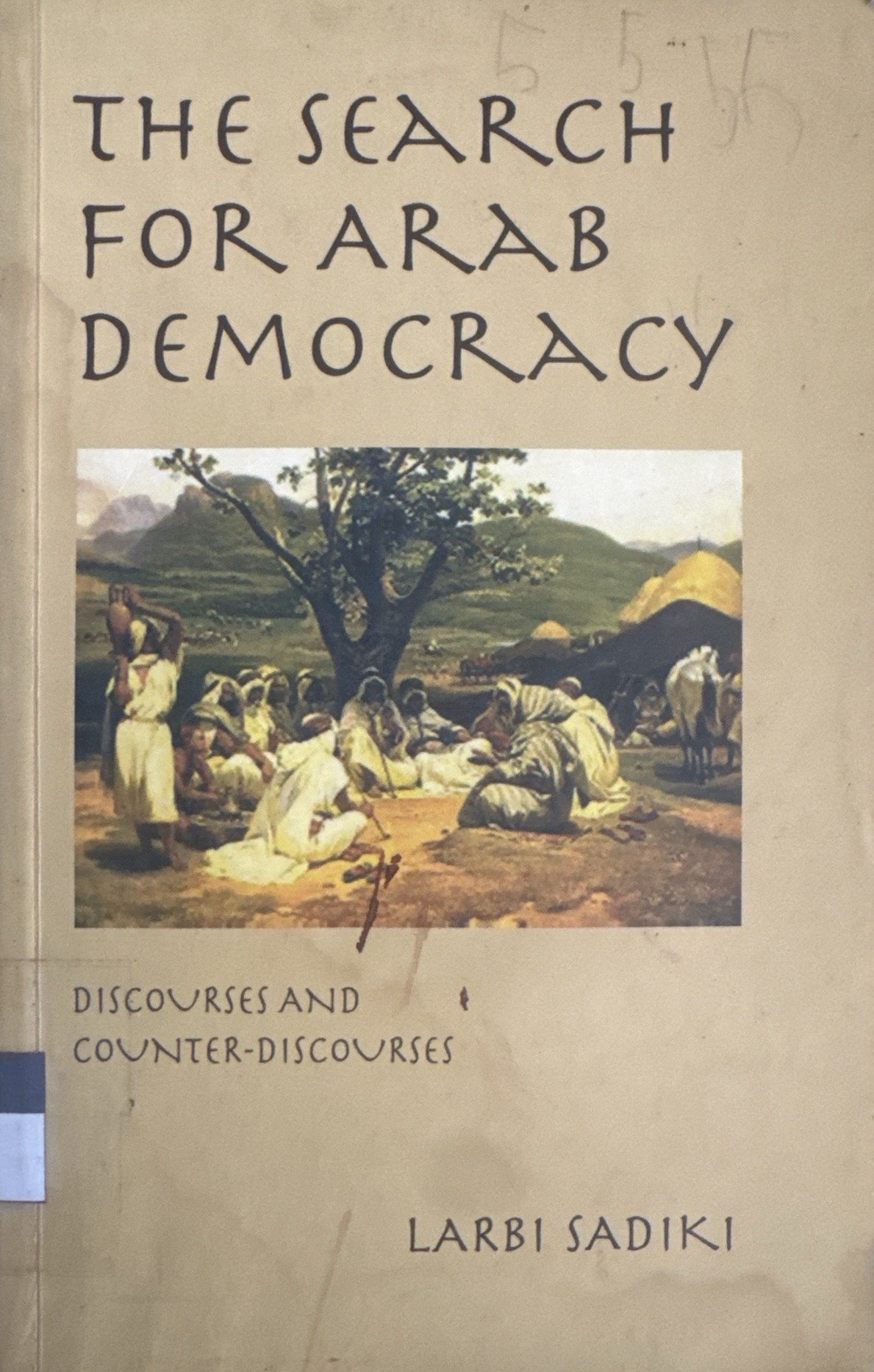
The Search for Arab Democracy: Discourses and Counter-Discourses is a study by the Tunisian political scientist Larbi Sadiki of how the idea of democracy has been argued over, adopted, resisted and reinterpreted in the Arab world. It was published in 2004 in two co-ordinated editions: by C. Hurst & Co. in London and by Columbia University Press in New York. Library catalogue records describe the book as xxii + 457 pages, with a bibliography on pages 410 to 434 and an index, and classify it under the Library of Congress number JQ1850.A91 S235 2004. The Hurst edition is recorded with ISBN 1-85065-489-1 for the casebound issue and 978-1-85065-494-0 for the paperback, and the Columbia edition with ISBN 0-231-12580-1 for the cloth issue and 0-231-12581-X for the paperback. The cover of the copy described here shows the title, the subtitle and the author's name over a painting in the Orientalist style showing a gathering of men seated beneath a tree, but no publisher's imprint is visible, so it cannot be determined from the cover alone which of the two editions this copy belongs to.
Larbi Sadiki earned his doctorate in politics and international relations at the Australian National University in 1997 and taught at that university's Centre for Arab and Islamic Studies before becoming a lecturer in Middle East politics at the University of Exeter in England, the position he held when this book appeared. He was later a scholar at the Carnegie Middle East Center and became Professor of Arab Democratization at Qatar University. He went on to write Rethinking Arab Democratization: Elections without Democracy (2009), edited the Routledge Handbook of the Arab Spring: Rethinking Democratization (2015), and has edited a Routledge series on Middle Eastern democratisation and government as well as the Brill journal Protest. He is also the founder of Tunisia Demos, a research and advocacy organisation based in Tunis. His research spans Arab democratisation, human rights, and dialogue between Western and Islamic intellectual traditions, and this book is in many ways the foundation of that later work.
The book's central claim is that neither "democracy" nor "Islam" is a fixed or uniform term. Both are contested, and Sadiki argues that it is more accurate to speak of multiple democracies and multiple Islams. Rather than asking whether Arab societies are ready for a ready-made Western model, he examines how democracy has been talked about: who claims it, who rejects it, on what grounds, and with what political effects. To do this he draws on critical theory and on poststructuralist approaches to discourse and power, using Western political philosophy to question Eurocentric assumptions about what democracy must look like, while also examining critically the ways in which Islamic thinkers have justified, adapted or rejected democratic ideas.
The book is arranged in eight chapters. The first, "Contesting Democracy: Discourses and Counter-discourses", sets out the theoretical framework and the idea that democratic meaning is produced through competing narratives. The second, "Defoundationalizing Democracy and the Arabo-Islamic Setting", argues against treating democracy as resting on a single foundation, whether liberal, secular or Western, and explores what that means for the Arab and Islamic context. The third and fourth chapters, "Democracy as an Occidentalist Discourse" and "Democracy as an Orientalist Discourse", examine two mirror-image ways of talking about democracy: Arab and Islamic constructions of the West, and Western scholarly and political constructions of the Arab and Muslim world, especially the claim that Islam and democracy are incompatible. The fifth chapter, "Contemporary Arab Conceptions of Democracy", turns to the ways in which Arab intellectuals, activists and ordinary citizens understand the term. The sixth, "Arab Women and Democracy: Breaking Out", considers women's perspectives and their struggles for political voice. The seventh, "The West and the Sponsoring of Arab Authoritarianisms: Islamist Narratives", analyses Islamist accounts of Western support for authoritarian regimes. The final chapter, "Discoursing Islam and Democracy", draws the threads together.
A distinctive feature of the book is its use of primary material gathered by the author. According to the publishers' descriptions, Sadiki draws on interviews conducted over several years with Muslims from a range of social and economic backgrounds and on indigenous Arab narratives, and he gives space for participants, including women and Islamists, to represent themselves in their own words. This gives the book a texture that differs from studies based mainly on regime types, electoral data or elite politics.
A review of the book, available through ProQuest, describes it as demanding, because its arguments are open-ended and its structure is not linear. The reviewer notes that Sadiki works with a poststructuralist conception of democracy as a democratic ethos, an ongoing resistance to the concentration of power and to political exclusion, rather than as a fixed set of institutions. Instead of a conventional discourse analysis, the book recovers a tradition of cultural syncretism and intellectual exchange within Arab and Muslim history. The reviewer finds some of Sadiki's choices of thinkers unexpected, notably his extended treatment of the philosopher al-Farabi, but reads them as consistent with the book's commitment to questioning its own assumptions. The reviewer also highlights the book's effort to dismantle binaries such as West and East, reason and revelation, and democracy and Islam, and in particular to challenge the view, shared by some Orientalists and by those Islamists Sadiki calls rejectionists, that Islam and democracy are opposed. The book was also reviewed in the International Journal of Middle East Studies.
The book appeared in the years after the attacks of 11 September 2001, when debates about Islam and democracy in the Arab world were dominated by security concerns and by arguments about promoting democracy from outside. Sadiki's emphasis on indigenous voices and on the way Western powers had supported authoritarian governments offered a counterpoint to those debates. Read after the Arab uprisings that began in Tunisia in late 2010, the book also gains interest as an account of the discursive resources on which later protest movements could draw, a theme Sadiki took up in his subsequent work on the Arab Spring.
For a library concerned with Islamic studies and Aceh studies, the book is a useful theoretical and comparative resource rather than a source on Southeast Asia. It helps readers think about how concepts such as shura, sovereignty, representation and the relationship between religious authority and popular will are argued over in Muslim societies, questions that also arise in the study of Islamic politics in Indonesia and in Aceh's experience of special autonomy, sharia-based regulation and post-conflict democratic politics. Its critique of both Orientalist and Occidentalist essentialism, and its attention to the voices of women and Islamists, are relevant to comparative work on Islam and democracy beyond the Arab world.
This catalogue record describes the copy held in the private collection of KBA13 Academy and was catalogued from its cover. Because the cover does not show a publisher's imprint, the record gives both the Hurst and the Columbia University Press editions, and the ISBN of this particular copy has not been verified.
Larbi Sadiki, “The Search for Arab Democracy: Discourses and Counter-Discourses”, C. Hurst & Co., London; Columbia University Press, New York, Sadiki, Larbi. The Search for Arab Democracy: Discourses and Counter-Discourses. London: Hurst; New York: Columbia University Press, 2004., 2004. KBA13 Academy Archive and Library, KBA-BKU-2004-0004.