Beschrijving van Atjeh
By Anonim (pemerintah Hindia Belanda)
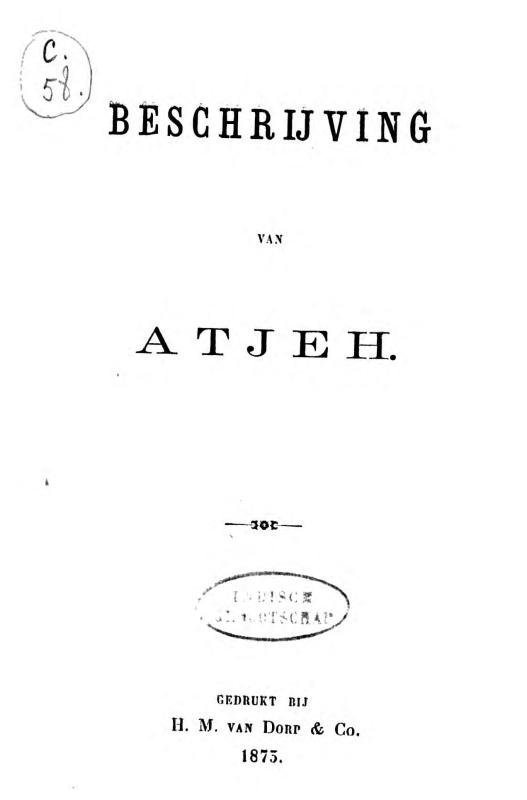
H. M. van Dorp & Co., Batavia · Beschrijving van Atjeh. Batavia: H. M. van Dorp & Co., 1873. Leiden University Libraries, KITLV, shelfmark M c 58 (Aceh Books). · 1873
Abstract
Beschrijving van Atjeh (Batavia: Van Dorp, 1873) is a Dutch-language military and geographical tract compiled before the second Dutch expedition to Aceh. It maps the political division of Aceh Besar into 73 mukim and three sagi, describes the Krueng Aceh basin, villages, forts and swamps around the dalam, details roads and footpaths for troop movement, and appends field rations and porter calculations for one brigade.
- Identifier
- KITLV-AB-M-c-58
- Type
- Buku
- Publisher
- H. M. van Dorp & Co., Batavia
- Date Issued
- 1873
- Bibliographic Citation
- Beschrijving van Atjeh. Batavia: H. M. van Dorp & Co., 1873. Leiden University Libraries, KITLV, shelfmark M c 58 (Aceh Books).
- Creator
- Anonim (pemerintah Hindia Belanda)
- Subject
- Aceh (Indonesia) -- Deskripsi dan perjalanan Perang Aceh, 1873-1904 Aceh Besar -- Geografi Sagi dan mukim -- Aceh Ekspedisi militer Belanda -- Aceh Logistik militer -- Hindia Belanda Toponimi -- Aceh Besar Kolonialisme Belanda -- Aceh Kraton Aceh Sumber primer -- Sejarah Aceh
- LC Classification
- DS646.15.A3
- LCSH Subject
- Aceh (Indonesia)--Description and travel; Aceh War, Indonesia, 1873-1904; Aceh (Indonesia)--History, Military; Netherlands--Colonies--Asia--Administration
- BISAC Category
- HIS003000 History / Asia / Southeast Asia; HIS027000 History / Military / General
- Language
- Belanda
- Description
- Beschrijving van Atjeh is a slim Dutch-language tract printed in Batavia by Van Dorp in 1873. In the KITLV collection now held by Leiden University Libraries it carries shelfmark M c 58 and belongs to the Aceh Books digital collection created after the 2004 tsunami to restore access to literature on Aceh. The title page names no author, and the main text runs to only about thirteen pages, followed by several pages of appendices. Brief as it is, the tract is an important document because it shows how the colonial government built knowledge about Aceh for the purposes of war, precisely between the failure of the first aggression in April 1873 and the second expedition launched at the end of that year. The opening explains that the kingdom of Aceh was divided into Great Aceh (Aceh Besar) and Little Aceh. Great Aceh is called the main theatre of the coming war and lies at the northern tip of Sumatra, while Little Aceh consisted of small states on the north, north-east and north-west coasts paying tribute to the Sultan of Aceh. Great Aceh is bounded by the Strait of Malacca to the north, the Surat Passage and the Indian Ocean to the north-west and west, the Djimbora and Ija Moeria ranges to the south, and the mountains separating it from Little Aceh and Pedir to the south-east and east. It is said to comprise seventy-three mukim or sagi, a mukim being explained as a group of villages under one head. The author then sets out the political arrangement well known in Acehnese historiography, the three sagi: the XXVI Mukim, the XXV Mukim and the XXII Mukim. Each grouping was under a head titled Panglima and addressed as Teuku. Originally, it is said, each mukim had about a thousand inhabitants, but this balance had not lasted and the XXII Mukim was by then the most populous. The author notes that the exact boundaries of the three great districts could not be fixed and gives a general picture: the XXVI Mukim extended to Krueng Raya on the right bank of the Aceh River; the XXII Mukim covered the southern land watered by that river and the Krueng Daroy; and the XXV Mukim covered the left bank as far as the peninsula of Ujung Aceh and Koningspunt. Within these sagi were smaller federations, such as the VII Mukim within the XXII Mukim, the IV and IX Mukim within the XXV, and the III and VI Mukim within the XXVI. The bulk of the tract is a description of the terrain with the Krueng Aceh as its axis. The river is said to rise in the Ija Moeria, flow north-west to near the kraton and then north to the sea. The author records the sandbar at the mouth, the river's width and depth, the access of boats and schooners, swamps and nipa palms at the mouth, rice fields and villages upstream, and the harbourmaster's house about two hours' rowing from the mouth. He also mentions the Krueng Daroy or Krueng Dalam flowing between the first and second walls of the kraton with drinkable water, the missigit or mosque near the north-west corner of the kraton, villages such as Jawa, Penayong, Pande, Ulee Lheue, Lambhuek and Lampineung, and the residence of Panglima Polem at Tunong at the foot of the Djimbora range, described as a stronghold more extensive than the sultan's kraton. The tract also records traces of the first expedition. Along the coast west of the river the author mentions the beach bivouac set up during the first expedition, abandoned fortifications, inlets and canals linking the lagoon with the river, and a mandarsah or hall near the mouth of the Kuala Naridji converted into a defensive work. To the east he mentions the Gigieng inlet, navigable by a schooner the size of the Gipsy, fortifications around Kuala Cangkoi, Kota Radja, Kota Perak and Fort Diamant, and ditches and earth embankments built by the inhabitants. All this shows that the Acehnese had strengthened their coast after the April 1873 attack. The next section, Opgave der wegen en paden, lists roads and footpaths. The author details routes from the coast to the kraton, walking times in hours, bridges, swamps passable only in the dry season, roads suitable or unsuitable for artillery, the route from the Aceh market to Tunong taking twenty-four hours, and a three-day route over the mountains to Pedir. Much information comes from informants who did not always agree, and the author sometimes records these differences openly. The tract closes with the observation that the whole plain of Great Aceh is low and floods once or twice a year so that even the mosque must be reached by boat, and that villages are therefore built on raised ground with houses on stilts. An appendix titled Vivres te Velde gives the daily ration for European, African and Ambonese soldiers and for indigenous troops and forced labourers, from rice, meat, coffee, tea and salt to coconut oil and firewood. Another appendix calculates the forced labourers needed to carry a brigade's supplies, with the Second Brigade composed of 110 officers, 1,378 Europeans, 460 Ambonese, 689 indigenous soldiers, 78 women, and officers' and government horses, plus 13 foremen and 392 coolies for the staff, infantry, mountain artillery, engineers and ambulance. These figures reveal the logistical scale of the second expedition and the large role of forced labour in colonial war. The tract's value for Aceh studies lies in several points. First, it records the toponymy of Aceh Besar in nineteenth-century Dutch spelling, useful for reconstructing the map of villages, rivers, inlets and forts around the dalam before Kutaraja was built. Second, it shows Dutch understanding of the sagi and mukim structure, which later underpinned colonial administration. Third, it records the defensive response of Acehnese society after the first attack. Fourth, its logistical appendices reveal a seldom-discussed face of the war: the thousands of forced labourers and porters mobilised to sustain the troops. Readers should approach the tract critically. It was written from the attacker's perspective, relies on unnamed informants and aims to facilitate conquest. Many place names are rendered as Dutch ears heard them and need to be matched with correct Acehnese names. Nonetheless, as a primary source on Aceh Besar in the year war broke out, it offers a valuable picture of a social, political and physical landscape soon transformed by thirty years of war. This digital edition is displayed through an IIIF viewer from Leiden University Libraries' collection, so every page can be read directly.
- Rights
- Domain publik. Salinan digital dari Leiden University Libraries (KITLV), koleksi Aceh Books.
- Alternative Title
- Description of Aceh
- Source
- Leiden University Libraries, Digital Collections IIIF manifest
- Extent
- 13 halaman teks utama dan lampiran; 32 citra digital
- Collection
- Books
How to cite
Anonim (pemerintah Hindia Belanda), “Beschrijving van Atjeh”, H. M. van Dorp & Co., Batavia, Beschrijving van Atjeh. Batavia: H. M. van Dorp & Co., 1873. Leiden University Libraries, KITLV, shelfmark M c 58 (Aceh Books)., 1873. KBA13 Academy Archive and Library, KITLV-AB-M-c-58.