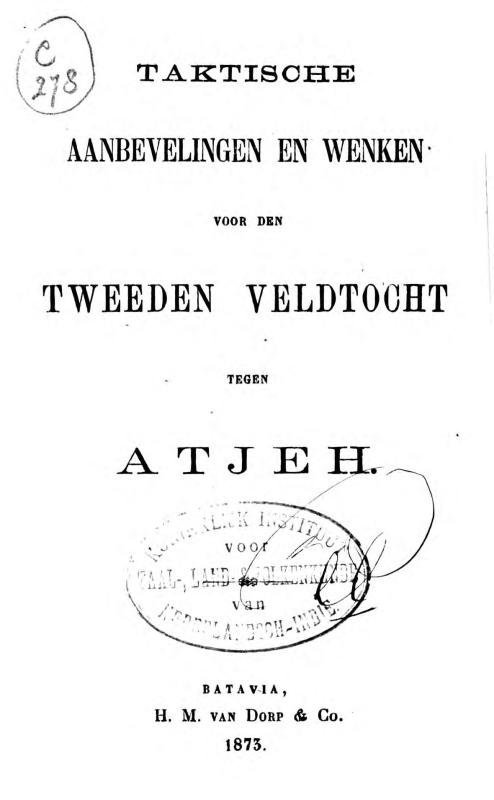
Taktische aanbevelingen en wenken voor den tweeden veldtocht tegen Atjeh
By Anonim (militer Hindia Belanda)
H. M. van Dorp & Co., Batavia · Taktische aanbevelingen en wenken voor den tweeden veldtocht tegen Atjeh. Batavia: H. M. van Dorp & Co., 1873. Leiden University Libraries, KITLV, shelfmark M c 278 (Aceh Books). · 1873
Abstract
A Dutch-language tactical tract of about thirty pages printed by H. M. van Dorp & Co. in Batavia in 1873 as guidance for Netherlands Indies troops ahead of the second expedition to Aceh. It covers general service rules (training, bivouacs, rations, coolies, marching, guides and spies), security while at rest, elementary infantry combat rules, methods for storming Acehnese fortifications and bamboo hedges, the use of mountain artillery, and general principles of war. The document shows how the failure of the first expedition of April 1873 was turned into colonial combat doctrine.
- Identifier
- KITLV-AB-M-c-278
- Type
- Buku
- Publisher
- H. M. van Dorp & Co., Batavia
- Date Issued
- 1873
- Bibliographic Citation
- Taktische aanbevelingen en wenken voor den tweeden veldtocht tegen Atjeh. Batavia: H. M. van Dorp & Co., 1873. Leiden University Libraries, KITLV, shelfmark M c 278 (Aceh Books).
- Creator
- Anonim (militer Hindia Belanda)
- Subject
- Perang Aceh, 1873-1904 Ekspedisi militer Belanda kedua ke Aceh, 1873-1874 Taktik militer -- Hindia Belanda Benteng pertahanan Aceh Pagar bambu dan ranjau -- Aceh Artileri gunung -- Hindia Belanda Kuli dan logistik militer -- Hindia Belanda Pemandu dan mata-mata -- Perang Aceh Kolonialisme Belanda -- Aceh Sumber primer -- Sejarah Aceh
- LC Classification
- DS646.15.A3
- LCSH Subject
- Aceh War, Indonesia, 1873-1904; Netherlands. Koninklijk Nederlandsch-Indisch Leger--Drill and tactics; Tactics--Handbooks, manuals, etc.; Aceh (Indonesia)--History, Military
- BISAC Category
- HIS003000 History / Asia / Southeast Asia; HIS027000 History / Military / General
- Language
- Belanda
- Description
- Taktische aanbevelingen en wenken voor den tweeden veldtocht tegen Atjeh, "Tactical recommendations and hints for the second campaign against Aceh", is a Dutch-language military pocket manual printed by H. M. van Dorp & Co. in Batavia in 1873. In the KITLV collection now managed by Leiden University Libraries it carries shelfmark M c 278 and belongs to the Aceh Books digital collection, an effort to digitise literature on Aceh begun after the 2004 tsunami. The title page names no compiler. The main text runs from page 3 to page 31 and is arranged in sections lettered A, B and C, followed by sections on mountain artillery and general rules. Its form is compact, dense and imperative, clearly meant to be carried and consulted by officers in the field. The context of its publication matters a great deal. In April 1873 the Netherlands Indies government launched its first expedition to Aceh under General J. H. R. Köhler. The expedition failed, Köhler was killed near the great mosque, and the troops were withdrawn. The colonial government then prepared a far larger second expedition under Lieutenant General J. van Swieten, which landed at the end of 1873. This small book was produced between those two events. It reads the first failure as a problem of discipline, logistics, vigilance and the method of attacking fortifications, and formulates its answers as practical advice. Together with Beschrijving van Atjeh, printed in the same year, it shows how knowledge of Aceh was systematically assembled for the purposes of war. Section A, Algemeene dienstvoorschriften or general service rules, opens by urging that every exercise imitate the reality of war as closely as possible. March discipline must be strict, blank cartridges issued in every exercise, and every soldier trained in fire discipline, meaning the absolute submission of each individual to the commander's will at every shot. Storm ladders were to be carried on every troop movement. On bivouacs, the author stresses undisturbed rest, forbids pitching camp in unfamiliar ground after five in the afternoon, and describes how to rig a blanket over a frame of four poles set at 45 degrees in the rain. Food is treated in detail. Troops must eat and drink coffee before setting off, water bottles should hold cold tea or water, and well water must be checked by a medical officer because of the danger of poisoning. For operations longer than a day, provisions were to be carried by coolies or in a bread bag holding five days of rations. The organisation of coolies receives special attention. Military personnel were assigned to supervise coolies and supplies, to see that loads were sensibly distributed, that coolies were fed before departure, that spare bearers were available for heavy loads, and that rattan and kajang mats were taken to protect the provisions from rain. Marching rules are equally precise. War marches normally began at six in the morning, halted ten minutes each hour, and aimed to arrive before midday. When the distance was too great, troops should halt, cook, and continue in the late afternoon. Long columns were to be avoided, pioneers with coolies and tools marched with the vanguard, and night marches were forbidden except in urgent cases. The section closes with advice on guides. Guides were to be treated seriously and gently but watched closely, accompanied by an interpreter when their language was not mastered, and no money was to be spared in obtaining good guides and spies. Section B deals with security while troops are at rest. The author criticises the habit of placing outposts too close and running them passively. Posts should be pushed well forward, the ground cleared, and approaches closed with iron wire, abatis and other obstacles. Outposts should act aggressively, frequently sending small detachments at night to alarm the enemy at several points so that he becomes tired and careless. Sneak patrols were advised to consist mainly of indigenous soldiers, for example two indigenous men and one European, always carrying machetes. Double sentry posts combining a European and an indigenous soldier were recommended. The author notes that guards most often fall asleep in the second half of the night, the most dangerous time, so posts should be inspected frequently and coffee served between two and three in the morning. This section also contains a policy that reveals the character of colonial war. Burning villages was discouraged, but the property of the leaders of resistance was to be burned or destroyed as punishment, while ordinary people, even those of doubtful loyalty, were to be spared. The advice shows an attempt to separate the resisting elite from the population, a pattern that would recur throughout the Aceh War. Section C, Elementaire gevechtsregelen, sets out infantry combat. Every engagement opens with dense skirmish lines, with groups no more than eight paces apart in covered terrain. The author warns against misuse of rapid fire from the breech-loading rifle, which wastes ammunition, raises thick smoke and makes soldiers nervous. In the Indies wars, volley fire was preferred at significant ranges, rapid fire was not to be used beyond 150 paces, and well-disciplined troops could hold their fire until the enemy was 60 to 70 paces away. Despite improved weapons, the bayonet was still said to decide the issue more than once. The longest part concerns attacks on enemy works, namely villages, hills, woods, hedges and ravines. Attacks should preferably be surprises, based on information from spies and sneak patrols, and succeed best against the enemy's rear. Night attacks were recommended between three and four in the morning, carried out by European and indigenous volunteers wearing recognition marks such as a white band on the arm, in total silence. For open assaults, the author explains that the salient angles of a work are its weakest points. He notes that Acehnese fortifications were generally open works fitted with bamboo tubes as loopholes, and advises plugging these tubes with stones, sods or wooden pegs. Thorny bamboo hedges are named as the hardest obstacle. To breach one, a hole was dug close to the bamboo clump and charged with 25 kilograms of gunpowder, while a footnote mentions trials with lithofracteur, a new explosive. The book also explains how to deal with ranjau spikes, pitfalls, wet ditches and palisades, and fixes storm ladders at 3.40 metres, six ladders per company, with six numbered soldiers to each ladder. Experience in the Indies, the author says, showed that many attacks failed because climbing equipment and explosives were not brought, or because coolies threw the ladders away at the critical moment. The section on mountain artillery explains the use of the 8 centimetre gun and the 12 centimetre mortar, the ranges for shell, shrapnel and canister, and light balls that could also serve as incendiaries against wooden and bamboo buildings. The book ends with general rules: do not be reckless with soldiers' lives, pair caution with boldness, be sparing with ammunition, never fight without a reserve, and remember that every engagement has three moments, namely introduction, firefight and decision. For Aceh studies, the book is valuable as a primary source on the colonial military view of the Acehnese and their defensive landscape. Its descriptions of fortifications, bamboo hedges, bamboo loopholes, spikes and pitfalls preserve traces of nineteenth-century Acehnese defensive techniques that were seldom recorded from an Acehnese perspective. Its reliance on coolies, guides and spies reveals a social side of the war that is often overlooked. Readers should of course read it critically, since the text was written to conquer rather than to understand. The digital edition is presented through IIIF images from Leiden University Libraries so that every page can be read directly.
- Rights
- Domain publik. Salinan digital dari Leiden University Libraries (KITLV), koleksi Aceh Books.
- Alternative Title
- Tactical recommendations and hints for the second campaign against Aceh
- Source
- Leiden University Libraries, Digital Collections IIIF manifest
- Extent
- 31 halaman teks; 36 citra digital
- Collection
- Books
How to cite
Anonim (militer Hindia Belanda), “Taktische aanbevelingen en wenken voor den tweeden veldtocht tegen Atjeh”, H. M. van Dorp & Co., Batavia, Taktische aanbevelingen en wenken voor den tweeden veldtocht tegen Atjeh. Batavia: H. M. van Dorp & Co., 1873. Leiden University Libraries, KITLV, shelfmark M c 278 (Aceh Books)., 1873. KBA13 Academy Archive and Library, KITLV-AB-M-c-278.