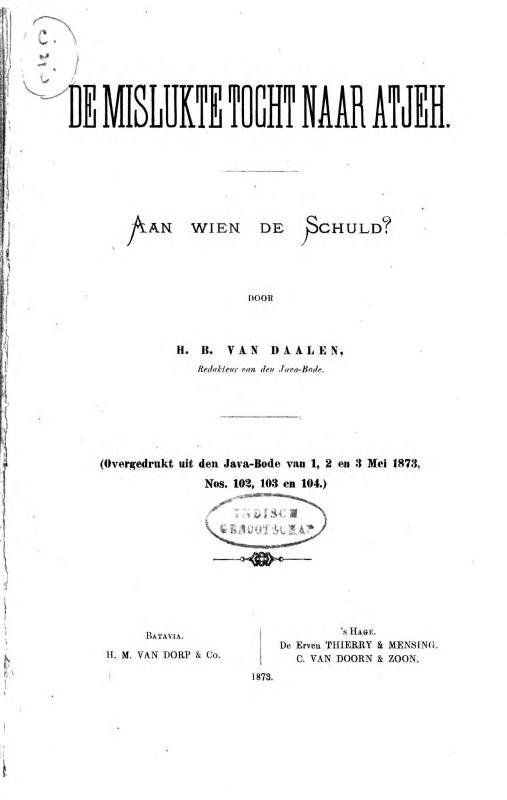
H. M. van Dorp & Co., Batavia; De Erven Thierry & Mensing dan C. van Doorn & Zoon, 's-Gravenhage · Daalen, H. B. van. De mislukte tocht naar Atjeh: aan wien de schuld? Batavia: H. M. van Dorp & Co.; 's-Gravenhage: Thierry & Mensing, C. van Doorn & Zoon, 1873. Overgedrukt uit De Java-Bode 1-3 Mei 1873. Leiden University Libraries, KITLV, shelfmark M c 7 (Aceh Books). · 1873
- Identifier
-
KITLV-AB-M-c-7
- Type
-
Buku
- Publisher
-
H. M. van Dorp & Co., Batavia; De Erven Thierry & Mensing dan C. van Doorn & Zoon, 's-Gravenhage
- Date Issued
-
1873
- Bibliographic Citation
-
Daalen, H. B. van. De mislukte tocht naar Atjeh: aan wien de schuld? Batavia: H. M. van Dorp & Co.; 's-Gravenhage: Thierry & Mensing, C. van Doorn & Zoon, 1873. Overgedrukt uit De Java-Bode 1-3 Mei 1873. Leiden University Libraries, KITLV, shelfmark M c 7 (Aceh Books).
- Creator
-
Daalen, H. B. van
- LC Classification
-
DS646.15.A3
- LCSH Subject
-
Aceh War, Indonesia, 1873-1904; Köhler, J. H. R., 1818-1873; Netherlands. Koninklijk Nederlandsch-Indisch Leger; Military intelligence--Indonesia; Aceh (Indonesia)--History, Military
- BISAC Category
-
HIS003000 History / Asia / Southeast Asia; HIS027000 History / Military / General; POL045000 Political Science / Colonialism & Post-Colonialism
- Language
-
Belanda
- Description
-
De mislukte tocht naar Atjeh. Aan wien de schuld?, "The failed expedition to Aceh. Who is to blame?", is a Dutch-language pamphlet by H. B. van Daalen, editor of the newspaper De Java-Bode in Batavia. It reprints articles that appeared in De Java-Bode on 1, 2 and 3 May 1873, numbers 102, 103 and 104, and was published in 1873 by H. M. van Dorp & Co. in Batavia together with De Erven Thierry & Mensing and C. van Doorn & Zoon in The Hague. In the KITLV collection now managed by Leiden University Libraries it carries shelfmark M c 7 and belongs to the Aceh Books digital collection. The main text runs to 20 pages, preceded by a four-page foreword dated Batavia, 10 May 1873, and followed by a subscription advertisement for De Java-Bode.
The circumstances of its writing were very close to the events. The first Dutch expedition to Aceh under General J. H. R. Köhler landed in early April 1873, Köhler was killed near the great mosque, and the troops were withdrawn at the end of that month. The failure shook public opinion in the Indies and the Netherlands, and newspapers argued over who was responsible. Van Daalen wrote in response to an article titled "Aan wien de schuld" in the daily De Indiër of 26 April 1873, and at the same time against an anonymous article titled "Bemoediging" that defended the Governor-General and attacked De Java-Bode.
The foreword shows the atmosphere of that polemic. Van Daalen says the article "Bemoediging" (encouragement) would better be titled "Ontmoediging" (discouragement). Its anonymous author, he says, defended the government by claiming that government and army had been equipped with the most precise knowledge of Aceh, yet if that claim were true the whole blame would fall on the government. Van Daalen also accuses the writer of sowing hatred between civilians and the army, and notes that when the article was reprinted as a brochure for readers in the Netherlands, its most offensive passages against the editor of De Java-Bode were removed.
The main text opens by stating that the blame cannot be laid on one person. Van Daalen then points to two important facts. First, the government did not know that three weeks after the troops sailed, the west monsoon would set in so strongly that communication with the shore would be cut for days. Second, the government thought the kraton of Aceh meant little, whereas besides a solid, storm-proof kraton armed with heavy guns there were many strong forts with earthen walls built years earlier. The government, he writes, never suspected it would face a powerful indigenous kingdom, well armed, with heavy guns and many firearms, wisely led, and backed by a patriotic, determined and numerous population ready to give its last drop of blood for its freedom.
Van Daalen then traces the efforts to gather information before the war. Until 1870 there was almost no contact with Aceh, and warships rarely visited its waters. After the treaty with Britain in 1871, war with Aceh came to be seen as inevitable. The Navy and War departments collected data, and Colonel Köhler, then commander of the troops on Sumatra, was ordered to compile information. The result was a thick volume with drawings, assembled from known and little-known writings and from interviews with people who had traded with Aceh. The Topographical Bureau was also involved. Yet all these reports described an Aceh that was divided, poorly armed and had lost its former courage, with a few forts and a kraton whose walls were crooked with age. The reality was entirely different. The author notes a strong unity, probably for the sake of independence, custom and religion, and fighters who, klewang in hand, charged through a hail of bullets with a contempt for death that astonished even experienced soldiers. Even the location of the kraton was not precisely known, since according to official reports nobody had seen it.
From this Van Daalen concludes that Köhler, the army command, the Navy and the Indies government cannot be blamed personally. Köhler was asked several times whether he needed more troops, and he and his staff judged the force sufficient. The root of the problem was ignorance. He gives examples of the same pattern in the history of colonial expeditions, from Bali and Bone to Deli, where troops were sent piecemeal, from twelve men to fifty, one hundred and twenty, half a battalion, and then another half battalion. He compares this with Prussia, whose General Staff knew France and neighbouring countries in detail. The Netherlands Indies army, some 27,000 strong, had no such General Staff. Had that corps been created years earlier as the Military Department proposed, Van Daalen argues, Aceh would not have been an unknown land, and many lives and much money could have been saved.
He finally directs the blame at the course of policy in the Netherlands and at successive Ministers of Colonies who treated the Indies army like a stepchild, as well as at a parliament that refused funds. He condemns a "penny wise and pound foolish" attitude and calls for proper weapons, adequate pay and a General Staff. A postscript quotes General Weitzel's review in the Militaire Spectator of Captain Perelaer's book on the Bone expedition, showing similar failures at Soepa in 1825, Bali in 1849, Tomori in 1856 and Bone in 1859, and a proposal for a bureau of topography and military statistics in Batavia that Governor-General Pahud had once rejected.
From a historiographical angle, the pamphlet also shows the role of the Batavia press in shaping public interpretation of the war. Van Daalen did not write as an eyewitness but as an editor reading reports, letters and news from many sides and turning them into an argument about the governance of the colonial army. The quarrel between De Java-Bode, De Indiër and the anonymous author of "Bemoediging" shows that the failure in Aceh at once became a political battleground between supporters and critics of the Governor-General, between civilians and soldiers, and between Batavia and The Hague. Aceh thus appears in this text not only as a battlefield but also as a mirror reflecting the weaknesses of the colonial system itself, a pattern that would recur throughout the thirty years of the Aceh War.
For Aceh studies, the pamphlet is an early testimony from the colonial press on Acehnese strength in 1873. The admission that Aceh was a united, armed and wisely led kingdom defended by a people ready to die for freedom comes from the attacking side and is therefore especially valuable. It also shows how the failure of April 1873 prompted demands for systematic knowledge of Aceh, which later underpinned colonial scholarship on Acehnese society. The digital edition is presented through IIIF images from Leiden University Libraries.
- Rights
-
Domain publik. Salinan digital dari Leiden University Libraries (KITLV), koleksi Aceh Books.
- Alternative Title
-
The failed expedition to Aceh: who is to blame?
- Source
-
Leiden University Libraries, Digital Collections
IIIF manifest
- Extent
-
IV, 20 halaman; 28 citra digital
How to cite
Daalen, H. B. van, “De mislukte tocht naar Atjeh: aan wien de schuld?”, H. M. van Dorp & Co., Batavia; De Erven Thierry & Mensing dan C. van Doorn & Zoon, 's-Gravenhage, Daalen, H. B. van. De mislukte tocht naar Atjeh: aan wien de schuld? Batavia: H. M. van Dorp & Co.; 's-Gravenhage: Thierry & Mensing, C. van Doorn & Zoon, 1873. Overgedrukt uit De Java-Bode 1-3 Mei 1873. Leiden University Libraries, KITLV, shelfmark M c 7 (Aceh Books)., 1873. KBA13 Academy Archive and Library, KITLV-AB-M-c-7.