Pilkada Tanpa Rakyat [Regional Elections Without the People]
Kompas · 2014-11-18
Abstract
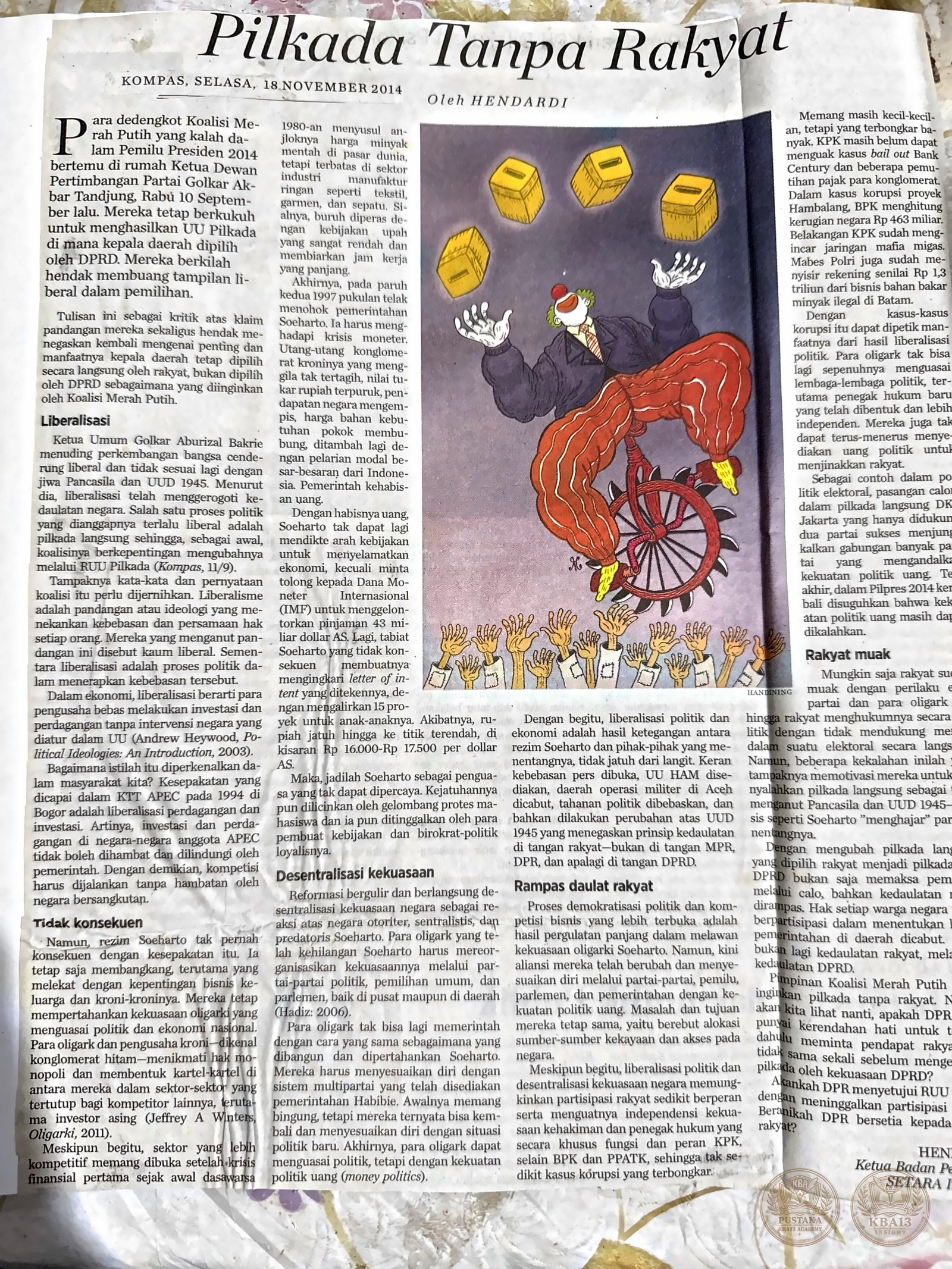
An opinion article by Hendardi, Chairman of the Executive Board of the SETARA Institute, in the daily Kompas, with an illustration by Hanoning, criticising the effort of the Koalisi Merah Putih (Red-and-White Coalition) to replace direct elections of regional heads with election by the DPRD (Regional House of Representatives) through the Pilkada (regional election) Law. He refutes Aburizal Bakrie's claim that direct regional elections are a product of liberalisation contrary to Pancasila and the 1945 Constitution, by explaining the meaning of liberalism and liberalisation (referring to Andrew Heywood) and its history in Indonesia: the 1994 APEC Bogor agreement, which the Soeharto regime did not implement consistently; oligarchy and crony conglomerates (referring to Jeffrey Winters); the 1997 monetary crisis; and on to reformasi and the decentralisation of power, which led the oligarchs to adapt through parties and money politics (referring to Vedi Hadiz). According to Hendardi, political liberalisation in fact strengthened the KPK (Corruption Eradication Commission), the BPK (Audit Board), and the PPATK (Financial Transaction Reports and Analysis Center) and made it possible for the people to punish parties, so that election of regional heads by the DPRD would mean seizing the sovereignty of the people.
How to cite
Hendardi, “Pilkada Tanpa Rakyat [Regional Elections Without the People]”, Kompas, 2014-11-18. KBA13 Academy Archive and Library, KBA-KLP-2014-0008.