
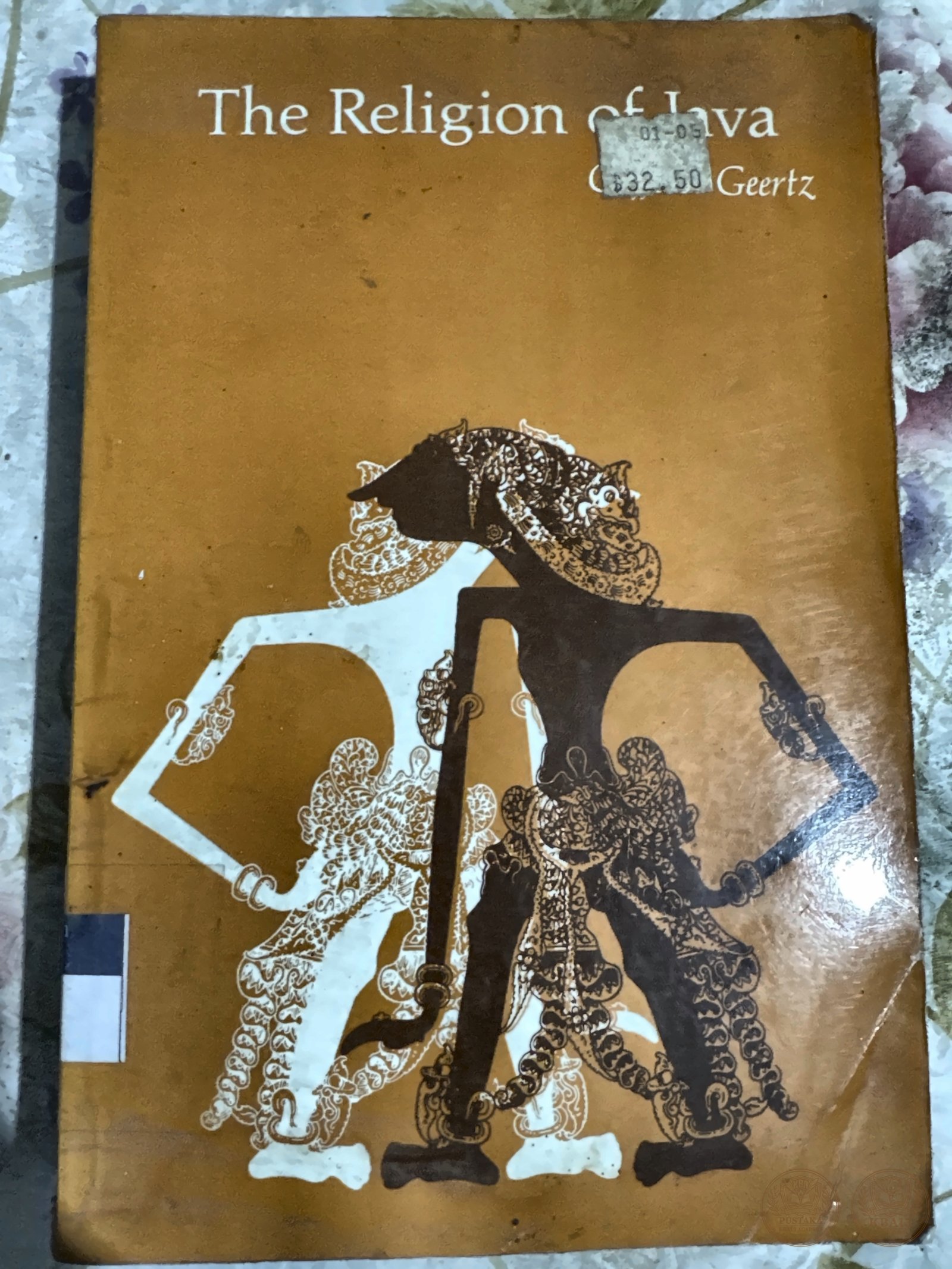
The Religion of Java
The Free Press, Glencoe, Illinois · 1960
Abstract
A classic work by the American anthropologist Clifford Geertz (1926–2006), the result of field research for the Modjokuto Project in the town of Pare, Kediri, East Java (disguised as Mojokuto) in 1952–1954. Geertz divides the religious life of Javanese society into three variants or subtraditions: the abangan, centred on the slametan ritual, belief in spirits, and healing by dukun (traditional healers) among village peasants; the santri, emphasising observance of Islamic teachings and linked to traders and to organisations such as NU and Muhammadiyah; and the priyayi, rooted in the Hindu-Javanese court tradition, etiquette, the arts of wayang and gamelan, and mysticism among bureaucrats. He shows how these three variants were connected with social structure and political streams (aliran) in the 1950s. The book has been highly influential and at the same time much criticised, among others by Harsja Bachtiar, Marshall Hodgson, Mark Woodward, and Indonesian scholars who judged that Geertz underestimated the Islamic character of Java. Translated as Abangan, Santri, Priyayi dalam Masyarakat Jawa, the work remains a principal point of departure for Islamic studies and the anthropology of religion in Indonesia.
How to cite
Clifford Geertz, “The Religion of Java”, The Free Press, Glencoe, Illinois, 1960. KBA13 Academy Archive and Library, KBA-BKU-1960-0001.