
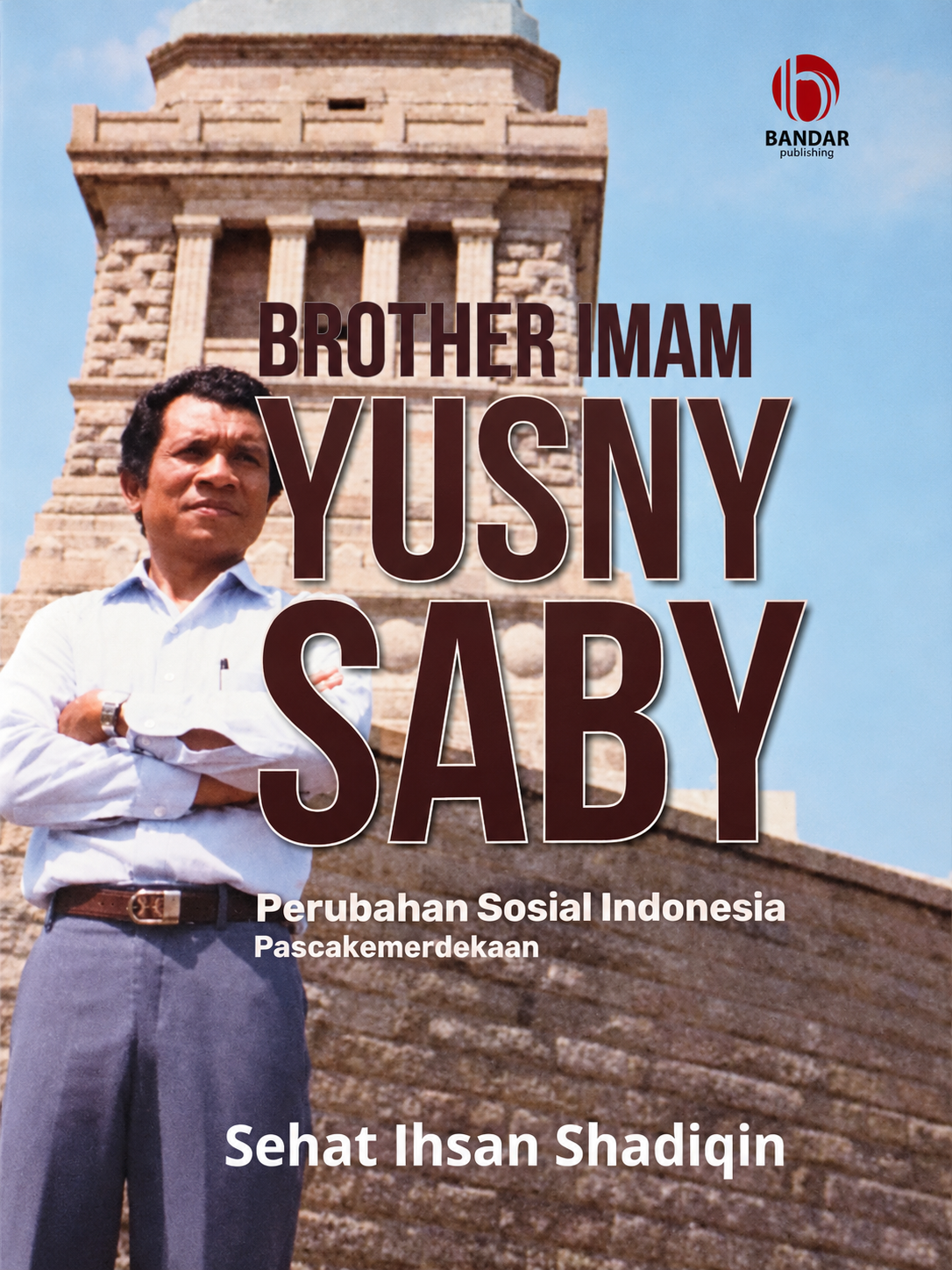
Book
Brother Imam Yusny Saby: Perubahan Sosial Indonesia Pascakemerdekaan [Brother Imam Yusny Saby: Social Change in Post-Independence Indonesia]
Bandar Publishing, Banda Aceh · 2026
- Identifier
- KBA-BK-2026-0100
- Type
- Buku
- Publisher
- Bandar Publishing, Banda Aceh
- Date Issued
- 2026
- Creator
- Sehat Ihsan Shadiqin
- LC Classification
- DS646.15.A2 — Sejarah Aceh
- LCSH Subject
- Saby, Yusny Indonesia -- Social conditions
- BISAC Category
- BIO018000 BIOGRAPHY & AUTOBIOGRAPHY / Religious
- Spatial Coverage
- Banda Aceh
- Language
- Indonesia
- Description
- Brother Imam Yusny Saby: Perubahan Sosial Indonesia Pascakemerdekaan is a book by Sehat Ihsan Shadiqin that takes the life journey of a figure as an entry point for approaching social change. Its title brings together two scales of reading: the life of Yusny Saby as an individual and post-independence Indonesia as a historical space. For library visitors, this juxtaposition offers a reason to read biography with attention to the relationship between personal experience, social environment, and the development of the times. This description has been compiled as a curatorial introduction based on the cover and available bibliographic information, not as a complete summary of the entire contents of the book. The thematic explanation below indicates possible uses for learning, research, and collection searching. According to the publisher's introduction, the figure at the centre of this book is Professor Yusny Saby, who comes from a modest family in Bireuen Regency, Aceh. The publisher describes the trajectory of his life through Bireuen, Lhokseumawe, Kutaraja, Yogyakarta, Jakarta, and on to the United States. This information shows that the spaces of life introduced to readers extend beyond a single local environment. However, the details of the journey, the sequence of events, and the experiences in each place need to be checked directly in the book. At the catalogue level, the available information already helps place this work among readings in biography, social history, and studies of the relationship between place of origin and cross-regional experience. One question readers can bring when opening this book is how a person's experience relates to the changes in the society around them. Biography allows history to be approached through human decisions, opportunities, encounters, and memories. This approach is useful because social change is often easier to understand when it is connected to concrete experience. Nevertheless, a single figure cannot be regarded as representing an entire society. Readers still need to distinguish individual experience, the picture of a particular group, and broader social tendencies. With such attention, a biography can become material for building historical questions without making a single life the sole explanation of its era. The phrase Indonesia pascakemerdekaan (post-independence Indonesia) in the subtitle provides a broad horizon of reading. Independence can be understood as the beginning of various processes of forming society, institutions, and shared hopes. Within the framework of this introduction, readers can ask how ideas of progress, education, service, and identity acquired meaning in different periods. These questions are suggestions for reading, not a statement that all these issues are specifically discussed by the author. To find out the actual emphasis, the table of contents, introduction, and conclusion need to be read. The catalogue serves to help readers recognise the field of issues before deciding which parts of the book best suit their interests. For Aceh studies, the starting point in Bireuen invites attention to the relationship between the environment of origin and the shaping of a life journey. A place of origin is not merely a geographical marker in a biography. It can be a context for asking about the role of family, social circles, language, customs, and opportunities for learning. The presence of several cities in the publisher's introduction also opens questions about changes of environment and the broadening of experience. Readers can use this book to trace whether and how the relationship with the place of origin is retold. Answers to these questions must follow the evidence in the text, not be inferred merely from place names or the image of the figure on the cover. The trajectory to the United States mentioned by the publisher opens possibilities for reading about encounters across societies. From a research perspective, moving between places can be an opportunity to examine experiences of learning, adaptation, network formation, and the exchange of ideas. The available information is not sufficient to establish particular institutions, years, or activities in that journey. Library visitors are therefore advised to use this information as an initial pointer for searching. When read together with other relevant documents, the biographical narrative can help formulate questions about the relationship between international experience and social life in the home environment, while maintaining care regarding chronology and sources of information. For students, this book can be used as material for practising critical reading of biography. The first step is to note who speaks in the narrative, which events are selected, and how information about the figure is arranged. Next, readers can distinguish accounts of events, testimonies, interpretations, and judgements. This distinction helps prevent a reading that merely collects praise or repeats stories without questions. Students can also compile a timeline based on the pages read, and then note the parts that still require checking. This approach makes reading more focused while providing a basis for discussion of the relationship between life writing and the construction of historical knowledge. For researchers, the value of a biography also lies in its ability to indicate directions for further source searching. Names of people, places, organisations, or events actually found in the text can be noted for comparison with archives and other publications. This catalogue does not state that the book uses interview methods, provides particular documents, or contains special reference apparatus, because these elements have not been examined. This stance ensures that the collection description remains accountable. Scholarly use needs to rest on direct reading and the recording of page numbers, especially if information from the book is to be quoted in articles, theses, historical research, or academic works requiring detailed sources. As an object of documentation, the book's cover also has significance for collection management. The figure's name is displayed in large type, while the subtitle gives an indication of its social and historical scope. The photograph on the cover and the building in the background form a visual identity that helps visitors recognise the copy. Tidy image documentation should preserve all the text, the publisher's logo, and the original visual arrangement. Cropping the background outside the book and adjusting legibility can aid catalogue presentation, but the result should be understood as a processed image for access. The original photograph remains useful as a reference, especially for checking details that may be diminished by digital processing. In the Pustaka KBA13 Academy, this book can be placed as a reading that links the life of a figure, Aceh studies, and the social history of Indonesia. This grouping is a cataloguing recommendation that can be adjusted to the existing arrangement of the collection. Focused keywords help visitors find the book by theme as well as by name, while bibliographic metadata make it easier to distinguish between titles and editions. Visitors interested in the relationship between people and the changes of their times can make this book a starting point for exploration. Further reading still needs to leave room for the complexity of experience, differences in perspective, and the checking of sources, so that appreciation of the figure goes hand in hand with academic rigour. For collection search purposes, the name of the author and the name of the figure need to be placed in separate fields. Sehat Ihsan Shadiqin is the author, while Yusny Saby is the subject of the biography. This distinction helps more precise searching. The year of publication must also be distinguished from the period of life being discussed. Likewise, the presence of the cover photograph in the catalogue indicates the documentation of a copy, not the availability of the full text for reading or download. Access information can be added in accordance with the library services in effect.
- Rights
- Koleksi Pribadi
How to cite
Sehat Ihsan Shadiqin, “Brother Imam Yusny Saby: Perubahan Sosial Indonesia Pascakemerdekaan [Brother Imam Yusny Saby: Social Change in Post-Independence Indonesia]”, Bandar Publishing, Banda Aceh, 2026. KBA13 Academy Archive and Library, KBA-BK-2026-0100.