
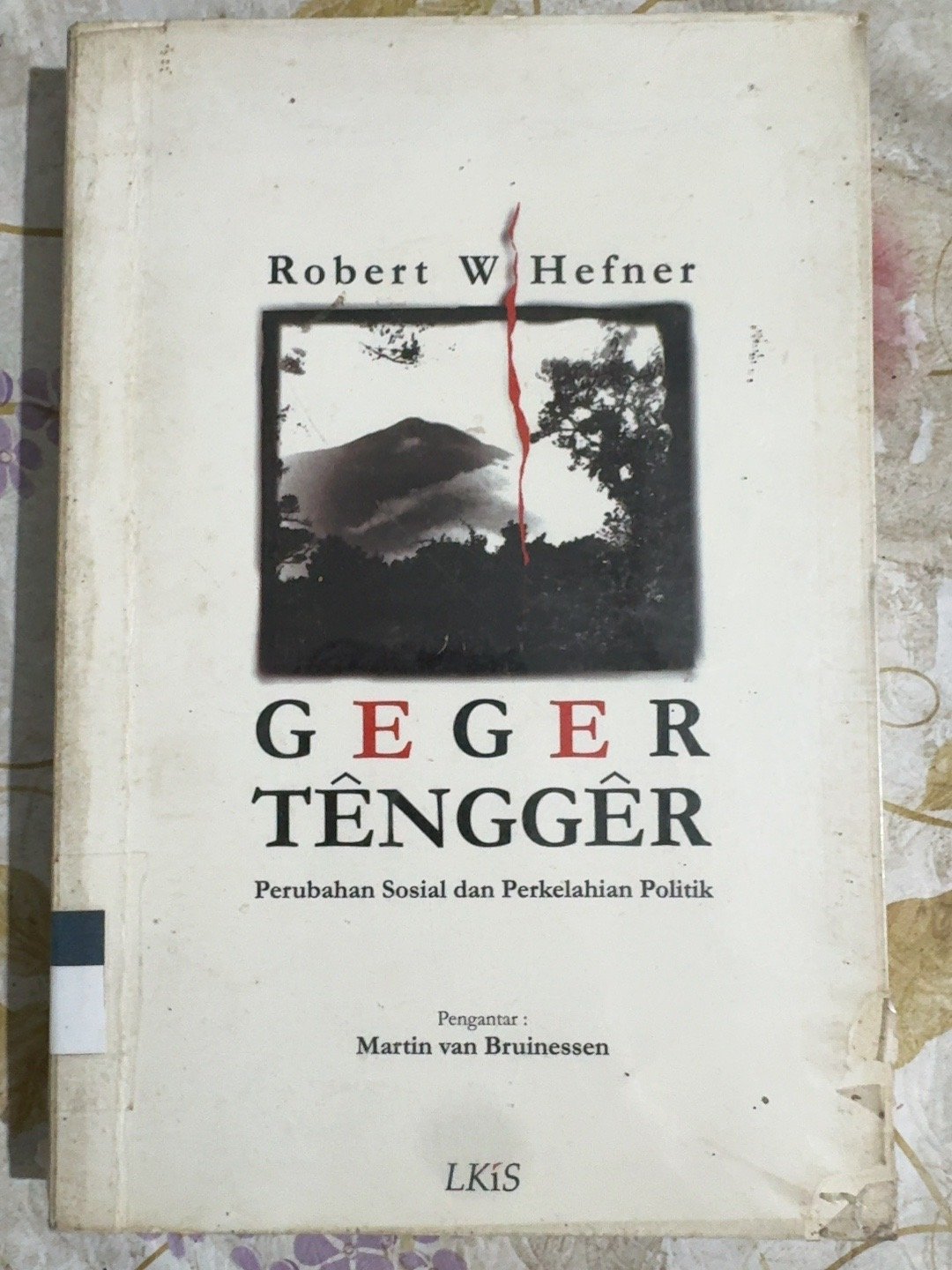
Geger Tengger: Perubahan Sosial dan Perkelahian Politik [Tengger in Turmoil: Social Change and Political Conflict]
By Robert W. Hefner, Martin van Bruinessen (pengantar)
LKiS, Yogyakarta · Tahun cetak eksemplar belum diperiksa. Rujukan katalog pembanding: LKiS, Yogyakarta, 1999; ISBN 979-8966-34-1; penerjemah A. Wisnuhardana dan Imam Ahmad (belum diverifikasi pada eksemplar) · Tanpa tahun
Abstract
A book by Robert W. Hefner on social and political change in Tengger society, with a foreword by Martin van Bruinessen as shown on the cover. The catalogue description introduces the relationships between economy, community, and power as a direction for reading. The LKiS 1999 data come from a comparative catalogue; the year of printing and the number of pages of the copy still need to be checked.
- Identifier
- KBA-BKU-TT-0006
- Type
- Buku
- Publisher
- LKiS, Yogyakarta
- Date Issued
- Tanpa tahun
- Bibliographic Citation
- Tahun cetak eksemplar belum diperiksa. Rujukan katalog pembanding: LKiS, Yogyakarta, 1999; ISBN 979-8966-34-1; penerjemah A. Wisnuhardana dan Imam Ahmad (belum diverifikasi pada eksemplar)
- Creator
- Robert W. Hefner
- Subject
- Tengger Jawa Timur Perubahan sosial Antropologi Ekonomi politik Masyarakat pegunungan Politik Indonesia
- LC Classification
- GN635.I65 — Etnografi Indonesia
- LCSH Subject
- Tengger (Indonesian people)
- BISAC Category
- SOC002010 SOCIAL SCIENCE / Anthropology / Cultural & Social
- Language
- Indonesia
- Description
- Geger Tengger: Perubahan Sosial dan Perkelahian Politik by Robert W. Hefner brings together attention to a mountain society with questions of change and power. The cover of this copy lists a foreword by Martin van Bruinessen and the identity of LKiS. A photograph of mountains in a black frame, a vertical red line, and the play of colours in the title form an easily recognisable visual identity. This catalogue introduction has been compiled from the cover, library information, and an examination of the context of the related English-language work. It does not replace a complete reading of the Indonesian edition, nor does it confirm all the bibliographic details that are not visible in the photograph of the copy. The catalogue of Universitas Indonesia records the publication as Yogyakarta, LKiS, 1999, with ISBN 9798966341 and the names A. Wisnuhardana and Imam Ahmad as translators. These data provide an initial bibliographic match for the cover submitted. However, library catalogues differ in recording the number of pages, so that figure should not be confirmed without examining the book. The year of printing and the impression of the copy are also not yet visible. Martin van Bruinessen's foreword can be recorded as a separate contribution because it is listed directly on the cover, without turning him into the principal author. This separation of roles is useful both for searching by name and for compiling accurate citations. The comparative text, The Political Economy of Mountain Java: An Interpretive History, shows Hefner's attention to the relationships between economy, community, and history in the Tengger highlands. Its framework connects agricultural change, land and labour, consumption, social identity, and politics. In the introduction to that work, economic change is also treated as a process that affects moral life and relationships between people. This idea gives direction to the reading of the Indonesian book: change can be questioned not only in terms of increases in production or income. Readers can also trace changes in expectations, respect, a sense of togetherness, and the ways in which a community understands a person's standing. As a curatorial introduction, one question that visitors might bring is how the mountain environment relates to social experience. The mountains are not merely a scenic backdrop on the cover. In research on societies, location may be related to patterns of travel, economic activities, distance from the centre of government, and relations with other regions. However, such relationships must be discovered through evidence, not established from geographical circumstances alone. Readers can ask how the author connects place with historical processes. This approach helps avoid the assumption that mountain societies possess fixed characteristics directly determined by their landscape. Questions about social change also require clarity of scale. Change in a single household, a single village, and a single region does not necessarily move in the same direction or at the same speed. In a reading exercise, students can separate these levels before drawing conclusions. They can note who gained opportunities, who faced obstacles, and which relationships became more important. In this way, the term society is not used to cover up differences in experience. A book of anthropological scope such as this can serve as material for practising the connection between detailed observation and broader explanation, provided readers keep returning to the author's account and evidence. The subtitle Perubahan Sosial dan Perkelahian Politik (Social Change and Political Conflict) invites attention to the relationship between everyday life and competition for power. Conceptually, politics can be read through contests for office, but also through the authority to make decisions and to define the common interest. A useful question for readers is how those interests are expressed and who has the opportunity to express them. Another question concerns the relationship between local ties and organisations that operate on a larger scale. This description does not add any particular events to the book; it provides a framework of questions so that the theme of politics does not stop at being a general label in catalogue searches. Reading on economics can be directed at the relationship between work, resources, and social recognition. Two people with different incomes do not necessarily have a standing determined solely by money. Conversely, a change in income can change relationships when accompanied by changes in expectations and shared practices. As a teaching illustration, students can compare an explanation that merely mentions increased agricultural yields with one that traces who controls the means of production and how the benefits are distributed. This illustration is not a quotation from the book. Its purpose is to clarify the kinds of relationships that can be looked for when reading studies of political economy carefully. For religious studies, the book opens the possibility of asking about the relationship between identity, community, and social change. Such a question needs to be framed without automatically equating religious affiliation with political choice. Readers can trace when religious identity is mentioned, how it relates to other ties, and whether the author distinguishes the experiences of different areas or groups. Sensitivity to difference helps avoid generalisations about the whole of Tengger society. As material for a class in the anthropology of religion, discussion can be built from particular sections with their page numbers, and then compared with other sources that discuss similar places and periods. Use for research also requires attention to method. Readers can examine the relationship between historical narrative, field observation, testimony, and other data actually found in the book. Each form of evidence offers both possibilities and limits. A person's memory, for example, can reveal the meaning of experience, but is not always sufficient to establish the whole chronology of an event. Economic figures can show patterns, but do not automatically explain the moral experience behind them. By bringing such methodological questions, students can learn why research on societies often requires more than one type of source and more than one level of explanation. The condition of the copy has documentary value of its own. The photograph shows a light-coloured cover that has aged, stains on the surface, a label on the left side, and damage at the lower right. These features need to be preserved in the original photograph. The straightened and sharpened access image helps visitors recognise the book, but must not be used to infer physical details that have been altered by processing. For searching, the book can be linked with the subjects Tengger, East Java, social change, anthropology, political economy, mountain societies, and Indonesian politics. Contributors' names are recorded according to their roles, while the relationship with the English title is explained as bibliographic context that needs to be matched against the title page of the translation. Within the arrangement of Pustaka KBA13 Academy, this work can be brought together with other books of social history and anthropology through the same question: how do large-scale changes become local experience? Such a connection does not mean that all societies follow identical patterns. On the contrary, comparison can clarify differences and show the limits of an explanation. Visitors can use the summary to determine initial relevance, the metadata to identify the publication, and the notes on the copy to recognise the material available. A complete reading then makes possible a stronger assessment of Hefner's argument, while also providing a basis for using the work in discussion and research whose sources can be traced. A comparison between editions should also note changes of title and the addition of a foreword. Such paratextual elements can help examine how a work is introduced to different reading communities.
- Rights
- Koleksi pribadi KBA13 Academy
- Contributor
- Martin van Bruinessen (pengantar)
- Collection
- Books
How to cite
Robert W. Hefner, Martin van Bruinessen (pengantar), “Geger Tengger: Perubahan Sosial dan Perkelahian Politik [Tengger in Turmoil: Social Change and Political Conflict]”, LKiS, Yogyakarta, Tahun cetak eksemplar belum diperiksa. Rujukan katalog pembanding: LKiS, Yogyakarta, 1999; ISBN 979-8966-34-1; penerjemah A. Wisnuhardana dan Imam Ahmad (belum diverifikasi pada eksemplar). KBA13 Academy Archive and Library, KBA-BKU-TT-0006.