Falsafatuna: Materi, Filsafat, dan Tuhan dalam Filsafat Barat dan Rasionalisme Islam [Our Philosophy: Matter, Philosophy, and God in Western Philosophy and Islamic Rationalism]
RausyanFikr Institute · Tahun, cetakan, penerjemah, dan ISBN eksemplar belum diverifikasi. Katalog penerbit menampilkan cetakan lain dengan subjudul berbeda; data tersebut tidak disalin ke entri ini · Tanpa tahun
Abstract
A work by Muhammad Baqir Shadr with the subtitle Materi, Filsafat, dan Tuhan dalam Filsafat Barat dan Rasionalisme Islam (Matter, Philosophy, and God in Western Philosophy and Islamic Rationalism). The introduction provides context on the theory of knowledge and the philosophical view of the world based on a comparison text, not a complete reading of the copy. The identity of the RausyanFikr Institute is visible on the cover; the year, printing, translator, and ISBN of the copy have not yet been verified.
Identifier
KBA-BKU-TT-0007
Type
Buku
Publisher
RausyanFikr Institute
Date Issued
Tanpa tahun
Bibliographic Citation
Tahun, cetakan, penerjemah, dan ISBN eksemplar belum diverifikasi. Katalog penerbit menampilkan cetakan lain dengan subjudul berbeda; data tersebut tidak disalin ke entri ini
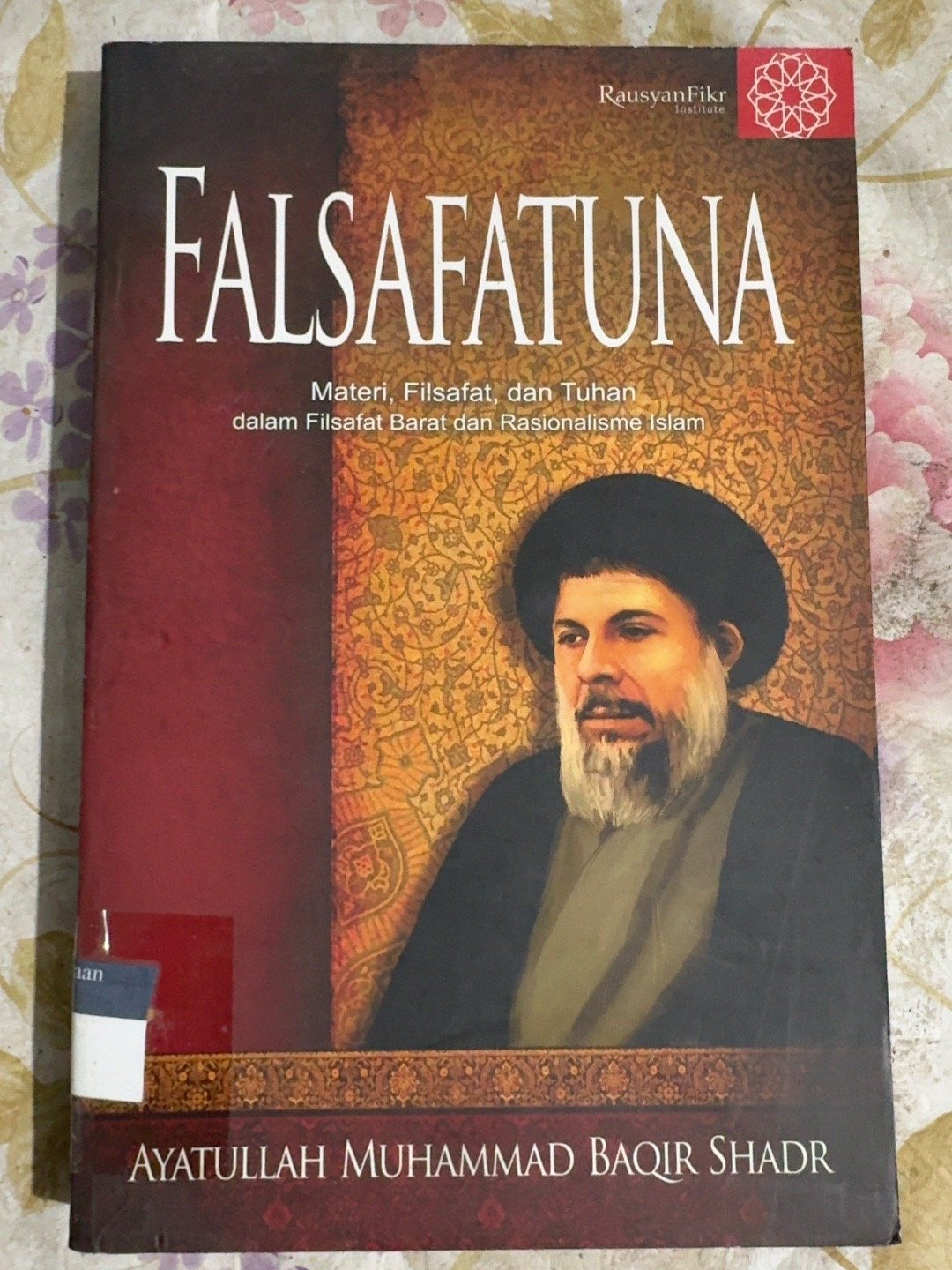
Falsafatuna is a work by Ayatullah Muhammad Baqir Shadr which, on the cover of this copy, carries the subtitle Materi, Filsafat, dan Tuhan dalam Filsafat Barat dan Rasionalisme Islam (Matter, Philosophy, and God in Western Philosophy and Islamic Rationalism). The identity of the RausyanFikr Institute is visible at the top, while a portrait of the figure and ornaments fill the central part. The title and subtitle indicate a field of discussion that brings together questions of knowledge, reality, and divinity. In the Pustaka KBA13 Academy, this book can be placed as material for exploring Islamic philosophy and comparative thought. This introduction distinguishes the identity visible on the cover from the context of the work examined through an English-language comparison text and the publisher's catalogue.
In the author's explanation of the nature of his work, Falsafatuna is divided into two main investigations: the theory of knowledge and the philosophical view of the world. The first investigation serves to prepare the method for the second. The author gives attention to the foundations of rational reasoning, the value of knowledge, and the relationship between experience and principles of thought. This framework shows that the discussion of the world is preceded by the question of how a piece of knowledge can be judged true. This information comes from the comparison text Our Philosophy, not from an examination of all the chapters of the Indonesian translation in this copy. Page numbering, translation terminology, and the completeness of each part still require direct checking.
The part on the worldview, according to the author's explanation, covers debates among philosophical schools, dialectics, causality, matter and God, and the problem of knowledge. This framework helps readers see the connections between questions. A view about the source of knowledge can influence how one assesses cause and effect; a view about cause and effect can in turn relate to explanations of the existence of the world. When reading, visitors can draw a map of the relations between concepts before assessing any particular conclusion. Such a map is useful for avoiding piecemeal reading that separates a claim from the reasons and meanings that support it within the structure of the author's argument.
The subtitle on the cover mentions Western philosophy and Islamic rationalism. Both terms are best used as markers of a field of debate, not as an assumption that each tradition holds a single view. As a reading guide, students can note who is discussed in each part and which theory is being responded to. A critique of one view does not automatically apply to all thinkers in the same tradition. This care helps distinguish comparative study from the construction of overly simple oppositions. An assessment of the success of a critique needs to follow the author's exposition and, where necessary, a reading of the sources being criticised.
The term matter in philosophical reading also requires special attention. It does not always mean a tangible object in the everyday sense. Questions about matter may concern what is regarded as fundamental reality, how existence is explained, and the boundary between physical explanation and metaphysical interpretation. These questions are a conceptual introduction for library visitors. The catalogue does not establish that a single simple formulation already represents the author's entire position. Readers can examine how the term is used in different parts, whether its meaning remains constant, and what consequences a change of meaning has for the argument being built.
The question of God in philosophy requires a distinction between statements of belief and the construction of philosophical reasons. The two may be related, but they are not identical in their mode of presentation. To read in a focused way, students can ask what form of reasoning is used, what assumptions are accepted from the outset, and what kinds of objections are answered. They can also distinguish criticism of an argument from judgement of the person who holds it. In this way, discussion of divinity can proceed as a careful inquiry of thought. The presence of the book in the catalogue opens access to its arguments, without requiring all visitors to accept its conclusions or intellectual affiliations.
Causality is one of the useful entry points for learners. In simple terms: does every event have a cause, how is a cause known, and what distinguishes temporal sequence from a cause-and-effect relationship? These questions can be used as an exercise before following the more complex discussion. For example, two events that occur in succession do not by themselves show that the first event caused the second. This example is a curatorial illustration, not a quotation from the book. By bringing clear questions, readers can assess how a philosophical work connects experience, general principles, and explanations of the world.
For learning activities, Falsafatuna can be used together with a reading sheet containing terms, definitions, arguments, objections, and answers. Each note should be accompanied by page numbers. This helps readers return to the text when differences in understanding arise in discussion. Comparisons with other works can also be made on the basis of the same questions, rather than simply juxtaposing different slogans. If used together with books on materialism or logic in the collection, readers can trace the notions of rationality and proof in each work. The relationship between these books is a suggestion for using the library, not a statement that the authors respond to one another directly.
Edition data must be handled carefully because the publisher's catalogue currently available displays variants of subtitle and printing that are not necessarily the same as this cover. The Rausyan Fikr Institute page lists a ninth printing, a size of 15 × 23 centimetres, and 407 pages, with a subtitle that uses the phrase Filsafat Islam (Islamic Philosophy). The cover submitted, by contrast, uses Rasionalisme Islam (Islamic Rationalism). This discrepancy is a reason not to simply copy the year, page count, translator's name, or ISBN from another printing. The copyright page will be the most important evidence for precisely identifying the edition of the KBA copy.
From the documentation side, the cover has a label at the lower left and signs of use that should remain traceable through the original photograph. The tidied version serves to aid visual access, not to replace evidence of the copy's condition. Suitable keywords for initial searching include Muhammad Baqir Shadr, Falsafatuna, Islamic philosophy, epistemology, rationalism, materialism, metaphysics, and causality. The name may be accompanied by the alternative form Muhammad Baqir al-Sadr to make searching easier. Cataloguing of this kind brings together readability, accuracy of identity, and thematic connectedness, while leaving room for updating once more complete bibliographic documentation becomes available.
Reading a translation adds another issue, namely the relationship between the original terms and the chosen equivalents. A word that looks ordinary may carry technical weight when used in a philosophical debate. Readers can therefore make a small glossary recording the term, its meaning in the paragraph, and its possible everyday meaning. When comparing with other languages, differences in equivalents do not necessarily indicate an error; they may be related to translation traditions or the context of discussion. Conclusions require closer examination. This exercise helps students use translated books more consciously, while ensuring that quotations are not separated from the specific meaning the author is giving them. The translator's introduction and notes, if available in the copy, are also worth reading as part of the work's journey to Indonesian readers, without being equated with statements by the original author.
Ayatullah Muhammad Baqir Shadr, “Falsafatuna: Materi, Filsafat, dan Tuhan dalam Filsafat Barat dan Rasionalisme Islam [Our Philosophy: Matter, Philosophy, and God in Western Philosophy and Islamic Rationalism]”, RausyanFikr Institute, Tahun, cetakan, penerjemah, dan ISBN eksemplar belum diverifikasi. Katalog penerbit menampilkan cetakan lain dengan subjudul berbeda; data tersebut tidak disalin ke entri ini. KBA13 Academy Archive and Library, KBA-BKU-TT-0007.