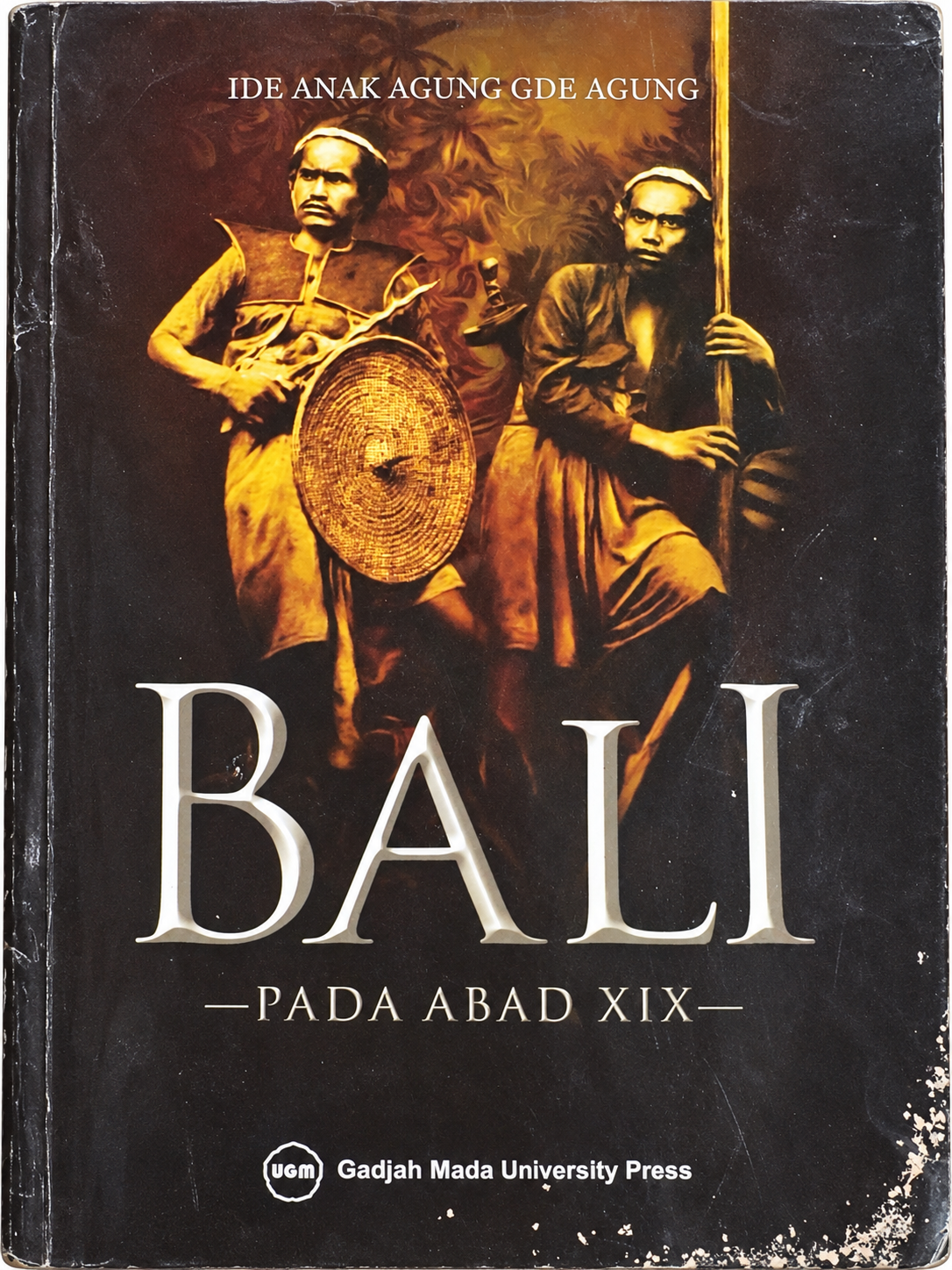
Gadjah Mada University Press, Yogyakarta · Tahun cetak eksemplar belum diketahui; menurut penerbit, terbitan pertama Maret 1989. Rujukan penerbit: ISBN 979-420-114-6; 875 halaman; 14,5 × 21 cm (belum diverifikasi pada eksemplar). Judul bibliografis lengkap: Bali pada abad XIX: perjuangan rakyat dan raja-raja menentang kolonialisme Belanda, 1808–1908 · Tanpa tahun
Abstract
A history book by Ide Anak Agung Gde Agung which, according to its table of contents, discusses the state of Bali on the eve of the nineteenth century, political relations with the Dutch in 1808–1830, the opening of trading posts in Bali and Lombok in 1830–1845, and the wars in Buleleng, Jagaraga, and Kusamba. The discussion continues with the political constellation from 1850, the Dutch military expedition of 1906, the Puputan Badung, and the Puputan Klungkung of 1908. There are seven chapters, a bibliography, an index, appendices, and a curriculum vitae. The catalogue description was compiled from the cover, table of contents, and publisher's data, not from a complete reading of the book.
Identifier
KBA-BKU-TT-0011
Type
Buku
Publisher
Gadjah Mada University Press, Yogyakarta
Date Issued
Tanpa tahun
Bibliographic Citation
Tahun cetak eksemplar belum diketahui; menurut penerbit, terbitan pertama Maret 1989. Rujukan penerbit: ISBN 979-420-114-6; 875 halaman; 14,5 × 21 cm (belum diverifikasi pada eksemplar). Judul bibliografis lengkap: Bali pada abad XIX: perjuangan rakyat dan raja-raja menentang kolonialisme Belanda, 1808–1908
Bali Island (Indonesia) -- History -- 19th century
BISAC Category
HIS048000 HISTORY / Asia / Southeast Asia
Spatial Coverage
BaliLombok
Language
Indonesia
Description
Bali pada Abad XIX by Ide Anak Agung Gde Agung is a work of history which, according to the table of contents of this copy, traces the changing relations between the kingdoms of Bali and Dutch power from the early nineteenth century to the early twentieth century. The cover shows two armed figures in golden-brown tones, the title in large letters, and the identity of Gadjah Mada University Press. In the Pustaka KBA13 Academy collection, this book can be placed as a source for exploring the political history of Bali, relations between kingdoms, the expansion of colonialism, and resistance to conquest. This catalogue introduction rests on the cover photograph, the table of contents, and publisher information; it is not a complete reading of all the pages of the book.
The structure of the book shows seven chapters, preceded by a preface and an introduction. The first chapter discusses Bali on the eve of the early nineteenth century. The placement of this discussion helps readers begin the history from local conditions, before following the development of relations with the Dutch. As a way of reading, this section can be used to ask how the local political environment is introduced by the author and which elements are considered important for the subsequent discussion. Readers should note that the term Bali refers to a space with its own internal dynamics. Relations with outside powers should therefore be traced together with relations among the centres of power that appear in the book's narrative.
The second chapter discusses the efforts of the Dutch government to establish political relations with the kings of Bali between 1808 and 1830. The chapter title places political relations as an important stage before the discussion of war. For students of history and international relations, this section provides a direction for reading about how contacts were built, interests formulated, and relations between parties defined. The table of contents does not explain the form of agreements or the details of negotiations, so that information must be checked in the text. However, the time span given already allows readers to construct an initial periodisation and compare it with subsequent sections without conflating the entire process into a single event of conquest.
The third chapter focuses on the expansion of political influence through the opening of trading offices or factorij in Bali and Lombok in 1830–1845. This structure shows that trade is placed close to the formation of political influence. For readers, this relationship opens questions about the function of the commercial presence, networks of intermediaries, and the position of an office in relation to local rulers. These questions are a guide for examining the content, not conclusions about a particular mechanism that has not been read. The mention of Lombok also widens the geographical scope of this section and reminds readers that the history of Bali's political relations cannot always be separated from the surrounding island environment.
The fourth chapter presents the series of the Buleleng, Jagaraga, and Kusamba Wars, and then mentions the peace at Kuta–Badung on 13–15 July 1849. An arrangement of this kind connects armed conflict with political settlement. Readers can trace how the sequence of battles is explained, which parties were involved, and how the transition from war to peace is described. For research purposes, the place names and dates listed serve as initial markers for cross-referencing. These markers still need to be checked on the pages of discussion, since chapter titles only summarise scope. This care helps avoid the oversimplification of assuming that all the conflicts had the same causes, actors, and consequences.
The fifth chapter discusses developments and the political constellation in Bali from 1850 to the end of the nineteenth century. This long span shows attention to the dynamics following the series of wars in the previous section. In a thematic reading, this section can be directed at questions of continuity, changes in position, and relations between forces. The term political constellation invites readers to pay attention to the arrangement of relations, not merely a list of changes of figures or events. By comparing this section with the early chapters, students can examine how the author builds a picture of change from one period to the next. Conclusions about particular changes must still follow the argumentation and evidence available in the book.
The sixth chapter takes the account beyond the boundary of the century named in the short title on the cover. The table of contents lists the Dutch military expedition of 10 September–30 October 1906, the Puputan Badung of 20 September 1906, and the Puputan Klungkung of 28 April 1908. The time frame of the book should therefore be recorded as extending to the early twentieth century. In the catalogue, the dates of these events are distinguished from the year of publication. For readers, this section is important for asking how the processes discussed from the early nineteenth century are connected to its concluding events, without assuming that every earlier development necessarily led towards a single predetermined outcome.
The seventh chapter consists of a brief summary and a conclusion or epilogue. After it, the table of contents lists a bibliography, an index, appendices, and a curriculum vitae. The existence of these sections is visible in the photograph, but their detailed contents and completeness have not been checked. In academic use, the index can be a gateway for searching names and places if it is indeed fully available in the copy. The bibliography and appendices need to be read to find out what sources were used and what additional materials are provided. The catalogue does not establish the number of appendices or the type of archives, because the photographs sent show only the section titles, not the documents contained in them.
The pedagogical value of this book also lies in its chronological arrangement and the shifting focus of its discussion. Students can create a simple table distinguishing period, place, actors, and forms of relationship: political contact, commercial presence, war, peace, and changes in constellation. The table should be filled in after reading the relevant sections and noting the source pages. In this way, the book can be used to practise the skill of connecting events while maintaining the boundary between evidence and interpretation. Readers can also compare how the terms sovereignty, power, resistance, and colonialism are used in this work with their use in other historical readings on a similar period.
In terms of collection documentation, the cover photograph shows signs of wear, especially at the bottom and the right corner. The table of contents photograph shows damage in the form of a tear on the left side and some page numbers cut off at the right edge. These conditions deserve to be recorded as characteristics of the copy, not removed from its documentation history. The original photograph should be preserved, while the tidied cover version can be used as an access image with an explanation that the image has been processed. Page numbers that cannot be read must not be filled in on the basis of estimates. Likewise, the printing year and ISBN of the copy require checking the copyright page before being regarded as certain.
As part of a personal library opened for exploration, this book enriches the materials on the history of power and intersocietal relations in Indonesia. Its placement in the Books collection can be complemented by separate subjects such as Bali, Lombok, political history, Dutch colonialism, Balinese kingdoms, and puputan. This separation helps visitors find the work through different paths. A good catalogue brings together bibliographic identity, a picture of the content, and the condition of the copy without equating the three. Through this arrangement, visitors can determine the relevance of the book to their needs and then read it directly to obtain fuller accounts, explanations, and evidence.
Ide Anak Agung Gde Agung, “Bali pada Abad XIX [Bali in the Nineteenth Century]”, Gadjah Mada University Press, Yogyakarta, Tahun cetak eksemplar belum diketahui; menurut penerbit, terbitan pertama Maret 1989. Rujukan penerbit: ISBN 979-420-114-6; 875 halaman; 14,5 × 21 cm (belum diverifikasi pada eksemplar). Judul bibliografis lengkap: Bali pada abad XIX: perjuangan rakyat dan raja-raja menentang kolonialisme Belanda, 1808–1908. KBA13 Academy Archive and Library, KBA-BKU-TT-0011.