
Mohammed Arkoun tentang Islam dan Modernitas [Mohammed Arkoun on Islam and Modernity]
By Suadi Putro
Paramadina, Jakarta · Tahun, cetakan, jumlah halaman, dan ISBN eksemplar belum diperiksa. Rujukan pembanding: Jakarta: Paramadina, 1998 (belum diverifikasi pada halaman hak cipta eksemplar) · Tanpa tahun
Abstract
A study by Suadi Putro of the thought of Mohammed Arkoun (1928–2010), the Algerian-born thinker who taught at the Sorbonne, published by Paramadina. The book introduces Indonesian readers to Arkoun's project of the critique of Islamic reason: a historical reading of the Islamic scholarly tradition, a critique of the logocentrism of the classical ulama, the use of structural linguistics, discourse analysis, and deconstruction, and a proposed reading of the Qur'an through linguistic, anthropological, and historical moments. The theme of modernity in its title points to the question of how Muslims can be critical both of romanticism about the past and of shallow modernism.
- Identifier
- KBA-BKU-TT-0012
- Type
- Buku
- Publisher
- Paramadina, Jakarta
- Date Issued
- Tanpa tahun
- Bibliographic Citation
- Tahun, cetakan, jumlah halaman, dan ISBN eksemplar belum diperiksa. Rujukan pembanding: Jakarta: Paramadina, 1998 (belum diverifikasi pada halaman hak cipta eksemplar)
- Creator
- Suadi Putro
- Subject
- Mohammed Arkoun Pemikiran Islam kontemporer Modernitas Kritik nalar Islam Hermeneutika Al-Qur'an Pembaruan Islam di Indonesia
- LC Classification
- BP1–253 — Islam
- LCSH Subject
- Arkoun, Mohammed Islam -- 20th century
- BISAC Category
- REL037060 RELIGION / Islam / Theology
- Language
- Indonesia
- Description
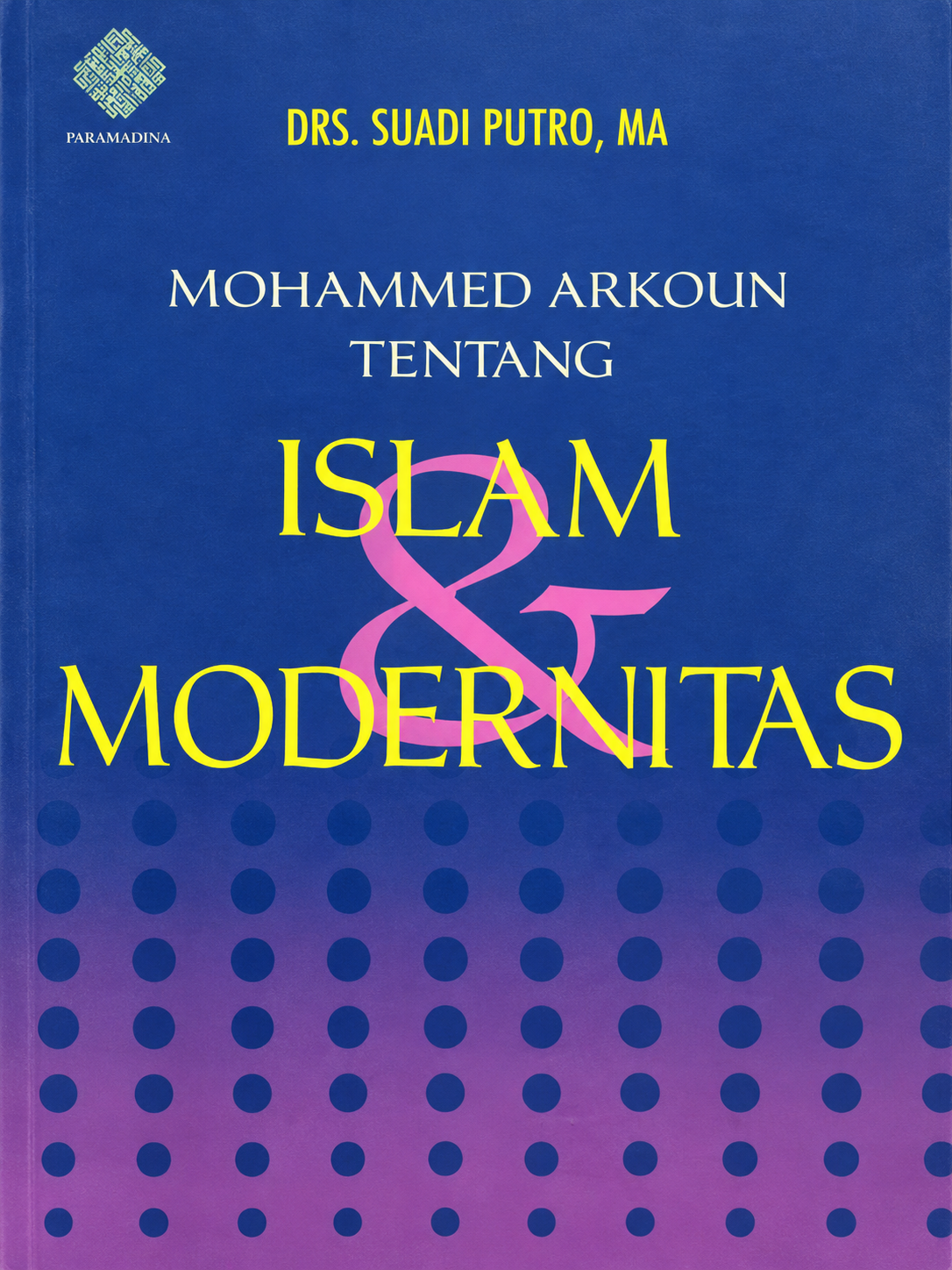
- Mohammed Arkoun tentang Islam dan Modernitas (Mohammed Arkoun on Islam and Modernity) by Suadi Putro is an Indonesian-language study of the thought of Mohammed Arkoun (1928–2010), the Algerian-born thinker of Berber background who for many years taught the history of Islamic thought at the Sorbonne University, Paris. The cover of this copy displays the Paramadina logo at the upper left, the author's name with his academic titles, the main title in large yellow letters with a pink "&" sign interrupting the words ISLAM and MODERNITAS, and a pattern of blue circles over a purple gradient background. A comparative catalogue records that this book was published in Jakarta by Paramadina in 1998, a year when the debate on the renewal of Islamic thought in Indonesia was very much alive, before and after the fall of the New Order. This note was compiled as a curatorial introduction based on the cover and secondary references; it does not replace a direct reading of all the chapters of the book. The appearance of this book among Paramadina's publications has a significance of its own. The Yayasan Wakaf Paramadina (Paramadina Endowment Foundation), founded by Nurcholish Madjid and colleagues in 1986, became one of the main nodes of inclusive Islamic and reformist discourse among the urban Muslim middle class. Through its publications, the ideas of contemporary Muslim thinkers from the Middle East, North Africa, and South Asia were introduced to Indonesian readers. Arkoun was among the important names in this current, together with Fazlur Rahman, Hassan Hanafi, Mohammed Abed al-Jabiri, and Nasr Hamid Abu Zayd. Suadi Putro's book can therefore be read not only as a study of a figure, but also as a document of how critical Islamic thought was received, translated, and debated in the Indonesian academic milieu at the end of the twentieth century. The core idea of Arkoun commonly discussed in studies of this kind is the project of the critique of Islamic reason. Arkoun regarded Islam as a historical phenomenon that developed in particular spaces and times, so that the scholarly tradition formed over the course of history must likewise be read historically. He judged that classical jurists, theologians, and exegetes often relied on logocentrism, namely the belief that grammatical and lexical analysis could capture the truth of revelation fully and definitively. According to Arkoun, this belief caused the historical dimensions of language, power, and social context to receive too little attention. Readers of this book can trace how Suadi Putro sets out this critique and to what extent he judges its relevance for Islamic studies in Indonesia. Arkoun is also known for using the tools of the Western humanities, such as Ferdinand de Saussure's structural linguistics, Michel Foucault's discourse analysis and archaeology of knowledge, and Jacques Derrida's deconstruction. He used these tools to reconsider the edifice of the classical Islamic tradition, including the ways religious authority determined what could be thought and what was excluded from the domain of thought. In the literature on Arkoun, this idea is often associated with the terms "the unthinkable" and "the unthought" in the history of Islamic thought. Studies such as this book help readers understand these technical terms in Indonesian, while also showing how concepts born in a French academic context were introduced to readers in the Nusantara. One part that often draws attention is Arkoun's proposal for reading the Qur'an. He proposed a stepwise approach that attends to the linguistic moment, the anthropological moment relating to symbolic and mythical language, and the historical moment that tests the limits of traditional exegesis. This proposal provoked wide debate: some saw it as an effort to revive the message of revelation in the modern world, while others criticized it for being regarded as overly dependent on a Western epistemological framework. In academic use, this book can serve as an entry point for weighing both positions fairly, by returning to the author's account and to Arkoun's primary sources. The theme of modernity in the book's title points to the great question that preoccupied Arkoun: how Muslims can confront modernity without merely rejecting or imitating it. Arkoun criticized two tendencies at once, namely romanticism about the past that closes itself off from historical critique, and shallow modernism that takes the products of Western civilization without weighing their epistemological foundations. He proposed a critical stance toward both, placing historical reason as a bridge. For Indonesian readers, this question resonates in debates about the reform of Islamic education, the relationship between religion and the state, and the place of tradition in a rapidly changing society. Within the study of Islam in Indonesia, this book can be placed alongside other works in the Pustaka KBA13 Academy collection that discuss the renewal of Islamic thought, hermeneutics, and the relationship between Islam and modernity. Students can use it to construct a concept map of Arkoun's thought, to compare him with other contemporary Muslim thinkers, or to trace how these ideas influenced discourse in Islamic religious higher education institutions. Lecturers can make it material for discussion on the methodology of Islamic studies, particularly the difference between normative approaches and historical-critical approaches to reading religious texts. A critical reading of this book also needs to attend to the author's position as interpreter. Every study of a figure makes a selection among the works discussed, emphasizes particular parts, and constructs a narrative about the development of that figure's thought. Because most of Arkoun's works were written in French and Arabic, readers are advised to check whether the author refers directly to the original texts or through translations and secondary sources. This question is important for further research, especially if quotations from this book are to be used to establish Arkoun's views in scholarly work. In terms of documentation, the cover image displayed in this entry is the result of AI processing to clarify its visual appearance, so small details such as paper texture, stains, library labels, or signs of use cannot be taken as evidence of the physical condition of the copy. The bibliographic data, namely the publisher Paramadina, the city of Jakarta, and the year 1998, come from comparative references and have not been checked against the copyright page of the copy. The number of pages, ISBN, and printing have also not been verified. This note is intended so that library users can distinguish information that is certain from information that still requires verification. Appropriate search subjects for this book include Mohammed Arkoun, contemporary Islamic thought, modernity, the critique of Islamic reason, Qur'anic hermeneutics, and Islamic reform in Indonesia. Separating these subjects allows the book to be connected with other materials in the collection through different paths, whether through the name of the figure or through the broad themes it discusses. In this way, library visitors can find this work when searching for material on Arkoun specifically, or when tracing the development of the discourse on Islam and modernity more broadly. As part of a personal collection opened for research, this book preserves the traces of a time when a generation of Indonesian Muslim academics was energetically introducing critical thinkers of the Islamic world to domestic readers. Reading it today offers an opportunity to reassess the legacy of that debate: which ideas have enriched Islamic studies in higher education, which ideas are still debated, and which questions remain open for the next generation. For citation purposes, references should state the author's name, the full title, the publisher, the year, and the pages read directly in the copy.
- Rights
- Koleksi pribadi KBA13 Academy
- Collection
- Books
How to cite
Suadi Putro, “Mohammed Arkoun tentang Islam dan Modernitas [Mohammed Arkoun on Islam and Modernity]”, Paramadina, Jakarta, Tahun, cetakan, jumlah halaman, dan ISBN eksemplar belum diperiksa. Rujukan pembanding: Jakarta: Paramadina, 1998 (belum diverifikasi pada halaman hak cipta eksemplar). KBA13 Academy Archive and Library, KBA-BKU-TT-0012.